Key Takeaways
- Employment gaps are now normal: LiveCareer UK found only 51% of job seekers have an unbroken work history.
- No mainstream ATS rejects a CV for a gap - the risk is a recruiter filling an unexplained hole with the worst assumption.
- Explain the gap as a dated entry in your work history, in one or two lines.
Almost half of UK job seekers now have at least one employment gap on their CV. If yours is one of them, the question is not whether to mention it - a recruiter reading your dates will see it in seconds - but how to explain a gap in your CV so it answers the question before anyone asks it. That starts with knowing what the software between you and the recruiter actually does with your dates, because most of what people fear about CV gaps is aimed at the wrong reader.
How common are employment gaps on a UK CV?
More common than most people with one assume. LiveCareer UK's 2025 employment gap report, drawn from 19 million CVs created by UK job seekers between 2020 and mid-2025, found that only 51% of candidates had no employment gap at all, down from 61% in 2020. Gaps of six months or more appeared on 32% of CVs, up from 24%. Gaps of a year or more rose from 18% to 24% over the same period.
The wider labour market says the same thing. ONS Labour Force Survey figures for spring 2026 put the number of economically inactive people aged 16 to 64 at around 9.1 million - roughly one in five of the working-age population, moving in and out of work through redundancy, caring, illness, study and travel. A CV with a gap is not an anomaly. It is the majority experience of the modern UK workforce.
The National Careers Service - the UK government's careers advice body - is direct about it: "Having a gap in your CV is not a problem, but you might be asked about it." That sentence carries the whole strategy. The gap is a fact. The explanation is the job.
What an ATS actually does with the gap in your CV
The fear behind most gap advice is that screening software silently bins CVs with holes in them. That is not how the machinery works.
An ATS parses your work history section into structured entries - job title, employer, start date, end date - and uses those dates to calculate your total years of experience, which feeds the ranking. We cover the mechanism in detail in how an ATS actually parses a CV, but the part that matters here: the parser is computing tenure, not auditing continuity. There is no standard "gap detector" that fails your application. Auto-rejection of any kind on CV content is rarer than the folklore suggests - a 2025 Enhancv study of US recruiters found only 8% had configured their ATS to auto-reject based on CV content or match scores, and the same platforms and configuration options are used by UK employers.
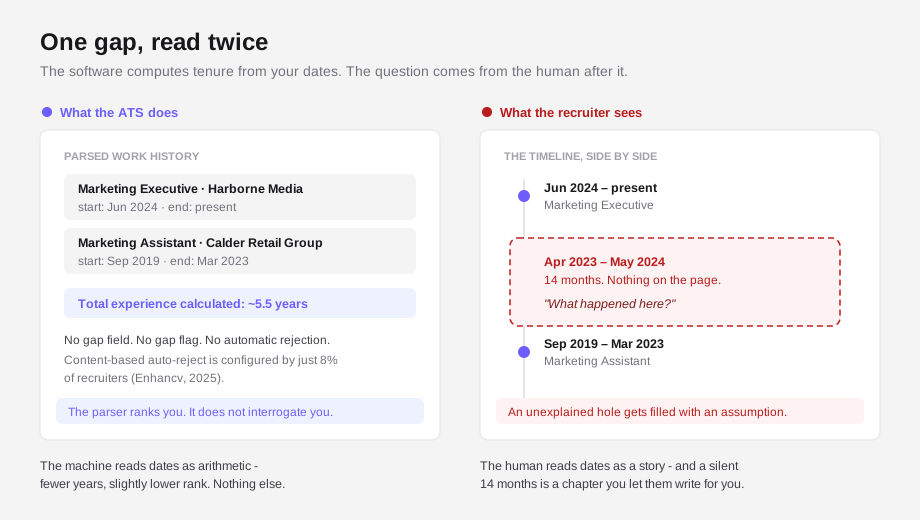
So where is the risk? In two places, and neither is a rejection.
- The ranking arithmetic. A gap means fewer accumulated years, which can nudge you down a ranked list against candidates with unbroken tenure - a marginal effect you offset with keyword relevance, not formatting tricks.
- The human reading the timeline. The recruiter skimming your parsed profile sees the dates side by side. An unexplained 14-month hole gets filled with an assumption, and recruiters do not default to generous ones. This is the actual damage, and it happens after the software, not inside it.
One more thing the machine will not do: hide you. Your CV surfaces in recruiter keyword searches whether it has gaps or not. A gap does not stop you being found - a CV whose skills vocabulary went stale during the gap does.
How to explain an employment gap on your CV
Treat the gap the way you treat a job: give it an entry in your work history, with dates. Not a paragraph of justification - a title line naming what the time was, the date range, and at most one or two lines on anything you did during it that an employer can use.
LinkedIn made this pattern official when it added Career Break as a profile entry type in March 2022, with thirteen named categories including caregiving, full-time parenting, health and wellbeing, and professional development. That vocabulary works just as well on a CV, because it names the break plainly without apology. LinkedIn's own research at launch found 51% of hirers say they are more likely to contact a candidate who provides context about their career break.
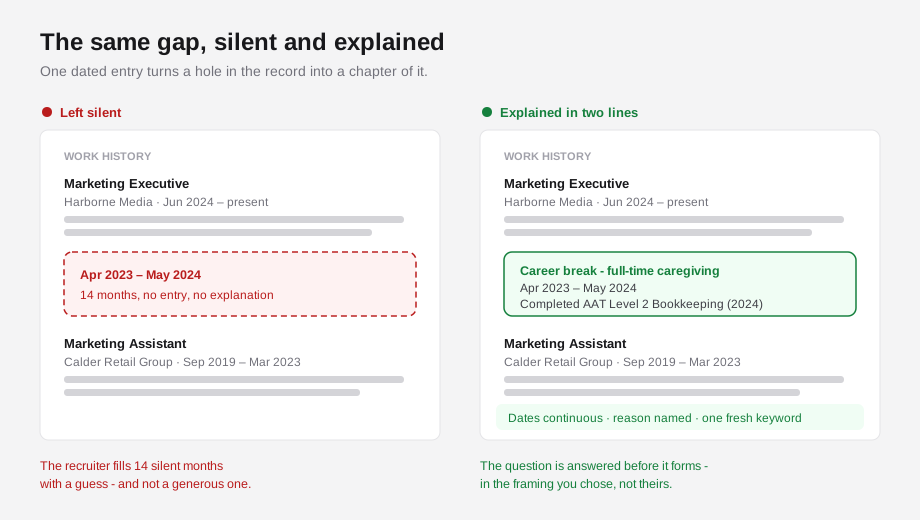
The entry keeps your date sequence continuous, answers the recruiter's question in the seconds they spend on it, and gives interviewers a framing you chose instead of one they guessed. Three rules keep it working:
- Name it honestly and briefly. "Career break - full-time caregiving (Apr 2023 – May 2024)" or "Career break - redundancy and retraining (2024)". The National Careers Service's guidance on explaining gaps in your work history is to be open and honest and ready to explain what you were doing - not to disclose every detail. "Health recovery" is a complete explanation; no CV needs a diagnosis.
- Add anything that kept you current. A course, freelance work, volunteering. The same NCS guidance makes the point that even a short online course "shows you're willing to learn" - and for the parser, a 2025 certification is fresh, searchable text in a section that would otherwise be silent. Where the freelance work was substantial enough to be the job, it stops being gap-filler and becomes an entry in its own right, written the way a self-employed period needs to be written.
- Stop at two lines. Over-explaining reads as anxiety. One entry, one or two supporting lines, done. Your most recent real role still carries the argument for hiring you.
One-line gap explanations by type
LinkedIn's career break vocabulary names the break plainly; these lines do the same job on a CV. Adapt the shape, not the wording:
- Redundancy: Career break - redundancy and job search; completed PRINCE2 Foundation (Jan – Jun 2025)
- Caring: Career break - full-time caregiving for a family member (Apr 2023 – May 2024)
- Parenting: Career break - full-time parenting (Sep 2021 – Aug 2023)
- Health: Career break - health recovery, now fully returned (2024)
- Retraining: Career break - retraining; AAT Level 3 Diploma in Accounting (2025)
- Travel: Career break - long-term travel, South-East Asia (Oct 2024 – Mar 2025)
Each line names the type, dates the break, and where something kept you current, says so. That is the whole job.
One sector takes this out of your hands entirely. Care providers registered with the CQC in England are legally required to hold a full employment history with a written explanation of every gap before they employ you, which is why a care assistant CV cannot leave a break silent, however short. Security work runs on the same logic: the BS 7858 vetting behind a security guard CV requires every gap in the last five years to be accounted for and confirmable. Children's social work adds a third case: under the Department for Education's agency rules, unpaid career breaks do not count towards the three years of post-qualifying experience an agency assignment needs, so the dated break line on a social worker CV is what lets the reviewer do the sum.

The gap "fixes" that make a CV worse
Three pieces of common advice try to make a gap invisible instead of explained. Each one trades a small, survivable question for a bigger one.
Years-only dates
Formatting every role as "2021 – 2023" instead of months can absorb a short gap, and for genuinely brief breaks it is a reasonable, honest simplification. As a concealment strategy for longer gaps it fails twice. Recruiters have seen the pattern for decades and treat it as a prompt to ask for exact dates. And if an agency is involved, your history gets checked as a matter of law: UK agencies operate under the Conduct of Employment Agencies and Employment Businesses Regulations 2003, which oblige them to confirm a work-seeker's experience to the hirer. A timeline that only holds together at year-level resolution does not survive that conversation comfortably.
The functional CV
The skills-based format - competencies at the top, employers and dates demoted or dropped - is regularly recommended to people with gaps, for the same reason it is recommended to career changers and older workers: it hides the timeline. That is exactly why it fails. Parsers expect a work history section to segment and score, and a CV without a readable one ranks badly before a human ever weighs in. Recruiters, meanwhile, have seen the format often enough to read it as concealment - which converts "there is a gap" into "there is a gap and they hid it".
Stretching the dates
Extending an end date a few months to close the hole is not presentation, it is fabrication of your employment history - the wrong side of the line between tailoring and lying, and exactly the kind of checkable claim reference checks exist to catch. Dates are the single most verifiable thing on a CV: the HMRC payroll record an employer can request covers five years, and you can read your own copy of it before you apply. A discovered date discrepancy costs you the offer in a way no honest gap ever would. The honest version of the same instinct is grouping: where the gap sits between short contracts or agency assignments, listing them under the organisation that engaged you closes the timeline without moving a single date.
If you're in the gap right now
A current gap - you are out of work and applying - follows the same rules with one addition: the top of your CV - the personal statement, not just the timeline - should show the return is already underway. A dated entry in the current position ("Career break - professional development; completing CIPD Level 3, expected Nov 2026") is the first thing both the parser and the recruiter meet.
This is also where keyword freshness earns its keep. After a long gap, the vocabulary of your last role may be a version behind what job adverts now ask for - and recruiter database searches run on the current terms. Check live adverts for your target role and update your skills section to match. An unexplained gap costs you an assumption; a stale skills section costs you the search result, and a CV that never surfaces joins the red flags that reject you silently.
FAQ
Do I need to explain every gap on my CV?
No. A few weeks between jobs is normal and needs nothing. The working rule from our red-flags checklist: any gap longer than about three months gets a one-line explanation. Shorter than that, a recruiter reading month-level dates will rarely register it.
Will an ATS reject my CV because of an employment gap?
No mainstream ATS auto-rejects a CV for a gap. The parser extracts your dates to calculate experience and rank you; content-based auto-rejection of any kind is rare - configured by only 8% of recruiters in a 2025 Enhancv study. The real risk is an unexplained gap read by the human after the software.
Should I use years instead of months to cover a gap?
For short breaks, years-only dating is a common and honest simplification. As a way of hiding a longer gap it tends to backfire: recruiters recognise the pattern and ask for exact dates, and agency checks under the Conduct Regulations 2003 confirm your history with your former employers anyway.
Do I have to say my gap was for health reasons?
You have to be honest, not exhaustive. "Career break - health recovery, now fully returned" answers the question completely; you are not obliged to give any medical detail on a CV. The National Careers Service advises saving sensitive specifics for the interview if they come up at all.
Is a career break entry really better than just leaving the gap?
Yes. A dated entry keeps your timeline continuous for the parser, answers the recruiter's question before it forms, and lets you choose the framing. A silent hole gets noticed anyway - LinkedIn's research found 51% of hirers are more likely to contact a candidate who gives context for a break than one who leaves it blank.
See how your CV reads with the gap in it
The honest test is not whether you think the gap is explained - it is what a screening system extracts from your dates and what is left for a recruiter to wonder about. Run a free scan of your CV and Shadow CV shows you how your work history parses, where your timeline raises questions, and which keywords for your target role are missing. If the scan finds real problems, the £5 rewrite restructures the history so every gap reads as a deliberate, dated entry and your skills match what recruiters actually search for. Once, no subscription.