Key Takeaways
- No ATS has a "job hopper" flag. It extracts each job's dates, computes the duration, and stops there.
- Short jobs on a CV become a problem when the pattern is left silent, not when it exists.
- Give every short role a dated entry with one clause of context, and group agency assignments under the agency.
Four jobs in three years reads badly on paper and often means nothing at all: two fixed-term contracts, a maternity cover, and a redundancy. The problem with short jobs on your CV is rarely the jobs. It is that a reverse-chronological list hands a recruiter a pattern with no explanation attached, and an unexplained pattern gets filled in by whoever is reading. Fixing that takes a dated entry, one clause, and a decision about what counts as a separate employer.
Why so many UK CVs have short jobs on them
Temporary work is a structural feature of the UK labour market, not an edge case. ONS labour market tables put temporary employees at 5.4% of all UK employees in April to June 2026 - about 1.6 million people out of 29.8 million (table EMP01, published 18 August 2026). The breakdown table for the same quarter, EMP07, shows what those jobs actually are:
- Fixed-period contracts: 706,000
- Casual work: 370,000
- Agency temping: 253,000
- Seasonal work: 74,000
Every one of those is a job with an end date written into it before the person started. ONS also recorded 106,000 redundancies in the three months to June 2026 (table RED02), a rate of 3.6 per thousand employees.
So a run of short roles is often a description of the contracts available in a sector rather than a description of the candidate. The CV does not say so on its own, and no recruiter is obliged to guess generously.
What an ATS actually does with short jobs
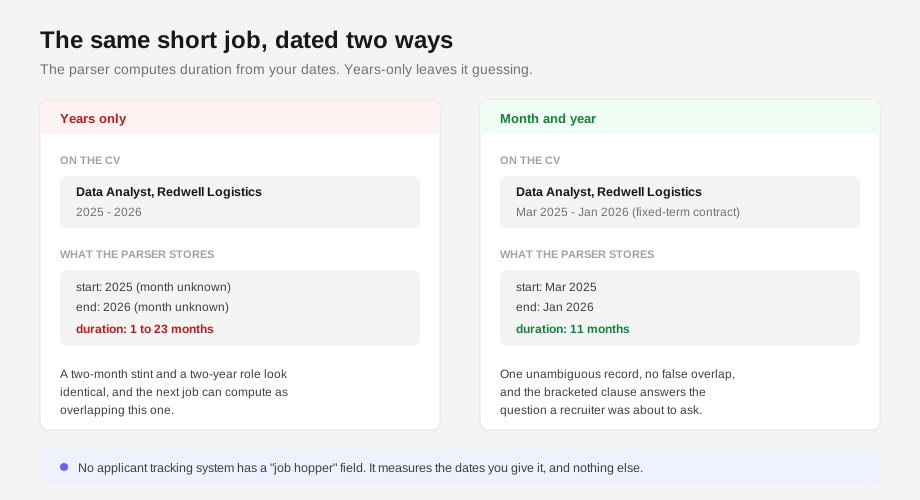
Less than the folklore claims. Screening software parses your work history section into structured records - job title, employer, start date, end date - and calculates the duration of each role from the dates. There is no tenure threshold, no stability score, and no field anywhere in that data model called "job hopper". The parser measures; a human judges.
Which means the real mechanical risks around short jobs are dull ones, and all of them are formatting:
- Year-only dates manufacture problems that are not there. "2024 - 2025" could be eleven months or two months. Two consecutive roles dated in years can compute as overlapping, which looks like an error or an inflation. Month and year on every entry removes the ambiguity: "Mar 2024 - Jan 2025".
- Merging short roles destroys the records. Collapsing four assignments into "2022 - 2024, various roles" hands the parser one record with no titles in it. The titles are the searchable part.
- A functional CV removes the structure entirely. Reordering your history by skill rather than date takes away the dated entries the software segments on, and recruiters read it as concealment. It is the standard advice for short-tenure CVs and it is the one move that reliably backfires.
- The current role still has to carry the right job title. Recruiters search candidate databases on job title above everything else. A three-month contract sitting at the top of your CV is what those searches return you for, so it needs the title the sector actually uses rather than an internal one.
The thing that turns short jobs into a red flag
Silence. A short job with a stated reason is a fact; a short job with nothing beside it is an invitation to speculate, and speculation runs pessimistic. That is the mechanism behind most of the CV red flags UK recruiters notice - the reader supplies the worst available explanation because the page supplied none.
The fix is smaller than most advice suggests. One clause, on the entry itself, where the reader's question actually arises:
Data Analyst - Redwell Logistics
Mar 2025 - Jan 2026 (11-month fixed-term contract)
Ward Administrator - Northgate NHS Foundation Trust
Apr 2024 - Feb 2025 (maternity cover)
Customer Operations Lead - Calder Retail Group
Sep 2022 - Mar 2024 (role ended in site closure)
Note what is not there. No paragraph of justification, no defensive "seeking long-term stability" line, no explanation on the roles that do not need one. A clause in brackets after the dates costs three words and answers the question before it forms. Applied to every entry it becomes noise; applied to the short ones it becomes a pattern the reader can follow.

How to list agency, contract and temp work under one employer
This is where most short-tenure CVs go wrong, and the fix is a matter of getting the employer right rather than hiding anything.
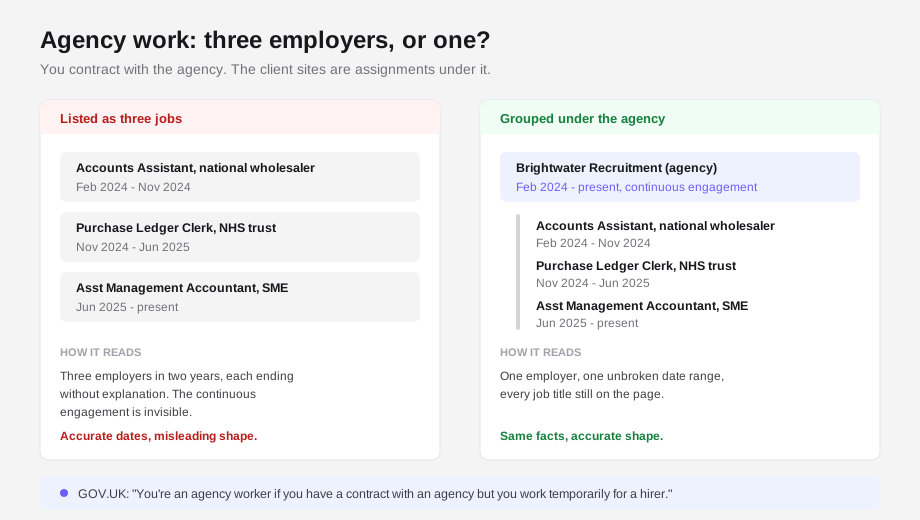
If you work through an agency, the agency is who you contract with. GOV.UK's guidance is explicit: "You're an agency worker if you have a contract with an agency but you work temporarily for a hirer." The hirers are placements. Listing eight placements as eight employers is not more honest than listing the agency, it is less accurate - and it turns a two-year continuous relationship into eight entries that each look like a job you left.
So group them, with the agency as the employer and the assignments underneath:
Brightwater Recruitment (agency) - Feb 2024 - present
Finance placements across three client sites, continuous engagement.
- Accounts Assistant, national wholesaler - Feb 2024 - Nov 2024
- Purchase Ledger Clerk, NHS trust - Nov 2024 - Jun 2025
- Assistant Management Accountant, manufacturing SME - Jun 2025 - present
The same structure works for freelance and day-rate contracting: your own company or trading name as the employer, the client engagements listed beneath it. The parser gets one employer record with a clean continuous date range plus the individual titles, and the recruiter gets a timeline with no holes in it. Working for yourself brings one extra problem the agency route does not, which is that nobody else holds a record of it - what to write and what to keep ready for a self-employed period deals with that separately.
What this is not is licence to invent. Grouping assignments under the organisation that actually engaged you is accurate. Presenting three separate permanent jobs as one continuous role, or stretching end dates to close a gap, is not - and it is the kind of thing employment checks find, as our guide to rewriting a CV without lying about your experience sets out.
Where the explanation belongs
Three places are available and they do different jobs.
- The entry itself. First choice, always. A bracketed clause after the dates handles fixed-term contracts, maternity cover, agency assignments, redundancy and site closures, and it sits exactly where the question occurs.
- The profile at the top. One clause here, but only when the pattern is the whole story - a contractor, an interim manager, someone whose sector runs on fixed terms. "Interim finance professional working on six to twelve month assignments" reframes an entire history in a line. Used for a single short job, it draws attention to something nobody had noticed.
- The cover letter. For the one role that needs a sentence rather than a clause, and only where a cover letter is actually read.
One ending gets no explanation in any of the three: a dismissal. It stays off the CV entirely, and what to do after being dismissed covers the reference and the application form, which is where it actually comes up. A redundancy is the opposite case: one clause on the entry is enough, though the leaving date after a redundancy depends on how your notice was handled.
Two things to avoid: a "reasons for leaving" column running down the CV, which reads like a disciplinary record, and a separate "Career Notes" section, which quarantines each explanation away from the entry it explains.
When the short job really was a mistake
Sometimes there is no structural reason. The role was wrong, or you were, and you left after five months.
Keep it, date it, and give it no clause at all. A dated entry with a job title and two lines of what you did is unremarkable; the same period missing from the timeline is a hole someone will ask about, and gaps attract more questions than short jobs do.
There is one hard limit on trimming, and it is that a dropped role is not invisible - the payroll record behind an employment history check still has it. Care providers in England must hold a full employment history with a written explanation of every gap before you start, and security screening to BS 7858 covers at least five years of verified employment. In those sectors nothing drops off - short roles included, compressed to a single line if space demands it, but present.
FAQ
How many short jobs count as job hopping on a CV?
There is no threshold, and no software applies one. What reads as a pattern is several roles under a year with nothing explaining them, in a sector where that is not normal. Three fixed-term contracts in construction or interim finance read as the job market; three unexplained eight-month exits from permanent roles read as a question.
Should I leave a short job off my CV?
Only if it is genuinely brief, unrelated, and inside a period your other roles already cover. Otherwise it creates a gap, and an unexplained gap prompts more scrutiny than a short job with a reason next to it. In care, security, financial services and anywhere else with formal employment screening, leave nothing off - the full history gets checked before you start.
Do I have to give a reason for leaving every job on my CV?
No, and doing so weakens the CV. Add a short bracketed clause to the entries where the end date needs context - fixed-term contract, maternity cover, redundancy, agency assignment - and leave the rest alone. A reason attached to every role reads as defensiveness.
How do I list agency work on a CV?
Put the agency in the employer position with the full date range of your engagement, then list each client assignment underneath as a sub-entry with its own title and dates. You contract with the agency, so this is the accurate structure as well as the tidier one, and it keeps every job title on the page where a recruiter's search can find it.
Does an ATS reject a CV with short jobs on it?
No. The parser extracts each role's title, employer and dates and calculates a duration from them. There is no field for stability and no automatic rejection on tenure. The judgement is made by a human reading your dates, which is why the explanation belongs on the page rather than saved for interview.
Short jobs cost you when the dates parse badly and the pattern goes unexplained - and both of those are visible before you apply. Run your CV through Shadow CV's free scan to see which roles the software actually extracted, what duration it computed for each one, and where an entry fell apart. If the work history needs rebuilding, the £5 rewrite restructures it so every role parses cleanly and reads as a career rather than a list, once, with no subscription.