Key Takeaways
- Redundancy on a CV is one short clause on the job entry, such as "(role made redundant)", and nothing anywhere else.
- Your end date is when employment ended: the end of notice if you worked it or took garden leave, earlier if paid in lieu.
- While you are still serving notice, the job is "present".
Being made redundant feels personal, and most CV advice treats it as something to manage carefully. A recruiter reads it the other way round. Acas defines redundancy as "a type of dismissal where a role is no longer needed": the employer decided it needed fewer of a job, not that it needed less of you. Recruiters see that on a CV week in, week out. ONS figures put UK redundancies at 113,000 in June to August 2026, a rate of 3.8 per 1,000 employees.
What actually goes wrong on a CV after redundancy is mechanical: an end date that does not match your employer's records, a profile that leads with the redundancy, and a gap left blank. Each one is easy to fix.
Does redundancy have to go on your CV?
No, and for most jobs it adds nothing. The rule for any reason for leaving is the same one set out in how to handle short jobs on a CV: a bracketed clause earns its place only where it answers a question the dates would otherwise raise.
Redundancy raises that question in two situations, and a clause helps in both:
- It is your most recent job and it has ended. The first thing a recruiter asks is why you are looking, and three words answer it before the phone call.
- The job was short. Eight months at one employer looks like a choice until the clause says it was not.
After ten years in a role, the dates already tell the story. A clause there is optional, and leaving it off is fine.
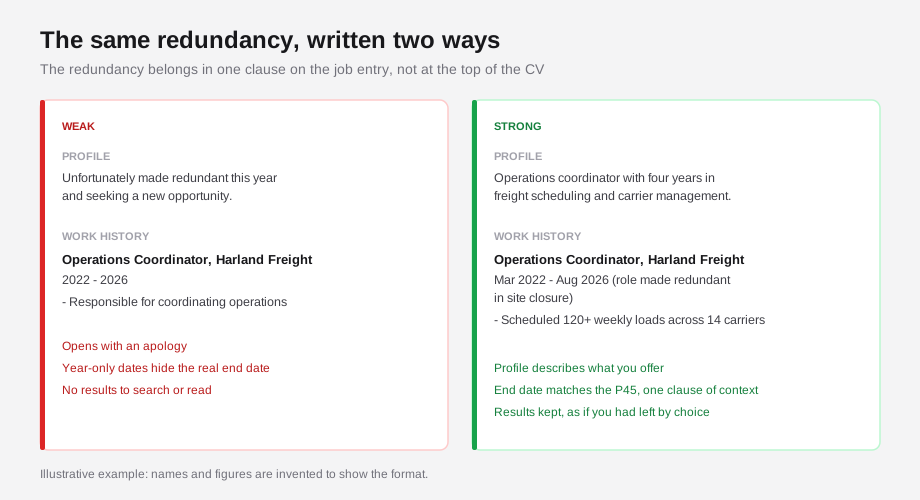
Where it never goes is the profile at the top. An opening line such as "Seeking a new challenge following redundancy" uses the most-read lines of the CV to describe the past rather than what you offer, and it reads as an apology.
Which leaving date goes on your CV after redundancy
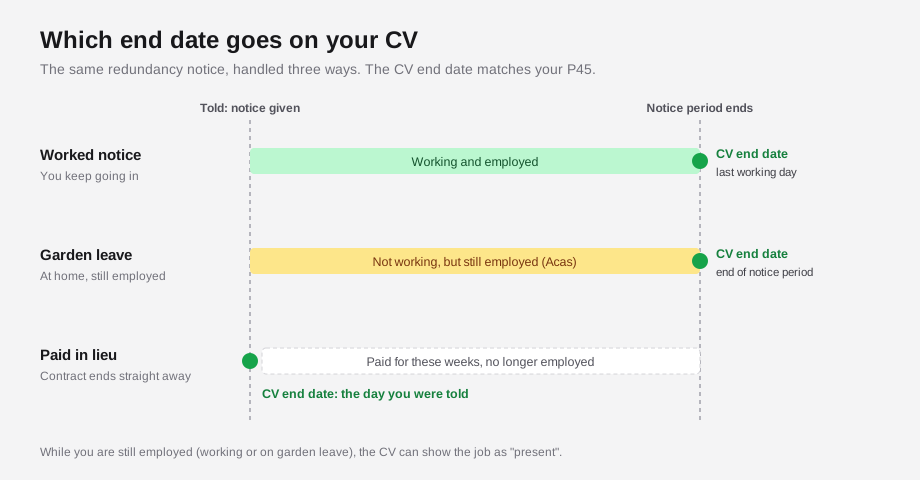
This is the part most advice skips, and the part an employer can actually check. Your end date should be the date your employment legally ended, because that is the date on your P45 and on the payroll record behind an employment history check. GOV.UK confirms that the P45 your employer gives you when you leave includes your leaving date.
That date depends on how your notice was handled:
- You worked your notice. The end date is your last working day at the end of the notice period. Acas says "you'll usually carry on working until the end of your notice period".
- You were put on garden leave. You are still employed until the notice period ends, even though you are at home. Acas is explicit: "The employee is still employed during garden leave, even though they're not working." The CV end date is the end of the notice, not your last day in the office.
- You were paid in lieu of notice. Acas says that with a payment in lieu of notice clause, "the contract will end straight away". Your end date is the day you were told, even though the money covers weeks afterwards.
Statutory notice is at least one week for one month to two years of service, one week per year from 2 to 12 years, and 12 weeks after 12 years (GOV.UK). If you are unsure which route applies, Acas advises asking your employer to confirm the notice dates in writing.
How to write redundancy on your CV
Put the clause on the job entry itself, after the dates, in neutral words that describe the role rather than you:
Operations Coordinator - Harland Freight Ltd
Mar 2022 - Aug 2026 (role made redundant in site closure)
Marketing Executive - Brightside Homes
Jan 2026 - Sep 2026 (position made redundant in restructure)
A few wording points matter more than they look:
- "Role made redundant", not "I was made redundant". It is accurate, and it keeps the subject of the sentence where Acas puts it: on the job.
- Name the cause if it is public. "Site closure", "restructure" or "administration" each tells the recruiter the decision was not about performance.
- Say "voluntary redundancy" if you volunteered. It is accurate, and it reads as a choice.
- Keep the bullets. The entry still needs your results, written exactly as they would be if you had left on your own terms.
If you accepted a different job with the same employer instead of leaving, it goes in as a new title with its own dates under the same employer, like a promotion. Acas gives you a four-week trial period in an alternative role; if you left during it, end the entry on the day you actually left.

Applying for jobs while serving redundancy notice
You do not have to wait until your notice ends. While you are still employed, your CV shows the job as "present", which is true until your employment ends.
Two rights help here that most redundancy advice leaves out:
- Paid time off to job hunt. Under section 52 of the Employment Rights Act 1996, an employee given notice of redundancy is entitled to "reasonable time off" during working hours to "look for new employment" or arrange training, if they will have two years' continuous employment by the end of their notice. Section 53 caps the statutory pay for that time at 40% of a week's pay across the whole notice period.
- Free CV help. In England, the Jobcentre Plus Rapid Response Service can help you "write CVs and find jobs", and you can contact it during your notice period or up to 13 weeks after redundancy, according to GOV.UK. Scotland and Wales run separate services.
If an offer comes before your notice ends, be careful about the start date. Acas says that to leave early and keep your redundancy pay, you have to give counter-notice during the "obligatory period" of your notice. Agree any early leaving date in writing before you accept a start date.
Covering the gap after redundancy
If the job search runs on, the CV ends with a month that has nothing after it. Treat that as you would any other break. A dated line such as "Career break - redundancy and retraining (Sep 2026 - present)" with one line about what you are doing - a course, a certificate, volunteering - closes the timeline honestly. Our guide to explaining a gap in your CV covers the wording.
What you should not do is stretch the old end date to cover the gap. A date that does not match your P45 is the kind of thing an employment check finds.
Redundancy on application forms and at interview
Forms are stricter than CVs. If a form asks your reason for leaving, write "Redundancy" with the cause. If it asks whether you have ever been dismissed, the accurate answer is yes: GOV.UK lists redundancy as one of the fair reasons for dismissal, and our guide to being dismissed from a job explains how to answer that question in one line.
At interview, keep the answer to three sentences: what happened to the role, the result you are proudest of from that job, and what you are looking for now. Do not criticise the employer and do not over-explain. The interviewer has met many people in the same position.
FAQ
Should I put redundancy on my CV?
Only as a short clause on the job entry, and only where it answers a question: your most recent job has ended, or the job was short. After a long tenure it is optional. Never put it in the profile at the top.
What end date do I put on my CV if I was paid in lieu of notice?
The day your employment ended, which with a payment in lieu of notice is usually the day you were told. Acas says the contract "will end straight away". That is the date on your P45, so it is the one an employment check will see.
Does garden leave count as still being employed?
Yes. Acas says "the employee is still employed during garden leave, even though they're not working", so your CV can show the job as "present" until the notice period ends.
Can a reference say I was made redundant?
Yes, and it usually helps. A reference must be fair and accurate, and a reason for leaving of redundancy tells the new employer the job ended for business reasons. Many employers give only a basic reference with your job title and dates.
Is voluntary redundancy worth mentioning on a CV?
If you are adding a clause anyway, yes: "voluntary redundancy" is accurate and shows you made the decision. If the job was long and has ended some time ago, you can leave the reason off entirely.
Once the reason is a single clause, the rest of the work is the entry itself: the right end date, the right job title and results a recruiter can search for. Run your CV through Shadow CV's free scan to see the work history an ATS actually extracts, dates included. If anything is landing wrong, the £5 rewrite rebuilds it - once, and not a subscription.