Key Takeaways
- Maternity leave is not a gap: you stay employed, so the job keeps one continuous date range.
- You do not have to mention it; add a short note only if it explains something.
- Never split one job into two entries around the leave.
- If you resigned after your leave, the job ends on your leaving date.
Most advice about maternity leave on a CV starts from the wrong question. It asks how to explain the gap. For most people on maternity leave in the UK, there is no gap to explain. You were employed before the baby arrived, you were employed while you were on leave, and in the eyes of the law and HMRC you stayed employed until the day you returned or the day your contract ended.
That one fact settles most of the CV questions. The job keeps a single, unbroken date range. Whether you mention the leave at all is your choice, and in most cases a CV is better without it. The exceptions are specific, and they are covered below, along with the formatting mistake that can make a year of leave look like a year out of work.
Is maternity leave a gap on your CV?
No. Statutory Maternity Leave in the UK is 52 weeks: 26 weeks of Ordinary Maternity Leave followed by 26 weeks of Additional Maternity Leave. Throughout that time your contract continues. GOV.UK's guidance on employee rights during leave says that "employee rights are not usually affected" when taking maternity, paternity, adoption or Shared Parental Leave, that employees "continue to build up holiday entitlement", and that they are "entitled to any pay rises and improvements in terms and conditions given during the leave".
The money tells the same story. Statutory Maternity Pay, according to GOV.UK, "is paid in the same way as your wages (for example monthly or weekly)", with tax and National Insurance deducted. It goes through your employer's payroll. So when an employer later checks your PAYE record, the job shows as one continuous period with the same employer. Our guide to getting your employment history from HMRC explains how to see that record yourself.
A CV that shows a break the payroll record does not is the inaccurate one. The leave belongs inside the job.
Do you need to mention maternity leave on your CV?
Usually not. A CV lists jobs, dates and evidence, and a period of leave inside a job is not a job, a date range or a piece of evidence. Leaving it out is not hiding anything, because the dates you give are exactly the dates you were employed.
There are four situations where a short note helps:
- The leave covers most of your recent time in a role. If you started a job in early 2025 and went on leave six months later, a recruiter may wonder why a role "to present" has so few results. A note answers that before it is asked.
- The leave was long, or back to back. Two periods of leave close together can account for most of a three-year spell. Saying so is simpler than leaving the reader to guess.
- The job description asks for recent hands-on experience. If the advert wants someone who has used a system in the last 12 months, the note explains why your most recent use was earlier.
- You are still on leave and applying. Your current job is "to present", and the note tells the employer you are available on a different timetable from someone working full time.
Pregnancy and maternity is one of the nine protected characteristics in the Equality Act 2010, and the Act's provisions on work, which cover how employers treat job applicants, apply to it. An employer cannot lawfully treat you less favourably because you took maternity leave. That protection is the reason the choice to mention it stays with you.
How to word maternity leave on your CV
When a note is worth adding, keep it short and put it on the job entry, where the question arises. A bracketed clause after the dates does the job, the same pattern our guide to short jobs on your CV uses for fixed-term contracts and redundancies.
Marketing Executive - Hartley & Rowe, Leeds
Jan 2022 – present (maternity leave Mar 2025 – Feb 2026)
A few rules keep it clean:
- Keep the main dates continuous. The job's start and end dates are your employment dates. The leave is a note inside them, never a replacement for them.
- Use the neutral term. "Maternity leave", "adoption leave" or "Shared Parental Leave" is enough. There is no need for explanation or apology.
- Leave it out of your personal statement. The opening lines of a CV are for what you offer the role, as our guide to writing a CV personal statement explains. A line about leave there takes up the most valuable space on the page.
- Do not write bullets about the leave. Your bullets should still describe the work you did in the role.
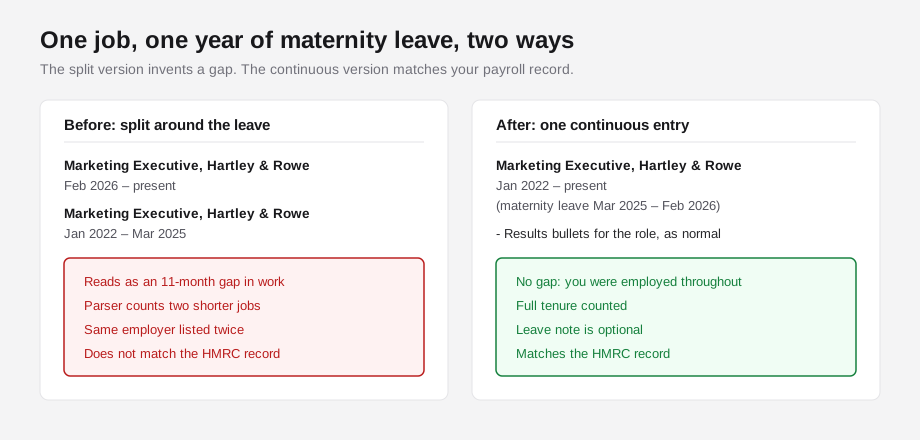
The dates mistake: splitting one job into two
The most damaging way to show maternity leave is to break the job in two: one entry ending when the leave started, another starting when you came back, with the leave in between, written up as a career break or not at all.
That layout creates three problems the leave itself never did:
- It invents a gap. The space between the two entries reads as time out of work, the exact thing that was not true.
- It halves your tenure. Applicant tracking systems read each entry as a separate job and calculate how long you held it. A four-year role becomes two short stints, and short stints are what recruiters screen for.
- It contradicts your payroll record. A pre-employment check sees one continuous employment with that employer. Your CV shows two.
Keep the employer once, with one date range. If you changed roles or hours when you returned, stack the job titles under that employer with their own dates, the same way our guide to the work experience section of your CV handles promotions.
Maternity leave on your CV: three situations
What the CV should show depends on how the leave ended.
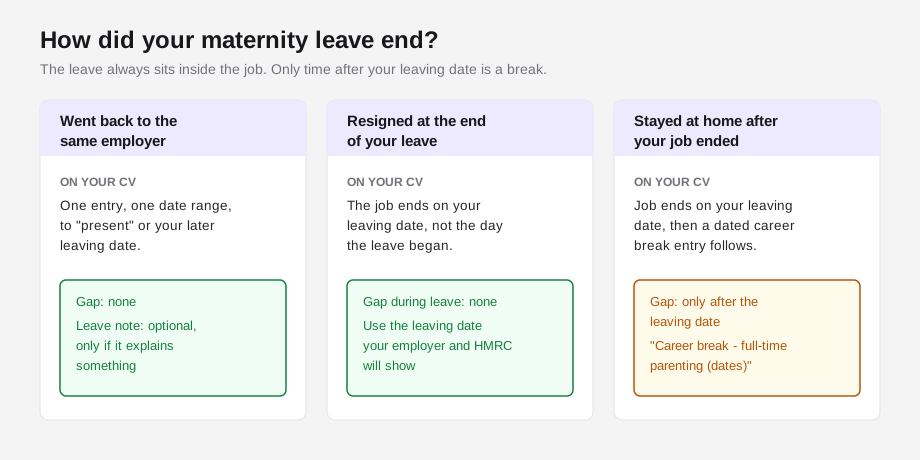
You went back to the same employer
The simplest case. The job runs from your start date to "present", or to the day you later left. Mention the leave only if one of the four situations above applies.
You resigned at the end of your leave
Many people decide during leave not to go back. If you handed in your notice and your employment ended when the leave did, your end date is that leaving date, not the day the leave began. The whole period of leave sits inside the job. Use the date your employer gave as your leaving date, which is also what HMRC and a reference will show.
You stayed at home after your employment ended
Any time after your leaving date is a genuine break, and it is the one place a career break line belongs. A dated entry such as "Career break - full-time parenting (Mar 2026 – present)" is clear, honest and common. Our guide to explaining employment gaps on your CV covers how to word it and what to add if you studied or volunteered during that time.
Applying for jobs while on maternity leave
Many people start job hunting during leave, and the CV is straightforward: your current job is still current. Write "to present" and keep your full job title. Three practical points come with it:
- Your notice period still applies. You are still bound by your contract, so a new employer will need to know when you can start.
- Starting a new job can end your Statutory Maternity Pay. HMRC's statutory payments manual is clear that if, after the baby is born, you start work for an employer who did not employ you in the qualifying week (the 15th week before your baby was due), your old employer must stop paying SMP from the week you start. Plan the start date with that in mind.
- Keeping in touch days do not change the CV. You can work up to 10 KIT days during maternity leave, or up to 20 SPLIT days each during Shared Parental Leave, without ending your leave. They are part of the same job, so they need no entry of their own.
Key point: Your CV dates should match your employment dates. Maternity leave sits inside them, so one employer gets one continuous date range, whether or not you choose to mention the leave.
FAQ
Should I put maternity leave on my CV?
You do not have to. You stay employed during maternity leave, so the job's dates already cover it. Add a short bracketed note only if the leave explains something a recruiter would otherwise wonder about, such as few recent results in a role or applying while you are still on leave.
Does maternity leave count as a gap in employment?
No. Your contract continues for the whole of Statutory Maternity Leave, your rights are protected, and Statutory Maternity Pay is paid through your employer's payroll. A gap only starts if you leave the job and do not start another.
Can I apply for a new job while on maternity leave?
Yes. List your current job as "to present", and remember that your notice period still applies. If you start working for a new employer after the baby is born, your Statutory Maternity Pay from your old employer will normally stop from that week.
Does the same apply to Shared Parental Leave and adoption leave?
Yes. GOV.UK groups maternity, paternity, adoption and Shared Parental Leave together as leave during which employee rights are not usually affected. The same CV rule applies: one continuous date range for the job, with an optional short note.
Can an employer ask about maternity leave at interview?
An employer cannot lawfully treat you less favourably because of pregnancy or maternity leave, which is a protected characteristic under the Equality Act 2010. You can choose how much to say. Keeping the answer to your dates and the work you did is entirely reasonable.
The leave rarely causes the problem. The way the dates are written does. Scan your CV free with Shadow CV to see how a parser reads your work history, including whether a split entry is showing up as a gap or a short job. The £5 rewrite fixes what the scan finds, once, with no subscription.