Key Takeaways
- A CV personal statement is three or four lines naming your role, your scope, one piece of evidence and the job you want.
- The National Careers Service calls this section your introduction, not a personal statement.
- Two other UK documents share the name - the public-sector supporting statement and the UCAS statement. Neither is written like this one.
Most CV personal statements say nothing. "A hard-working and motivated professional with excellent communication skills, seeking a challenging new role in a dynamic organisation" appears, in some form, on a very large share of the CVs a UK recruiter opens. It costs you the first four lines of the document and returns no information at all.
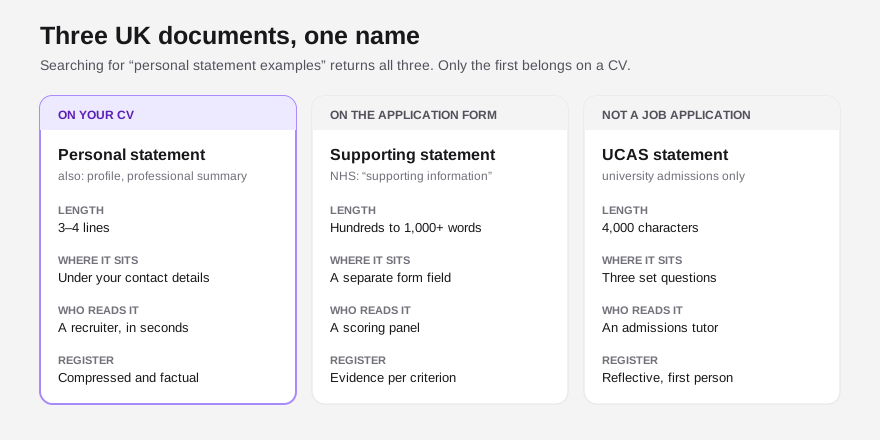
Part of the problem is the name. Three different things are called a personal statement in British job-hunting and education, they have almost nothing in common, and searching for examples returns all three mixed together.
What a CV personal statement is - and what the National Careers Service calls it
It is the short block of prose directly under your name and contact details, before your work history. Depending on which template you downloaded it is labelled personal statement, personal profile, professional summary or career summary. Those are the same section.
The government's own careers service uses none of those terms. The National Careers Service CV guidance lists five sections - contact details, introduction, education history, work history, references - and calls this one your introduction: "a few short lines that sum up who you are and what you hope to do." It should sit "just under your name and contact details", and the instruction on content is one sentence: "Make your introduction sound like you're the right person for the job."
That is a lower bar than the advice industry implies, and a more useful one. Three or four lines. Not a paragraph about your values.
Why the CV personal statement is worth more than its four lines
It is the first prose a human reads, and the first pass is fast. Eye-tracking research by Ladders, a US careers site, found in 2018 that recruiters spent an average of 7.4 seconds on their initial review of a CV - a small study, and not UK data, but an indication of the register you are writing for. Nobody is reading four lines of adjectives before deciding whether to read line five.
It is also the cheapest part of the CV to change. Your employment history, dates and qualifications are fixed. The opening block is not, which makes it the natural home for the language of the specific advert you are answering - the part of tailoring a CV per application that takes two minutes rather than twenty. Keyword guidance treats the summary as the most valuable real estate on the page, and where each term sits in the document affects how a recruiter's database search finds you.
One caution. No ATS vendor publishes a scoring rule that says the top of the page counts for more, so treat the opening block as the place to state your case plainly, not as a scoring trick. It is read first and rewritten easily. That is enough.
Three different things are called a "personal statement" in the UK
This is where most of the confusion comes from. Search for personal statement examples and you get results written for three separate purposes.
The CV personal statement. Three or four lines at the top of a CV. Written in compressed, factual prose. Read in seconds by a recruiter deciding whether to continue.
The public-sector supporting statement. NHS applications call this section supporting information; Civil Service adverts, built on the Success Profiles framework, ask for a personal statement or statement of suitability. It is a separate free-text field on the application form, runs to hundreds or sometimes over a thousand words, and is scored line by line against the essential criteria in the person specification. It is an evidence document, not an introduction, and it is the section that actually decides whether an NHS application is shortlisted.
The gap between those two matters more than it looks, because in parts of the public sector the CV version is never read at all. NHS Greater Glasgow and Clyde's applicant guidance is explicit: "NHS Scotland does not accept CV's in addition to/instead of a completed application form." A CV can be uploaded, but only to pre-populate the form - "This is the only reason we ask for a CV. It will not be visible to the interview selection panel during shortlisting or interview." Shortlisting there is anonymised and scored against the essential criteria in the job description. Four beautifully written lines at the top of your CV reach nobody.
The UCAS personal statement. University admissions, not employment. UCAS replaced the single free-form essay for 2026 entry with three set questions - why you want to study the subject, how your qualifications have prepared you, and what you have done outside education - with a 4,000-character total and a 350-character minimum per question. It is reflective, first-person and long. Written into a CV it reads as a student essay, which is exactly what happens when job seekers copy the examples that dominate search results for the bare phrase.
What a good CV personal statement looks like
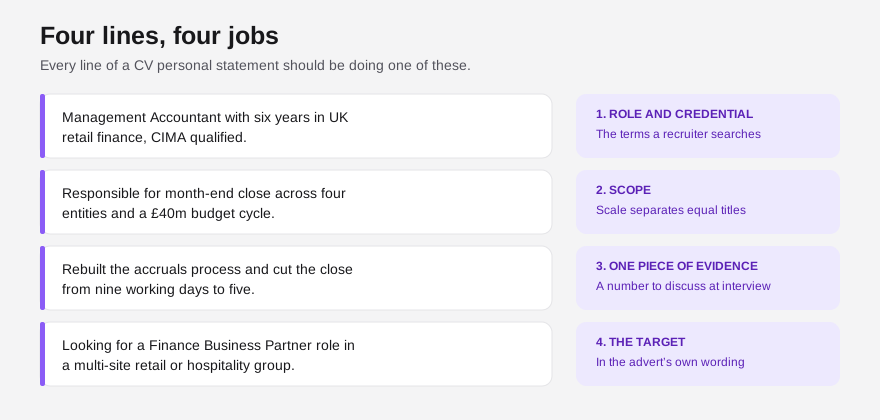
Four lines, four jobs. Name the role, state the scope, prove one thing, say what you are applying for.
Here is the generic version, of the kind that appears on thousands of CVs:
A hard-working and motivated professional with excellent communication skills and a proven track record of success. Seeking a challenging new role in a dynamic organisation where I can utilise my skills and grow within the company.
A recruiter learns nothing from it. Every claim is unfalsifiable, and nothing in it would change if the candidate were an accountant, a nurse or a warehouse supervisor. Now the same candidate, written as an introduction:
Management Accountant with six years in UK retail finance, CIMA qualified. Responsible for month-end close across four trading entities and the annual budget cycle for a £40m cost base. Rebuilt the accruals process and cut the close from nine working days to five. Looking for a Finance Business Partner role in a multi-site retail or hospitality group.
Fifty-seven words, and every line does work:
- The role and the credential - "Management Accountant", "CIMA qualified". These are the terms a recruiter types into the applicant database.
- The scope - four entities, a £40m cost base. Scale is what separates two people with the same job title.
- One piece of evidence - nine days to five. A single number that can be discussed at interview.
- The target - the role being applied for, in the advert's own words.
Third person without pronouns - "Management Accountant with six years..." - is the conventional register and saves words. First person works too. Switching between them mid-paragraph is the common mistake.
CV personal statement examples by career stage
The four-line formula flexes with the evidence you have. Three more worked examples - take the structure from them, never the wording.
School leaver, first job:
Sixth-form leaver with A levels in Business and Maths, applying for a customer service apprenticeship. Two years of Saturday shifts on a busy pharmacy counter, regularly running the till queue solo and handling refunds. Treasurer of the school's Young Enterprise company, managing a £400 float across two trading terms.
No work history to summarise, so verifiable specifics carry it: real shifts, a named responsibility, a number.
Career changer:
Retail store manager moving into HR, CIPD Level 3 in progress (completing Mar 2027). Eight years managing teams of up to 25, including rota planning, absence management and two redundancy consultations run to ACAS guidance. Looking for an HR Administrator role where frontline people management counts.
The changer's statement has two jobs the others do not: translate the old field's experience into the new field's vocabulary, and name the bridge qualification.
Returning after a career break:
Payroll administrator returning after a two-year caregiving break, dated in the work history below. Completed a payroll refresher course (Jun 2026) and current on RTI submissions. Five years running end-to-end monthly payroll for 300+ staff on Sage 50. Seeking a payroll or finance admin role, immediate start.
The break is named once, pointed at its dated entry, and the rest is evidence - the same plain honesty that works when explaining the gap itself.
The mistakes that make a personal statement worthless
- Copying an example. The published example statements are indexed, widely read and heavily reused. A recruiter has seen the phrasing before, and a CV that could have been sent for any job reads as a red flag rather than a strong opener. Use examples for structure, never for wording.
- Adjectives instead of evidence. Hard-working, motivated, passionate, detail-oriented, results-driven. None can be checked and all are claimed by everyone. Replace each one with the thing that made you say it.
- Writing what you want instead of what you offer. "Seeking an opportunity to develop my skills" describes your ambitions. Only the last line should be about what you are looking for.
- Writing it once and never touching it. The opening block is the part of the CV that should change per advert. A statement aimed at nothing in particular is aimed at nothing.
- Padding it to a paragraph. Six or seven lines pushes your first job further down the page. If it does not fit in four lines it belongs in your experience section.
FAQ
How long should a CV personal statement be?
Three or four lines - roughly 50 to 120 words. The National Careers Service describes it as "a few short lines". Longer and it competes for space with your work history, which is where the evidence lives. If you are struggling to cut it, the surplus is usually adjectives rather than facts.
Should a CV personal statement be written in the first or third person?
Either is acceptable, as long as you stay consistent. Third person without pronouns ("Management Accountant with six years in UK retail finance") is more compressed and is the more common UK convention. First person reads warmer but uses more of your four lines. Switching between the two within one statement is the error to avoid.
Do I need a personal statement on my CV at all?
For most UK applications, yes - the National Careers Service lists an introduction as a standard CV section, and it is the only place to state what role you are targeting. Where a CV is not the scored document it matters far less: NHS Scotland, for instance, does not show the uploaded CV to the panel at all.
Is a CV personal statement the same as a supporting statement?
No. A supporting statement - called supporting information on NHS applications, or a personal statement in Civil Service adverts - is a separate free-text field on the application form, often several hundred to over a thousand words, and it is scored against each essential criterion in the person specification. The CV version is three or four lines of summary. Writing one when the employer asked for the other is a common and costly mistake.
Can I use the same personal statement for every job application?
You can, but it is the part of the CV that most rewards changing. Keep one master version, then adjust the role title and the target line to match each advert. It takes a minute or two, and it is the difference between a CV that reads as written for this vacancy and one that reads as circulated.
Write four lines that say something
The opening block is short enough to fix this afternoon. The harder question is whether the rest of the document backs it up - whether the terms in your introduction appear where a search would find them, and whether the CV parses cleanly enough to be read at all.
Scan your CV free - Shadow CV reads it the way an employer's system does and shows you what your opening block is claiming, what the rest of the document evidences, and where the gap sits. The £5 rewrite closes it, in your own experience and your own words - once, with no monthly subscription.