Key Takeaways
- Strong CV bullet points that pass ATS follow one formula: action verb + specific task + measurable outcome.
- Starting with "Responsible for" wastes the most-read word in the line and scores worse than an active verb like "Managed" or "Delivered".
- Aim for a number or concrete result in at least half your bullets.
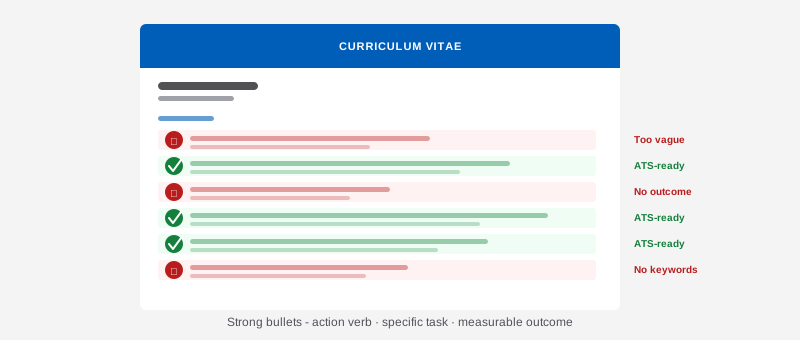
Most CV bullet points do one of two things wrong. Either they describe responsibilities in vague terms that do not trigger ATS keyword matching - "responsible for managing projects," "assisted with marketing activity" - or they stuff keywords in so mechanically that a human recruiter immediately discounts them.
The formula that works does both things simultaneously: passes the ATS keyword filter and gives a human recruiter concrete evidence they can act on. It is not complicated, but it requires deliberate application rather than instinct.
This article covers exactly how to write bullet points that achieve both - with a practical formula, role-specific examples, and the specific mistakes that quietly sink applications at the first automated filter.
What ATS Does to Your Bullet Points
Before writing a single bullet, it helps to understand what actually happens to your text when it enters an ATS.
ATS parsers strip bullet characters and read the content as plain strings. The symbol you use - round bullet (•), dash (-), arrow (→) - is irrelevant to scoring. Arrow characters and decorative symbols are sometimes stripped entirely, leaving the line as a run-on sentence. Standard round bullets pass through cleanly.
What the ATS reads is the text. And it reads it literally. "Responsible for managing projects" does not match "project management" as reliably as "Managed end-to-end project delivery across five workstreams" does. The gap between those two phrasings is the gap between passing and failing the keyword filter on that criterion.
Keyword placement within a bullet also matters. Terms near the start of a bullet score slightly higher in many systems than terms buried at the end. Starting with a strong action verb - "Managed," "Delivered," "Reduced" - positions your most credible keyword in the highest-weighted position.
A bullet point is an opportunity to place one or two keywords naturally in a context that supports them. Used well, your work experience section becomes the highest-scoring zone on your CV - more valuable even than the skills section, because it shows keywords in action rather than just listing them.
The Formula
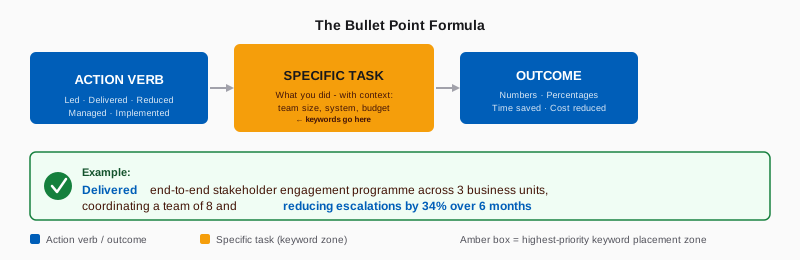
The formula: ACTION VERB + SPECIFIC TASK + MEASURABLE OUTCOME
Every strong CV bullet point contains these three parts. Here is what each one does.
Action verb
Start every bullet with a strong past-tense verb for previous roles, or present-tense for a current position. The verb signals immediately - to the ATS and the recruiter - what type of contribution this bullet describes.
Do not start with "Responsible for," "Helped with," "Assisted in," or "Worked on." These phrases waste the most-read word in the bullet. They describe proximity to a task, not ownership of it. An ATS looking for "stakeholder management" will score a bullet starting with "Managed stakeholder relationships" more confidently than one starting with "Responsible for managing stakeholders."
Vary your verbs across bullets. If every line starts with "Managed," it becomes noise - both to the ATS parser and to the recruiter reading the third bullet.
Strong action verbs by category:
- Leadership: Led, Directed, Oversaw, Spearheaded, Managed, Delegated
- Delivery: Delivered, Implemented, Executed, Launched, Deployed, Built
- Improvement: Reduced, Increased, Improved, Streamlined, Optimised, Cut
- Analysis: Analysed, Evaluated, Assessed, Reviewed, Modelled, Identified
- Communication: Presented, Negotiated, Advised, Collaborated, Liaised, Trained
Specific task
This is what you actually did - and it is where the keywords belong. The task description should include enough context to make the claim credible: team size, budget, system used, department, geography, client type.
Specificity does two things at once. It gives the ATS terms to match - "cross-functional stakeholder engagement," "PRINCE2 methodology," "Salesforce CRM" - and it gives a human recruiter the detail they need to picture your experience accurately.
Generic task descriptions like "managed a team" or "improved processes" are low-scoring because they match weakly against specific criteria and give recruiters nothing to differentiate you from the next candidate.
Measurable outcome
The "so what" - what changed as a result of what you did. Numbers, percentages, time saved, cost reduced, revenue generated, incidents resolved, satisfaction score improved. Any concrete evidence of impact.
If you do not have an exact number, use a range ("typically 10–15 concurrent projects"), a relative comparison ("reduced average resolution time by approximately a third"), or a qualitative outcome with context ("resulting in zero compliance breaches over a 24-month period"). Do not invent numbers - but do not leave outcomes out because you cannot be precise.
Aim for at least half your bullets to have a measurable outcome. The other half can be strong without a number - but five bullets with outcomes will outperform eight bullets without them every time.

Before and After Examples
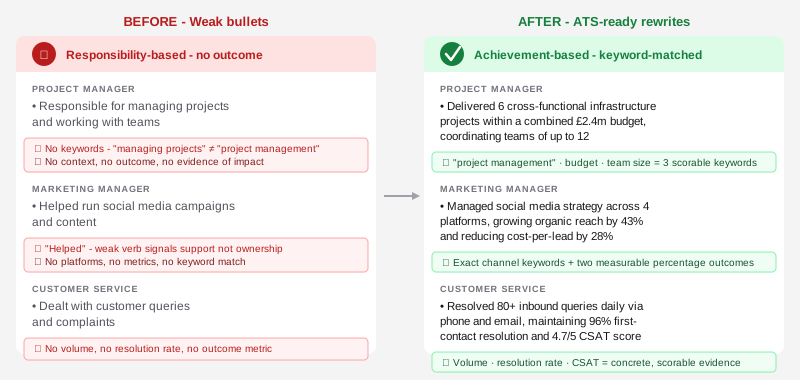
Project Manager
Before: "Responsible for managing projects and working with teams"
After: "Delivered 6 cross-functional infrastructure projects on time and within a combined £2.4m budget, coordinating teams of up to 12 across three departments"
What changed: "Responsible for managing" became "Delivered" - an active verb that signals completion, not oversight. "Projects and teams" became specific - infrastructure, £2.4m, 12 people, three departments. The ATS now has "project management," "cross-functional," and "budget management" to score against. A recruiter has numbers to put in the shortlisting matrix.
Marketing Manager
Before: "Helped run social media campaigns and content"
After: "Managed social media strategy across 4 platforms, growing organic reach by 43% and reducing cost-per-lead by 28% over 12 months"
What changed: "Helped run" became "Managed" - ownership, not support. "Social media campaigns" became "social media strategy across 4 platforms" - matching the language of job descriptions that specify channel management. Two measurable outcomes replace the vague "content" reference. The ATS has platform-count, percentage improvements, and a time frame.
Customer Service
Before: "Dealt with customer queries and complaints"
After: "Resolved 80+ inbound customer queries daily via phone and email, maintaining a 96% first-contact resolution rate and contributing to a 4.7/5 CSAT score"
What changed: "Dealt with" became "Resolved" - a completion verb. Volume (80+ daily), channel (phone and email), resolution rate (96%), and satisfaction score (4.7/5) turn a one-line job description into a set of evidence points. "First-contact resolution" is a standard industry keyword that ATS systems configured for customer service roles are likely to weight. None of this was invented - it is the same experience, described precisely.
Common Mistakes That Fail Both ATS and Recruiters
Starting with "Responsible for." This is the most common and most damaging mistake on UK CVs. It signals task ownership without any evidence of performing the task well. Replace it with the strongest active verb that accurately describes what you did.
One-line bullets with no context or outcome. A bullet that reads "Managed stakeholder relationships" passes the keyword filter but tells a recruiter nothing. Add context (who, what scale, what environment) and an outcome (what improved, what was delivered). This is also where communication, leadership and the other soft skills earn their keep - asserting them in a skills list proves nothing, while a bullet with a situation and a result attached does.
Identical bullets across every role. ATS systems look for role-specific terminology that reflects progression. Copying the same three bullets into every job entry signals that you are not tailoring - and scores consistently below a tailored CV that uses language specific to each role and seniority level.
Internal jargon and project code names. "Led Project Phoenix" or "drove ODIN migration" means nothing to an ATS or a recruiter outside your organisation. Translate internal names into standard industry terms - "led a CRM platform migration" or "managed a cloud infrastructure upgrade."
Listing duties that are obvious from the job title. If you are a software engineer, "wrote code" is not a bullet point. If you are an accountant, "prepared financial reports" is not a bullet point unless it comes with specifics - volume, value, scope, standard applied. Evidence of impact is what differentiates candidates at the same level.
Too many bullets. Six to eight bullets per role is the practical maximum for most positions. Ten weak bullets score lower than five strong ones, and a recruiter who reaches the eighth bullet in a wall of text is already skimming. Prioritise quality over coverage.
Tailoring Bullets to the Job Description
The formula produces strong bullets in general. Tailoring makes them score for a specific role.
Before editing your bullets, read the job description and identify the three or four keywords that appear most frequently - particularly in the essential requirements section. These are the terms the ATS is most likely weighted to find. If you are not sure how to separate the essential criteria from the desirable extras, our guide to reading a job description the way a recruiter does walks through marking one up in about ten minutes.
Then review your existing bullets with those keywords in mind. Where the experience genuinely supports it, adjust the specific task description to use the advert's language. "Cross-functional project delivery" becomes "cross-functional programme management" if that is what the advert says. The experience is identical - the language is matched.
For a systematic approach to identifying and prioritising keywords before you start editing, read How to find and use ATS keywords in your CV.
Do not fabricate results or inflate numbers to fit a keyword. Beyond being a legal risk, manufactured specifics produce unconvincing bullets that an experienced recruiter will recognise immediately - and a second-round question about your "43% cost reduction" will expose the gap quickly. Duties written up as achievements is one of the biggest CV red flags UK recruiters notice, and inventing the numbers to avoid it is worse than leaving them out.
Bullets also age. Quantified results you can still evidence this year become vague the longer they sit unrevised, which is part of why updating your CV on a schedule rather than only when job-hunting produces stronger bullets than a rushed rewrite.
Shadow CV scans your CV free and shows you exactly which bullet points are losing points. The £5 rewrite fixes them - strong action verbs, natural keyword integration, and consistent formatting - once, no subscription.