Key Takeaways
- ATS keywords for your CV come from three sources: the job description, the person specification (public sector roles), and similar adverts for the same role.
- Match the employer's exact phrasing rather than a synonym - the ATS does not reliably infer meaning.
- Place critical keywords in your summary, job title, and bullet points, not just a skills list.
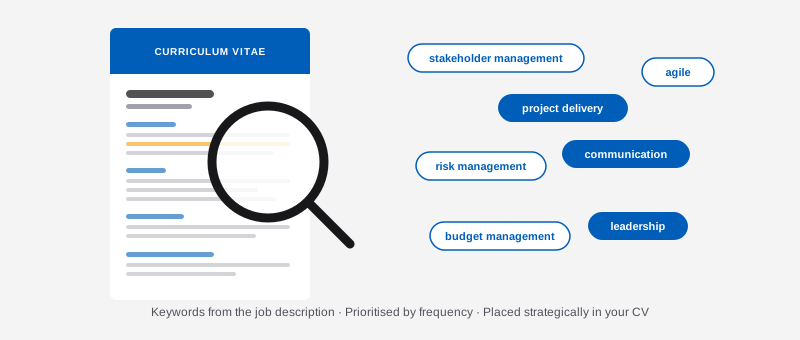
ATS software does not read your CV the way a human does. It scans for specific words and phrases, scores your application on whether they appear, and filters out anything that falls below the threshold. Most job seekers know this in theory - but very few know how to systematically find the right keywords for any given role and use them effectively.
The result is CVs that are well-written but consistently underperform. Not because the experience is wrong, but because the language does not match what the ATS is configured to look for.
This guide covers exactly how to identify the right keywords for any UK job advert, how to decide which ones matter most, and where to place them so they score points with the ATS and still read naturally to a human recruiter.
What ATS Keyword Matching Actually Means
Understanding how keyword matching works changes how you approach CV writing entirely.
ATS systems match keywords literally. If the job description says "stakeholder management" and your CV says "managing stakeholders," many systems will not register a match. The language has to align - not just the concept.
That said, modern ATS platforms handle some close variants. "Managed" will usually match "management." "Project delivery" may partially match "delivering projects." But synonyms are a different matter entirely - "led" does not match "leadership," and "communicated with" does not match "stakeholder management." Do not rely on the ATS inferring your meaning.
Keyword matching is not the only scoring factor, but it is the largest single contributor to an ATS score. Other factors - formatting, section structure, completeness - matter too, but a CV with the right keywords in the right structure will consistently outrank one that is better written but keyword-light.
Not all keywords carry equal weight. Think in three tiers:
- Critical keywords - near-certain rejection if absent. These are the essential requirements listed in the job advert. They appear multiple times and are usually the job title itself, the core qualification, or the primary methodology.
- Important keywords - your score drops significantly without them. These are the responsibilities and skills listed in the main body of the advert.
- Nice-to-have keywords - present in "desirable" or "preferred" sections. Including them boosts your score but missing them is not fatal.
The practical implication: fix critical gaps first, important gaps second, and only spend time on nice-to-haves once the essentials are covered.
Where to Find the Right Keywords
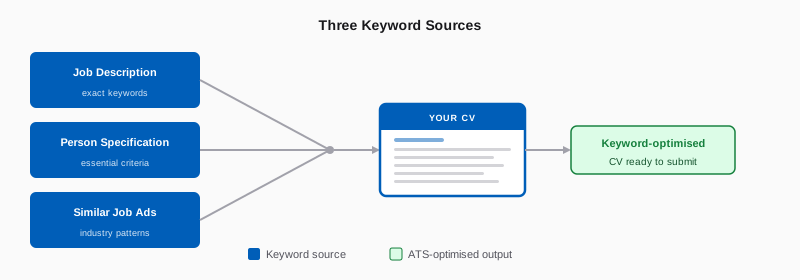
Source 1: The job description itself
The job description is not a description - it is a keyword list. Every skill, tool, qualification, and responsibility named in it is a potential keyword the ATS is likely configured to look for. It is also the marking scheme a recruiter scores you against, which is why reading a job description like a recruiter is worth doing properly before you touch your CV.
Frequency signals priority. If "project management" appears three times in the advert, it is a critical keyword - match it exactly. If it appears once in a "desirable" section, it is nice-to-have.
Read the advert in three passes:
- Job title and opening paragraph - keywords here are near-always critical. The role's core function is usually stated in the first two sentences.
- Essential requirements / person specification section - these are must-haves. Every item is a keyword gate. Mark each one as present or missing in your current CV.
- Responsibilities section - these are important keywords. Each responsibility named is a prompt to add a matching bullet point to your experience section.
Keywords in the "preferred" or "desirable" section are bonuses. Include them if you have the experience - but do not manufacture them.
Source 2: The person specification (public sector roles)
NHS, Civil Service, and local government roles publish a person specification alongside the job advert. This document is the scoring matrix - it is literally the list the recruiter uses to shortlist applications. Every essential criterion in that document is a keyword gate.
Use the exact phrases from the person specification, not paraphrases. If the spec says "experience of working in a multi-agency environment," use that phrase. "Cross-team collaboration" or "partnership working" are not the same thing in the eyes of the ATS.
For NHS roles in particular, the person specification is the single most important source of keywords - it outweighs the job description itself. For detailed guidance on NHS-specific keyword strategy, read How to Write an ATS CV for NHS Jobs.
Source 3: Similar job adverts
Search for three to five similar roles on Reed, Totaljobs, or LinkedIn Jobs - same job title, same seniority level, different employers. Keywords that appear consistently across multiple adverts are industry-standard terms. They are high priority because any ATS configured for that role type is likely to weight them heavily.
This source is particularly useful when the specific advert you are applying for is vague. If the original advert says "good communication skills" without elaboration, scanning similar adverts will reveal the more specific language that tends to accompany that role - "stakeholder management," "written briefings," "senior leadership presentation," and so on.
How to Prioritise Keywords
Before editing your CV, build a simple priority list from the three sources above.
Go through the job description and person specification and highlight every keyword. Then mark each one against your current CV: present, missing, or partially present (concept there, wrong phrasing).
Work through gaps in this order:
- Critical keywords missing entirely - these must appear at least once in the professional summary and at least once more in a bullet point. A keyword that appears only in the skills section is not as convincing to either the ATS or the recruiter as one that appears in context.
- Critical keywords present but phrased incorrectly - update the phrasing to match the advert exactly. If you have "led stakeholder engagement" and the advert says "stakeholder management," change it.
- Important keywords missing - add them to relevant bullet points in your experience section.
- Nice-to-have keywords missing - add to the skills section if genuine; ignore if not.
One practical technique: copy the job advert into a plain text document, then search for each keyword in your CV draft. Anything with zero hits is a gap. Fix the high-tier gaps before moving on.
Where to Place Keywords in Your CV
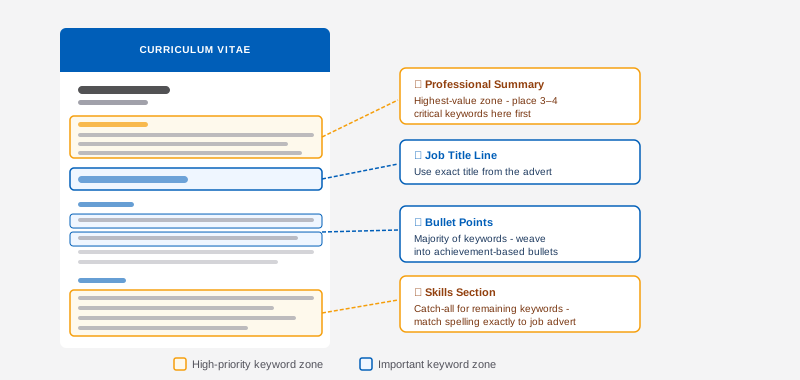
Professional summary (highest-scoring zone)
Your professional summary is the most valuable keyword real estate on the CV. ATS systems weight content near the top of the document more heavily - and keywords in the summary signal role-match before the parser has processed the rest of the document.
Write two to three sentences that include three to four critical keywords naturally. Do not stuff them in - if the summary reads like a keyword list it will damage your credibility with the human recruiter who reads it after the ATS has passed it. The goal is a tight, accurate description of your experience that happens to use the right language. If you are starting this section from scratch, our guide to what a CV personal statement should actually say breaks the four lines down job by job.
Job titles
Where possible, use the exact job title from the advert - not an internal version, an abbreviation, or an informal one. "Project Manager" not "PM." "Business Analyst" not "BA." ATS systems weight job titles heavily, and an exact match on job title is one of the strongest signals the system uses to assess role-fit.
If your current or previous title was different from the standard industry term, it is acceptable to add the equivalent title in brackets - "Delivery Lead (Project Manager)" - provided it is accurate.
Bullet points in the experience section
This is where the majority of keywords should appear. Each bullet point covering a relevant responsibility is an opportunity to place an important keyword in a context that supports it.
Integrate keywords naturally: "Managed a stakeholder engagement programme across three business units" scores better than a skills section that lists "stakeholder management" in isolation, because it shows the keyword in action. Weave them into achievement-based bullets rather than listing them as a sentence.
Skills section
The skills section is the catch-all for keywords that cannot be integrated naturally elsewhere. List skills exactly as they appear in the job description - "A/B testing" not "AB testing," "SQL" not "sql," "PRINCE2" not "Prince 2."
A skills section that lists 30 items in no particular order is less effective than one with 10–12 precisely matched, genuine skills. Quality over quantity - and the shortlist is easier to build once you know which kinds of skills are worth the space at all, because the adjectives most candidates include are not among them.
What Not to Do
A few common mistakes that either damage your ATS score or undermine your application with the human recruiter who reads it next.
Keyword stuffing. Pasting the job description at the bottom of your CV in white text is an old trick that modern ATS systems now detect and penalise. Some platforms flag it as an automatic disqualification. Do not do it.
Using synonyms instead of exact terms. "Liaised with" instead of "stakeholder management." "Communicated across departments" instead of "cross-functional collaboration." The ATS will not make the connection - you have to use the language the advert uses.
Abbreviating without expanding. "PM" instead of "Project Manager." "BA" instead of "Business Analyst." Some ATS systems match abbreviations; many do not. Write the full term on first use, then abbreviate if needed.
Keywords in the skills section only. Placement matters as well as presence. A keyword buried in a list at the bottom of the CV scores less than one that appears in the summary and in a relevant bullet point. Use the skills section as a supplement, not the primary location for your most important keywords.
Tailoring once and reusing. Keywords change per role, per advert, per employer. A CV tailored for one Project Manager role will not be optimally matched for a slightly different Project Manager role at a different organisation. Each application should be checked - and adjusted - against the specific advert.
Keyword expectations also vary by sector, sometimes sharply. Finance CVs are screened against qualifications and regulatory terms that carry little weight elsewhere, retail and hospitality applications are often filtered on availability and volume-screening criteria before keywords matter at all, and on a construction CV the keywords are literal credentials - card types and ticket names an agency searches for by exact string. A warehouse CV works the same way, with truck types like counterbalance and reach doing the matching, and an electrician CV goes a step further - the card and grade behind its keywords sit on a register the employer can check online.
Shadow CV scans your CV against the keywords for your target role and shows you exactly what is missing. The £5 rewrite integrates them naturally - so your CV passes the ATS filter and reads well to a human recruiter.
Check your CV's keyword coverage - free scan, no account needed.