Key Takeaways
- Recruiters score against a job description; they rarely read it twice. To read a job description like a recruiter, split every requirement into essential or desirable.
- Essential criteria decide shortlisting. Desirables are tiebreakers, not reasons to self-reject.
- The advert's repeated terms are the recruiter's search keywords - mirror them where they are true of you.
The person screening your application did not read the job description the way you did. You read it as a description - of the work, the team, the projects you might get. They use it as a marking scheme: a list of criteria your CV either evidences or fails. Learning how to read a job description the way a recruiter does is the difference between applying to adverts and answering them.
It takes about ten minutes per advert. This is what to look for.
What a job description actually is (and who writes it)
A job advert is assembled, not written. The hiring manager supplies a wish list, HR fits it to a house template, legal and benefits boilerplate gets bolted on, and a fair amount of the text is recycled from the last time the role - or a role like it - was advertised. That is why adverts so often contradict themselves, and why some requirements read as oddly specific while others are filler.
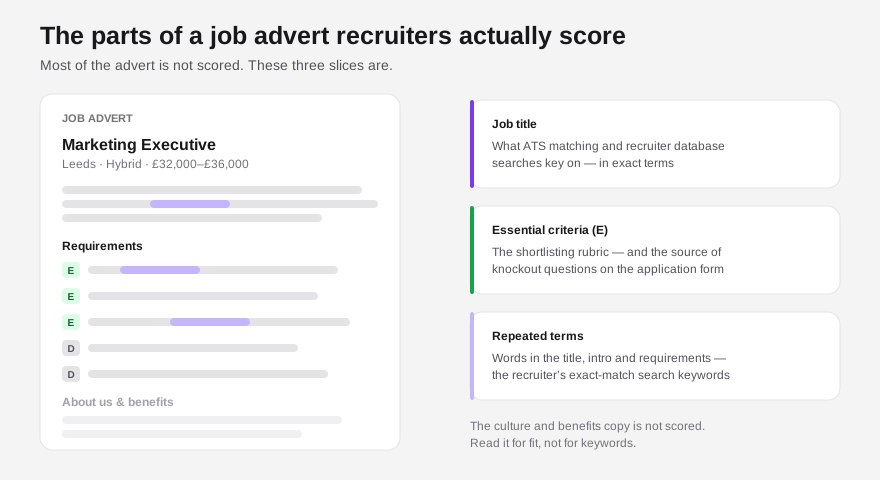
The screening process ignores most of it. At volume - the Institute of Student Employers' 2025 survey found an average of 140 applications per graduate vacancy - nobody scores your application against the paragraph about company culture. What gets used is a narrow slice: the job title, the requirements list, and the vocabulary those two share. That slice becomes the recruiter's search terms, the ATS ranking criteria and any knockout questions on the application form. Recruiters do not read every CV they receive - they triage against exactly this slice.
UK public-sector adverts make the marking scheme explicit. NHS vacancies come with a person specification, and applications are scored line by line against its essential and desirable criteria. Civil Service adverts are built on the Success Profiles framework, and applications are assessed against the behaviours the advert lists. The private sector runs the same logic - it just hides the rubric inside one undifferentiated "requirements" section and leaves you to reconstruct it.
Essential vs desirable: the only split in the job description that matters
Every requirement in an advert is one of two things. Essential criteria are what shortlisting scores - miss one and the application usually fails regardless of everything else on the page. Desirable criteria are tiebreakers between candidates who already cleared the essentials. The essentials are also the test for the Disability Confident interview offer: a disabled applicant who opts in is interviewed only if the CV or form evidences every essential criterion.
Public-sector adverts label the two columns for you. Private-sector adverts rarely do, but the language gives it away:
- Essential markers: "must have", "required", "essential", "you will have", "minimum of", a named qualification or licence
- Desirable markers: "ideally", "nice to have", "a plus", "an advantage", "familiarity with", "exposure to"
Do the split yourself, in writing, before you decide anything. Most adverts that look impossible turn out to have four or five genuine essentials wrapped in a dozen desirables. The decision rule is simple: meet the essentials and you are a legitimate candidate. Missing desirables is not a reason to self-reject - it is the normal condition of every applicant the recruiter shortlists.
How to find the keywords a recruiter will search for
The requirements list is also a keyword list, and it is worth reading a second time just for that.
Repetition is weighting. A term that appears in the job title, the opening paragraph and the requirements - "service delivery", "financial modelling", "safeguarding" - is a term the recruiter will search the applicant database for, and a term the ATS weights when it ranks your CV against the advert. Recruiter searches are usually exact-term: a search for "management accountant" does not return a CV that only says "responsible for month-end".
The nouns in the essential criteria matter most: named systems, qualifications, methodologies and regulated activities. Circle them. Then check each one appears on your CV - in the advert's wording, where it is genuinely true of your experience. Our guide to finding and using ATS keywords covers where in the document each term should sit.

How to decode job description jargon
Some advert phrases carry more information than they appear to. None of these readings is a guarantee - adverts are written by committee - but the patterns are consistent enough to be useful:
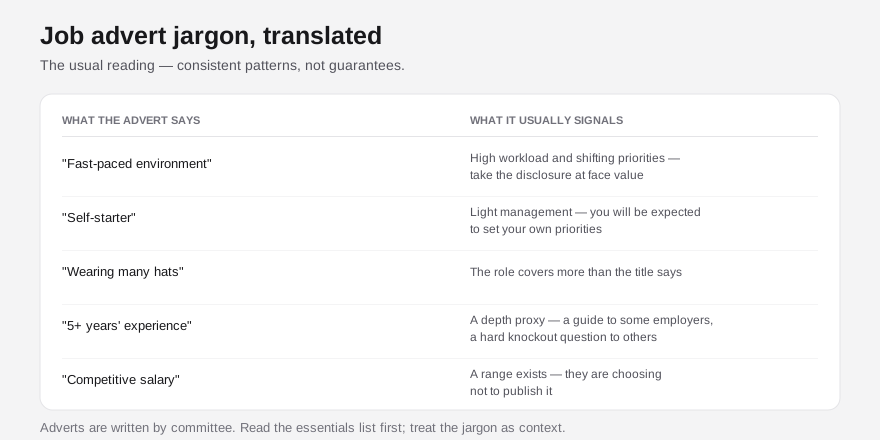
Two of these deserve a closer read. "Fast-paced environment" paired with "resilience" and "ability to work under pressure" is a workload disclosure - take it at face value. And a years-of-experience figure is a proxy for depth, not a legal threshold: some employers treat "5+ years" as a guide, others wire it into a knockout question. You usually cannot tell which from the advert, which is an argument for applying when you are close and the essentials are otherwise met.
A five-step method for reading a job description before you apply
Work through the advert once, pen in hand, before the CV is touched:
- Split every requirement into essential or desirable. Use the advert's own labels where they exist, the language markers above where they do not.
- Spot the likely knockout questions. Right to work, licences, registrations, location, shift availability, named qualifications. These become yes/no questions on the application form, and a wrong answer rejects the application instantly, before any human review. Adverts that rule out sponsorship say so in this part of the page too, which is why it pays to check whether the employer can sponsor before you apply.
- Circle the repeated vocabulary. Title plus intro plus requirements. That is the keyword list your CV will be searched and ranked against.
- Find the evidence for each essential on your CV. If you cannot point at a specific line, the recruiter cannot either. Add one - truthfully - before you apply. This is the core of tailoring a CV to the role, and it is a fifteen-minute job once the essentials are listed.
- Decide on the essentials alone. Meet them all, or all but one with strong compensating evidence: apply. Miss several: your time is better spent on the next advert.
When you should apply anyway
Most people read requirements lists too literally, and the cost of that is measurable. LinkedIn's Gender Insights Report found that women apply to 20% fewer jobs than men - yet when women do apply, they are 16% more likely to be hired, rising to 18% for roles more senior than their current one. The often-quoted companion claim - that women apply only when they meet 100% of the criteria while men apply at around 60% - comes from an internal Hewlett-Packard finding popularised by a 2014 Harvard Business Review article, not a controlled study. But LinkedIn's behavioural data points the same way: the people who treat the advert as a rough sketch outperform the people who treat it as an entry exam.
The practical version of that lesson: desirables are negotiable, and even essentials lists are sometimes inflated - a committee's combined wish list rather than a screening rubric anyone enforces. What is never negotiable is the genuine knockout: the qualification, registration, licence or right to work the role legally or contractually requires. Split the list, respect the real essentials, and ignore the rest of the noise.
FAQ
What is the difference between a job description and a person specification?
The job description describes the role - duties, reporting line, purpose. The person specification describes the candidate - the qualifications, experience, skills and behaviours needed to do it, usually split into essential and desirable. In NHS and other public-sector recruitment the person specification is the scoring document; private-sector adverts merge both into one advert, but shortlisting still works from the candidate criteria.
Do I have to meet every requirement in a job description?
No. You should meet the essential criteria - the "must have" items - because shortlisting scores against them and knockout questions enforce the hard ones. Desirable criteria are tiebreakers; very few shortlisted candidates have all of them. Missing one essential with strong compensating evidence is often survivable; missing several is not.
What does "desirable" mean in a UK job advert?
It means the employer would value it but will still shortlist candidates without it. Desirable criteria typically separate candidates at interview stage or when two applications score equally on the essentials. Treat them as opportunities to strengthen an application you were already going to make, not as conditions of entry.
Should I copy words from the job description into my CV?
Use the advert's exact terms for skills, systems and qualifications you genuinely have - recruiter database searches and ATS ranking mostly match exact terms, so "management accounts" and "month-end reporting" are different strings to the software. Copying whole sentences, or claiming terms that are not true of your experience, does the opposite: it reads as padding to a human and as fabrication at interview.
Why do job adverts ask for so much experience?
Because adverts are assembled from several people's wish lists and often recycled from previous, sometimes more senior, versions of the role. A years-of-experience figure is a proxy for depth, and employers apply it unevenly - some as a hard knockout, many as a guide. If you meet the essentials and are close on the years, the evidence says apply.
Read the advert, then test your CV against it
The ten-minute markup tells you what the screening will score. The remaining question is whether your CV actually evidences it - and that is hard to judge from inside your own document.
Scan your CV free - Shadow CV reads it the way an employer's system does and shows you the keyword coverage, parse problems and missing evidence a recruiter's search would expose. The £5 rewrite fixes what the scan finds and works the advert's genuine terms into bullets that stay true - once, with no monthly subscription.