Key Takeaways
- Most people need one master CV they never send, plus one base version per role family they genuinely apply to - usually one, occasionally two.
- Everything beyond that is a per-application edit, not a new version of your CV.
- Reed and Indeed store one CV per account - whatever you leave there is what recruiters find.
Ask how many versions of your CV you should have and you get two bad answers. One says keep a single CV and send it everywhere, which loses you the keyword match on every advert. The other says write a fresh CV for every application, which nobody sustains past the first fortnight. The workable answer sits between them, and it depends on a distinction most advice skips: the difference between a version of your CV - a separate document you maintain - and an edit you make on the way out the door.
How many versions of your CV should you have?
Two or three files in total. In practice:
- One master CV. The complete, honest record of everything you have done, with every achievement quantified. You never send this document to anyone.
- One base version per role family you actively apply to. Cut from the master, aimed at a type of job rather than a specific advert. For most job seekers this is a single file. Two if you are genuinely applying across two different families.
- Per-application edits on top. Title line, profile, keyword phrasing, bullet order. These are changes you make to a copy on the day, not documents you keep.
A fourth or fifth base version is nearly always a sign that per-application edits have been promoted to permanent files by accident. The cost shows up later, when an achievement gets added to one file and quietly missing from the other three.
The competition is what makes the base version worth building properly. Tribepad, a UK applicant tracking system, analysed 4,530,894 applications made through its platform between September and November 2024 and recorded 48.7 applications per job in November - a 286% rise on the same month a year earlier. Against that volume, a CV written for no particular role ranks below one written for the role family, every time.
The three layers: master CV, base versions, per-application edits
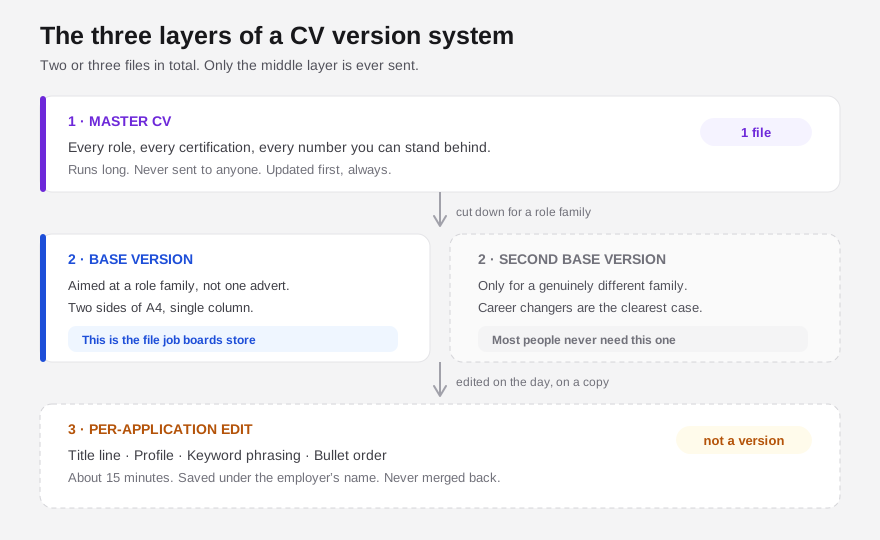
The master CV is the source of truth. Every role, every contract, every certification, every number you can stand behind. It runs long and that is fine - nobody reads it. Its job is to mean you never have to remember what you did in 2019 under time pressure, and never have to hunt through four files to find out which one has the up-to-date figure in it.
A base version is the master cut down for one type of job. Same history, different emphasis: the roles that matter to that family get the space, the ones that do not get compressed to a line. This is the file you actually send, and the file you upload to job boards. Two sides of A4, standard headings, single column.
A per-application edit is what the National Careers Service means when it advises that "you should tailor your CV to the job or opportunity you're applying for". It touches four things - the title line, the profile, the phrasing of keywords the advert uses, and the order of bullets under your most recent role - and takes about fifteen minutes from a solid base. The method is in our guide to whether you should tailor your CV for every job application. Crucially, you save that file under the employer's name, send it, and never merge it back.
Key point: New achievements go into the master CV first, then down into the base versions. Updates that flow the other way are how version drift starts.
The role-family test: when you genuinely need a second CV
Two adverts belong to the same role family, and therefore the same base version, when they share the vocabulary a recruiter would search on. Put the two job descriptions side by side and check three things:
- The job title. Would a recruiter searching a CV database find you for both with one search string? "Marketing Executive" and "Digital Marketing Executive" - yes. "Marketing Executive" and "Project Manager" - no.
- The essential criteria. Do the must-have skills overlap by more than about half? Read the advert the way a recruiter marks it, which is covered in how to read a job description like a recruiter.
- The evidence page one needs. If one job wants campaign results and the other wants delivery-on-budget, page one cannot serve both without becoming vague.
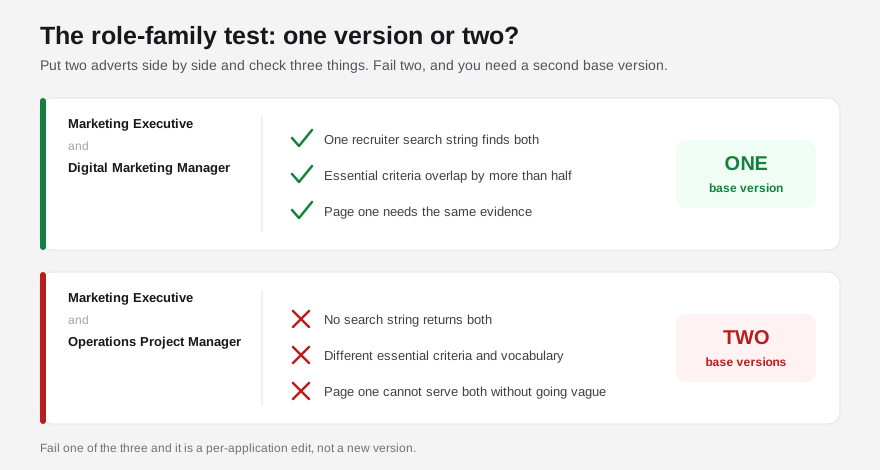
Fail two of the three and you need a second base version. Fail one and you are looking at a per-application edit. Career changers are the clearest case for two files: the target field uses a different vocabulary from the one your history is written in, and translating between them is a rebuild rather than an edit - the method is in our guide to rewriting your CV for a career change.
Which version recruiters actually see when they search
Here is the part that quietly decides the question. On most UK job boards you do not get to keep a menu of versions - the platform keeps one, and it is the one recruiters search.
- Reed.co.uk stores a single CV per account. Its own help pages state that a new upload "will replace the CV on your Reed.co.uk account and will be used for any future applications you make, until you upload a new version."
- Indeed is the same. Its UK help centre says you can only upload one CV file at a time, and that a new upload replaces the old file, which is then used for future applications.
- LinkedIn is the exception, and a narrow one: it stores up to four recently uploaded CVs for reuse in applications, with the most recent selected by default.
Two consequences follow. First, the file sitting on a job board is doing unattended work - it is what turns up in recruiter database searches for weeks after you forget it is there, so it should be your strongest, broadest base version rather than something you cut down for one advert. Second, the fifteenth per-application variant you uploaded to Reed in a hurry is now the CV every future Reed application sends, and the CV every Reed recruiter finds.
Getting found in those searches is a keyword problem, not a design one. How to find and use ATS keywords in your CV covers which terms your target role is actually searched on.
How to manage CV versions without losing track
- Name files so the wrong one cannot be sent.
Surname-Firstname-CV-Marketing-2026-07.docxbeatsCV final v3 (2).docx. Put your name first - it is what a recruiter sees in their downloads folder. - Date every file in the filename. A version with no date in it is a version you will not know whether to trust in four months.
- Update the master first, always. New job, new certification, new number worth quoting: it goes in the master, then into each base version in the same sitting.
- Review the boards quarterly. Log into Reed, Indeed, Totaljobs, CV-Library and LinkedIn and check what is actually stored there. Most people find something eighteen months out of date. Our guide to how often you should update your CV covers the wider cadence.
- Delete per-application copies once the outcome is known. Keeping forty of them is how the wrong file gets attached.
When more CV versions makes things worse
Beyond two base versions, the maintenance cost outruns the benefit:
- Drift. A promotion updated in one file and not the others means half your CVs now understate your current job title - the single most searched field on any CV database.
- The stale board CV. A version uploaded for one application in 2024 is still being served to recruiters searching today.
- Fake versions. Three files that differ only in font, margins or section order are one CV in three places, with three times the upkeep and no extra reach.
- Sending the wrong one. The failure is mundane and common: a well-written CV aimed squarely at a different profession, attached at eleven at night.
If maintaining a version feels like admin rather than strategy, it has stopped being a version and become a copy.
FAQ
How many CVs should I have?
Two or three files: one master CV that holds everything and is never sent, and one or two base versions cut from it for the role families you apply to. Anything further is usually a per-application edit that got saved by mistake.
Should I have a different CV for every job I apply for?
No - you should make a different edit for every job. The document stays the same; the title line, profile, keyword phrasing and bullet order change to match the advert. That takes around fifteen minutes from a good base version and does not create a file you have to maintain afterwards.
Can I upload more than one CV to a UK job board?
Usually not. Reed.co.uk and Indeed both store one CV per account, and uploading a new one replaces the previous file for all future applications. LinkedIn keeps up to four recently uploaded CVs. Whatever is stored is what recruiters searching the database will find.
How do I know which version of my CV to send?
Match it to the role family, not the individual employer. If the advert's job title and essential criteria sit inside one of your base versions, send that one with a per-application edit on top. If it sits between two of them, the advert is telling you the roles are closer than you thought, and one version can probably cover both.
How often should I update each version?
Update the master whenever something happens worth recording, and push the change down into the base versions at the same time. Separately, check what is stored on the job boards every three months - that file works without supervision, and it is the one most likely to be out of date.
Before you decide how many versions to keep, it is worth seeing what any one of them actually looks like to the software doing the screening. Scan your CV free and Shadow CV parses it the way an ATS does, scores it against your target role, and shows which keywords for that role family are missing. The £5 rewrite fixes what the scan finds and gives you a base version worth building the rest on - once, with no subscription.