Key Takeaways
- A career change CV fails when it keeps the old field's language - ATS software ranks you against the new role's keywords, not your old job titles.
- Translate your experience into the target field's vocabulary, restate your direction in the profile, and keep a conventional reverse-chronological structure.
- Never hide the change behind a dateless, skills-only CV.
Changing careers is common - 39% of UK employees say they are likely to look for a new role in the next 12 months, according to New Possible's 2025 What Workers Want survey of just over 2,000 UK workers - but the CV problem it creates is unusually specific. A career change CV has to do something no ordinary CV does: convince a system configured for one profession that a decade of evidence from a different profession is relevant. Send the CV that got you your last promotion, and you will lose to candidates with half your ability, because every line of it is optimised for the career you are trying to leave.
Why Your Current CV Fails a Career Change
The vast majority of large UK employers screen applications through ATS software, and those systems parse your CV into structured data and rank it against the specific vacancy. Three things about that process work against a career changer:
- Your job titles argue against you. "Store Manager" scores nothing against a Project Coordinator vacancy, even though running a store is largely coordination, budgets, and deadlines.
- Your keywords belong to the old field. Matching is largely literal. If the advert says "stakeholder management" and your CV says "liaised with head office and suppliers", many systems will not connect the two.
- Recruiter database searches never surface you. Recruiters search their ATS for the new field's terms. A CV written in the old field's vocabulary is invisible to those searches - not rejected, just never found.
The result is the classic career changer experience: dozens of applications, near-total silence, and no way to tell whether the problem is your background or your document. Usually it is the document.
The Career Change CV Is a Translation Job
Your experience does not change when you change careers. What changes is the language it needs to be described in. The core work of a career change CV is translation: taking what you actually did and re-expressing it in the target field's vocabulary - honestly. Service leavers face the most extreme version of this, and turning a military CV into a civilian one applies the same method to ranks, units and acronyms.
Take a retail store manager moving into project coordination:
- Before: "Managed day-to-day running of a £2.1m turnover store with 14 staff."
- After: "Managed budgets, schedules, and a team of 14 to deliver against monthly targets in a £2.1m operation - planning resources, tracking performance, and reporting to senior stakeholders."
Nothing was invented. The second version describes the same job, but in the words a project coordination vacancy is configured to look for: budgets, schedules, resources, stakeholders, reporting. That is the difference between scoring and not scoring - and it must survive the honesty test: you should be able to defend every phrase at interview with a concrete example.
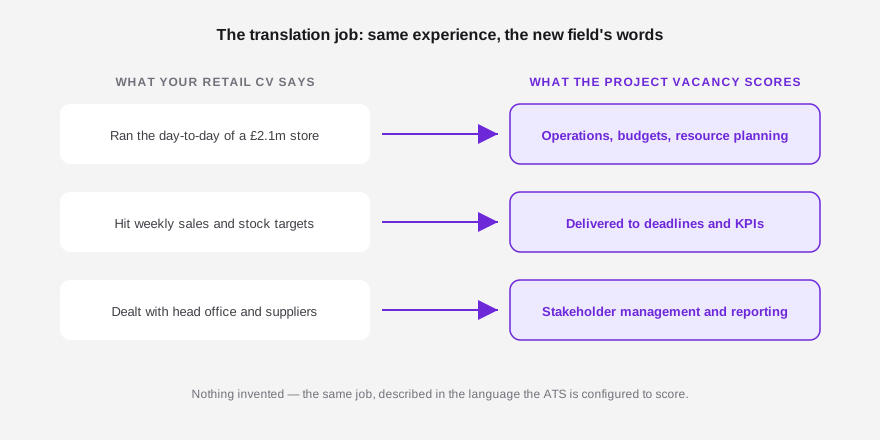
To find the target vocabulary, collect three to five adverts for the role you want and extract the terms they share - the same method covered in our guide to finding and using ATS keywords. Words that appear in most of the adverts are the field's core language. Those are the words your experience needs to be described in.
How to Structure a Career Change CV
The National Careers Service advises tailoring your CV to highlight the skills the employer has asked for, and notes the section order is flexible. For a career changer, the right order is conventional with two adjustments at the top:
- Title line - the target job title, not your old one. You are labelling the document for the role it is aimed at.
- Professional profile - three sentences that state the change plainly: where you are coming from, what transfers, and what you are moving into. Do not be coy. "Retail operations manager moving into project coordination, bringing eight years of budget, scheduling, and team delivery experience" beats any amount of vague ambition.
- Core skills - a short section of 6–10 skills phrased in the target field's language, each one defensible from your history.
- Work history - reverse chronological, with real titles and dates, but with the bullets rewritten for the new field (more on this below).
- Education and training - including any bridging courses or certifications for the new field, even in progress.
One structural warning: do not use a functional (skills-only) CV that strips out dates and employers to disguise the change. It is the traditional advice for career changers and it backfires twice - ATS parsers expect a work history section and score the document poorly without one, and recruiters read a dateless CV as hiding something. Keep the conventional skeleton; do the persuasion inside it. The same trap is set for anyone changing career after 50, where the functional format is recommended even more insistently and costs even more, because a longer history is exactly what the parser needs dates to make sense of.
Note that a career change often also means changing the level you are pitching at. If you are stepping sideways and down, or applying to roles junior to your last title, it is worth knowing what an entry-level CV has to prove versus a senior one - the format stays identical, but the evidence a screener looks for does not.

Rewriting the Work History for a New Career
The experience section is where most career change CVs quietly fail. The titles and dates stay (they are facts), but almost every bullet should be rebuilt around two questions: what did I actually do, stripped of the old field's jargon, and which target-field keyword does this evidence?
- Lead with transferable outcomes, not old-field process. "Reduced stock loss 18% by redesigning the audit process" carries into any field. "Drove availability through gap-scan compliance" carries into nowhere.
- Use the action verb + specific task + measurable outcome formula - quantified achievements transfer even when job titles do not.
- Cut ruthlessly. Deep old-field technical detail earns nothing against the new vacancy and buries the lines that do score. Two or three translated bullets per old role beat six untranslated ones.
- Keep anything that already matches. Budgets, people management, clients, data, compliance - most careers share more vocabulary than the job titles suggest.
What stays untouched is anything you cannot evidence. Translation means re-describing real work; the moment a bullet describes work you never did, you have crossed from tailoring into fabrication, and it unravels at interview.
Bridge the Gap With Evidence, Not Adjectives
A career change CV becomes dramatically easier to write when there is something concrete pointing in the new direction. In rough order of weight:
- A recognised qualification or certification in the target field - even one in progress. List it prominently, with the expected completion date.
- Volunteering, side projects, or freelance work in the new field - real deliverables, however small.
- Parts of your current job that already overlap - the internal project you ran, the system you implemented, the training you delivered. Promote them from footnote to headline.
Each of these also carries keywords the old career cannot supply. "Enthusiastic about data" scores nothing; "SQL (Google Data Analytics Certificate, completing September 2026)" scores.
Career Change CV Mistakes That Get You Filtered Out
- Keeping the old job title as your headline. The first thing parsed becomes the role you are matched to.
- Hiding the change behind a functional CV. Missing dates hurt you with parsers and humans alike.
- Translating nothing and hoping recruiters infer. They have hundreds of on-profile applicants; nobody infers.
- Inflating your way across the gap. Claiming the new field's experience rather than translating your own fails at interview, if not before.
- Applying without meeting the essentials. Where an advert requires a specific qualification you lack, no phrasing clears the knockout question - target adverts where the essentials are skills you can evidence.
And once the career change CV exists, it is your new master document - you should still tailor it to each specific vacancy like any other CV. The rewrite fixes the field mismatch; tailoring fixes the vacancy mismatch. A career change is also the clearest case for running a second base version of your CV while you are still applying in both fields, because the two use different vocabularies and one document cannot carry both.
FAQ
Should I use a skills-based (functional) CV for a career change?
No. A skills-only CV with no dated work history parses poorly in ATS software and reads as evasive to recruiters. Use a conventional reverse-chronological CV with a strong profile and core skills section at the top, and translate the bullets under each role into the target field's language.
Do I need to explain my career change on the CV itself?
Yes, briefly - in the professional profile. Three sentences stating what you did, what transfers, and what you are moving into removes the confusion a recruiter otherwise feels at a mismatched work history. Save the fuller story for the cover letter and interview.
Will an ATS reject me because my job titles don't match the vacancy?
Not automatically - very few systems auto-reject on content alone. But job title is a heavily weighted ranking signal, so mismatched titles push you down the list. Compensate with a target-field title line, a keyword-rich profile and skills section, and translated bullets throughout the work history.
How far back should a career change CV go?
The same as any UK CV: roughly the last 10 years in detail, two pages total. For older roles, a single line each is enough - unless an early role happens to contain your best evidence for the new field, in which case give it the bullets and trim a recent role instead.
Do I need a qualification in the new field before applying?
It depends on the field. Regulated professions require it. For most others, evidenced transferable skills plus a bridging course in progress is a credible package - and a certification, even incomplete, supplies target-field keywords your old career cannot.
The hardest part of a career change CV is that you cannot see it the way the ATS sees it - which keywords from your target field are present, and which are missing entirely. Scan your CV free - Shadow CV parses it the way ATS software does, scores it against the role you are moving into, and lists the exact keywords the translation missed. The £5 rewrite then rebuilds it in the new field's language - once, with no subscription.