Key Takeaways
- Yes - tailor your CV for every application you care about. Tailored CVs convert to interviews at more than twice the rate of generic ones.
- A tailored CV is not a rewrite. Around 80% of the document stays fixed; you change the title line, summary, keyword phrasing, and bullet order.
- From a master CV, tailoring takes about 15 minutes per application.
The average UK graduate vacancy now attracts 140 applications - the highest figure since the Institute of Student Employers began keeping records in 1991. Against that kind of competition, the question of whether to tailor your CV for every job application has a short answer: yes, for any role you genuinely want. The longer answer - how much to change, what to leave alone, and when tailoring is a waste of your time - is what actually determines whether the effort pays off.
Most people get this wrong in one of two directions. Either they send an identical CV to fifty jobs and hear nothing, or they burn an evening rewriting the whole document for a single application and run out of energy after four. Both approaches lose. The evidence points to a middle path: a stable master CV, adjusted in specific, predictable places for each role.
What Tailoring Your CV Actually Means (It's Not a Rewrite)
Tailoring is often imagined as starting from a blank page. It isn't. Your employment history did not change because the job advert did. Your dates, employers, qualifications, and quantified achievements are fixed facts - rewriting them per application adds hours of work and zero score.
What tailoring actually means is adjusting the language and emphasis of an existing CV so it matches what one specific employer's ATS is configured to look for:
- The title line - matching the advertised job title exactly.
- The professional summary - two to three sentences rebuilt around the advert's top requirements.
- Keyword phrasing - swapping your wording for the advert's wording where they describe the same thing.
- Bullet order - moving the most relevant achievements to the top of each role.
Everything else stays put. If you find yourself inventing new experience to match an advert, that is not tailoring - that is fabrication, and it unravels at interview.
The Evidence: Tailored CVs Get More Than Twice the Interviews
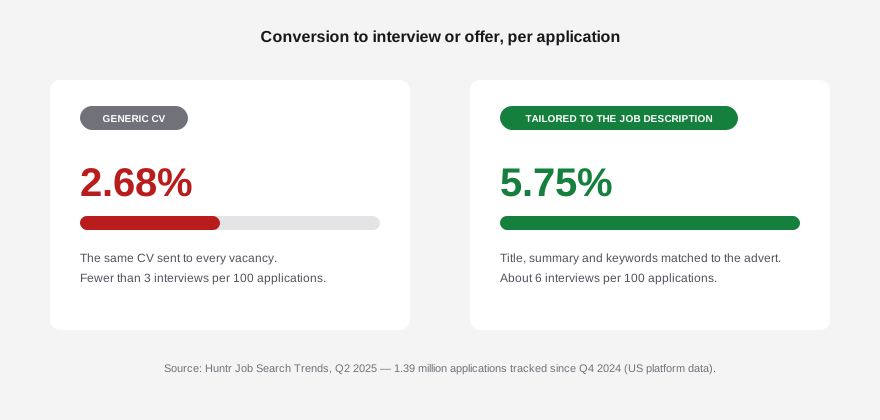
The strongest recent dataset comes from Huntr, a US job-search platform that analysed over 1.39 million applications submitted through its tracker since late 2024. Applications sent with a CV tailored to the job description converted to an interview or offer at 5.75%, against 2.68% for untailored ones - roughly six interviews per hundred applications instead of fewer than three.
That is US platform data rather than a UK study, but there is no reason the mechanism works differently here - because the mechanism is the ATS itself, and UK employers use the same software. The vast majority of large UK employers screen applications through an ATS, and those systems rank CVs against the specific job description, not against some general standard of quality. A generic CV is, by definition, optimised for no particular vacancy.
The UK competition data makes the same point from the other side. Tribepad, a Sheffield-based ATS used by major UK employers, recorded 48.7 applications per advertised job across its platform in November 2024 - up 286% year on year. The ISE's 2025 recruitment survey puts graduate vacancies at 140 applications each. When a recruiter's shortlist is built from a ranked list of that many candidates, the difference between a 60% keyword match and an 80% match is the difference between being seen and being invisible.
Why Tailoring Your CV Works: You're Competing Against a Ranking
An ATS does not read your CV and form an impression. It parses the document into structured data, compares it against the requirements configured for that specific vacancy, and scores it. Recruiters then work from the top of the ranked list down - or search the database for the advert's key terms and see only the CVs that match.
Two properties of that process explain why tailoring has such a large effect:
- Matching is largely literal. If the advert says "stakeholder management" and your CV says "liaised with senior colleagues", many systems will not connect the two. The same experience, phrased in the advert's own language, scores where your phrasing did not. Our guide to finding and placing ATS keywords covers this in detail.
- The threshold is per-vacancy, not universal. A CV commonly needs to match roughly 60–75% of a role's configured requirements to be shortlisted. Your generic CV might clear that bar for one Project Manager role and miss it for another, because different employers weight different requirements - even for near-identical jobs.
This is also why "my CV is well-written, so it should work everywhere" fails as a strategy. Writing quality is invisible to the ranking. Relevance to this vacancy is the whole game - a pattern we see constantly in CVs that get no responses despite looking good.
How Much of Your CV Should Change? The 80/20 Rule
Build one master CV - the complete, honest, well-structured version of your experience, with every achievement quantified. That document is 80% of every application you will ever send. Per application, you touch four zones:
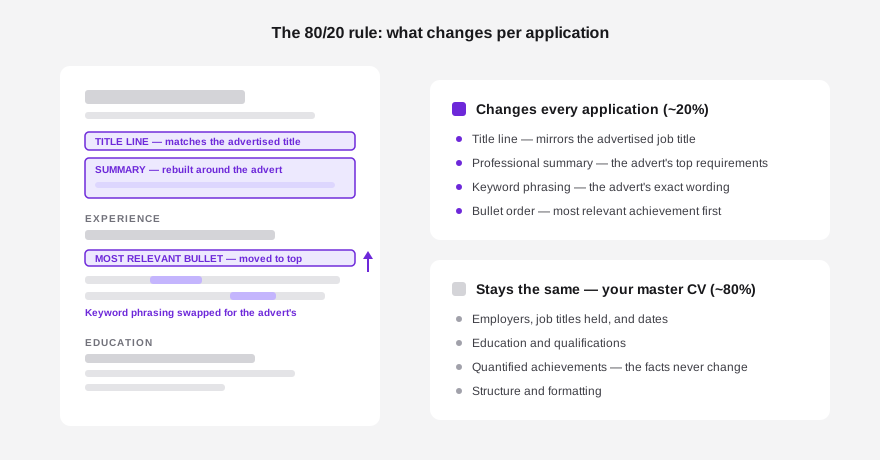
- Title line. Mirror the advertised title exactly - "Business Analyst", not "BA" or your employer's internal variant. Job title match is one of the heaviest signals in ATS ranking.
- Professional summary. Rebuild your two to three opening sentences around the advert's three or four essential requirements. This is the highest-weighted zone on the document.
- Keyword phrasing. Where the advert and your CV describe the same skill in different words, adopt the advert's words. You are translating, not inventing.
- Bullet order. Within each role, move the bullets most relevant to this vacancy to the top. Recruiters give a CV around 7.4 seconds on first review, according to eye-tracking research by Ladders - the first bullet under each job title is often the only one read.
If a change does not fall into one of those four zones, it probably is not worth making per-application. Strengthening weak bullet points, for example, belongs in the master CV once - the action verb, specific task, measurable outcome formula - not in every tailoring pass.
A 15-Minute Method to Tailor Your CV for Each Application
With a master CV in place, tailoring is a repeatable process, not a creative exercise:
- Highlight the advert (3 minutes). Mark every skill, tool, qualification, and responsibility it names. Anything mentioned twice, or listed as essential, is a critical keyword. Our guide to reading a job description like a recruiter covers this step on its own, including how to tell an essential criterion from a desirable one when the advert does not label them.
- Audit against your master CV (3 minutes). For each critical keyword, mark it present, missing, or present-but-phrased-differently. Phrasing mismatches are the cheapest wins - the experience is already there.
- Rewrite the title line and summary (4 minutes). Advertised job title in the title line; top three requirements woven into the summary in the advert's own language.
- Fix phrasing and reorder bullets (4 minutes). Swap mismatched wording in your experience section, then move the most relevant bullet to the top of each role.
- Run the five-keyword check (1 minute). Take the advert's five most important terms and search your document for each. Zero hits on a critical keyword means you are not done.
The first two or three applications will run over 15 minutes. By the tenth, they will run under it - the same role type keeps demanding the same adjustments, and you can keep dated variants of your master CV for each role family you apply to. How many of those variants are worth maintaining is a question in itself: two or three files is usually the right number, and anything beyond that starts drifting out of sync.
When Tailoring Your CV Is Not Worth the Effort
An honest answer to "should I tailor my CV for every job?" includes the exceptions:
- Applications you don't care about. If you would not accept an interview, don't spend 15 minutes earning one. Tailor for the shortlist of roles you actually want; a scattergun of generic applications is how you fill the gaps, if you fill them at all.
- Recruitment agency registrations. When an agency asks for your CV to keep on file, they match you to many roles - send the strong master version. Tailor again when they put you forward for something specific.
- Roles where you miss the essential criteria. Tailoring adjusts language; it cannot manufacture a qualification or five years of experience you do not have. If you genuinely do not meet the essentials, the ATS threshold will catch it regardless of phrasing.
- Speculative applications with no advert. With no job description to mirror, there is nothing to tailor against. Send the master CV with a specific covering note instead.
Everywhere else, the arithmetic favours tailoring. Fifteen minutes per application that doubles your interview rate outperforms any amount of extra volume at the generic rate.
FAQ
Do I need to rewrite my whole CV for every job?
No. Around 80% of your CV - employment history, dates, education, quantified achievements - stays identical across applications. Tailoring means adjusting the title line, professional summary, keyword phrasing, and bullet order to match one specific advert. A full rewrite per application is wasted effort.
How long should tailoring a CV take?
About 15 minutes per application once you have a solid master CV: highlight the advert's requirements, audit your CV against them, rewrite the title line and summary, fix phrasing mismatches, and reorder bullets. The first few attempts take longer; it gets faster as you build tailored variants for each role family.
Can an ATS tell if I use the same CV for every application?
Not directly - no mainstream ATS flags reused documents. But the effect shows up in your score: a generic CV matches each specific vacancy's configured keywords less well, so it ranks lower against candidates whose CVs mirror the advert. The penalty is invisibility, not detection.
Is it OK to change my job title on my CV to match the advert?
Match the advertised title in your CV's title line and use standard industry titles for your roles - "Project Manager", not "PM" or an internal codename. It is acceptable to clarify an unusual employer title with the standard equivalent in brackets, such as "Delivery Lead (Project Manager)", provided it accurately describes the job you did. Never change a title to claim seniority you did not hold.
Should I tailor my CV differently for small companies without an ATS?
The same tailoring helps either way. A hiring manager reading applications by hand still scans for evidence you match their advert, and the requirements language is still the fastest way to show it. The stakes are simply lower - a human can infer that "liaised with stakeholders" means stakeholder management; most ATS software cannot.
Before you tailor anything, find out what an ATS actually sees in your CV. Scan your CV free - Shadow CV parses it the way ATS software does, scores it against your target role, and shows you exactly which keywords are missing. The £5 rewrite fixes the gaps and gives you a master CV worth tailoring - once, with no subscription.