Key Takeaways
- ATS software parses your CV in four stages - extraction, segmentation, parsing, and ranking - and an early failure cascades, scoring you near zero regardless of your qualifications.
- The most common failures are image-based PDFs, which extract no text, and ambiguous dates that break the experience calculation.
- Use a text-based .docx or PDF, single-column layout, and one consistent date format.
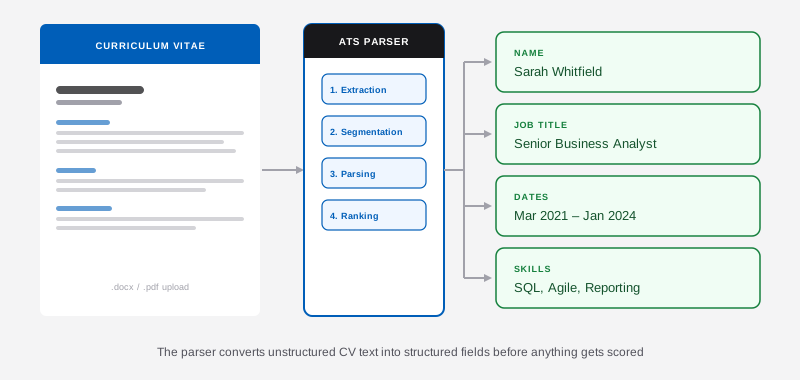
Most advice about "beating the ATS" skips the part that actually matters: what the software is mechanically doing to your CV in the seconds after you hit apply. Understand the machinery and the formatting rules stop being superstition - you can see exactly why each one matters. This is the technical companion to our plain-English explainer of what ATS software is and why it rejects CVs. Here, we go under the hood.
An Applicant Tracking System does not read your CV the way a person does. It runs it through four sequential stages, and each stage depends on the one before it. A failure early on cascades - and the candidate never finds out, because ATS rejection is silent. Your application status just sits at "under review" while your CV never surfaces in the recruiter's shortlist.
The Four Stages of ATS CV Parsing
Every major parsing engine follows the same basic logic. The parsers themselves are usually not built by the ATS vendor - they license specialist engines. The dominant ones are Sovren (now Textkernel), DaXtra, RChilli, and HireAbility, and they sit inside the ATS platforms UK employers actually use: Workday, Greenhouse, Lever, iCIMS, Trac, and Oleeo. Whichever platform a UK employer runs, the pipeline is broadly the same:
- Extraction - the file is converted into raw plain text.
- Segmentation - that text is divided into sections (Contact, Work Experience, Education, Skills) using the headings.
- Parsing - each section is broken into structured fields (job title, employer, start date, end date).
- Ranking - your relevance is scored from those parsed fields, then compared against other candidates.
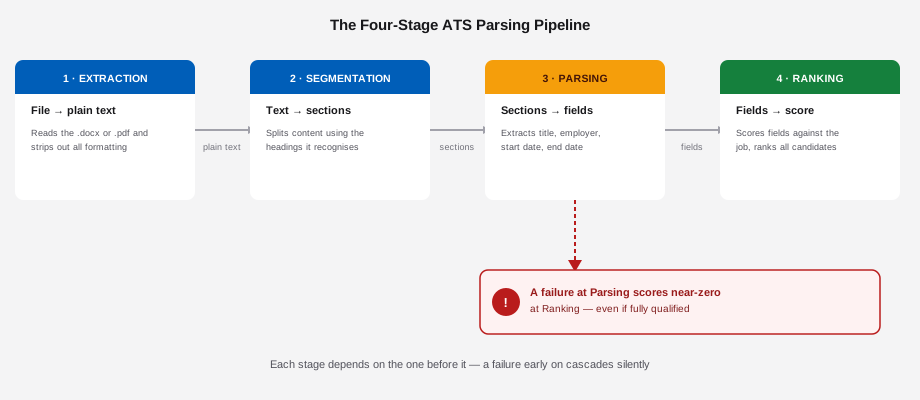
The critical thing to understand: the ranking in stage four is built from the parsed fields, not from the visual document you designed. If stage three misreads your CV, stage four scores what it misread - not what you actually wrote.
Stage 1: Extraction - Turning Your File Into Text
The parser opens your file and strips it down to plain text, discarding all formatting, images, and layout. How cleanly this works depends heavily on the file.
A .docx stores text in a sequential XML structure, so the reading order usually matches the visual order. A text-based PDF is also read reliably by modern parsers. The failure case is a PDF exported from a design tool where the "text" is actually an image - the parser extracts nothing, and you score zero on every keyword. This is the single most catastrophic and most common own goal: a beautiful CV that contains, as far as the machine is concerned, no words at all. If you are weighing up which format to send where, our guide to choosing between a PDF and a Word CV works through it route by route.
Stage 2: Segmentation - Finding Your Sections
Next, the parser scans the extracted text for headings it recognises, and uses them to carve the document into sections. This is why standard headings are non-negotiable. "Work Experience", "Education", and "Skills" map to fields the parser expects. A creative heading like "My Journey" or "What I Bring" maps to nothing - and the content underneath it can be dropped entirely, because the parser does not know what kind of information it is.
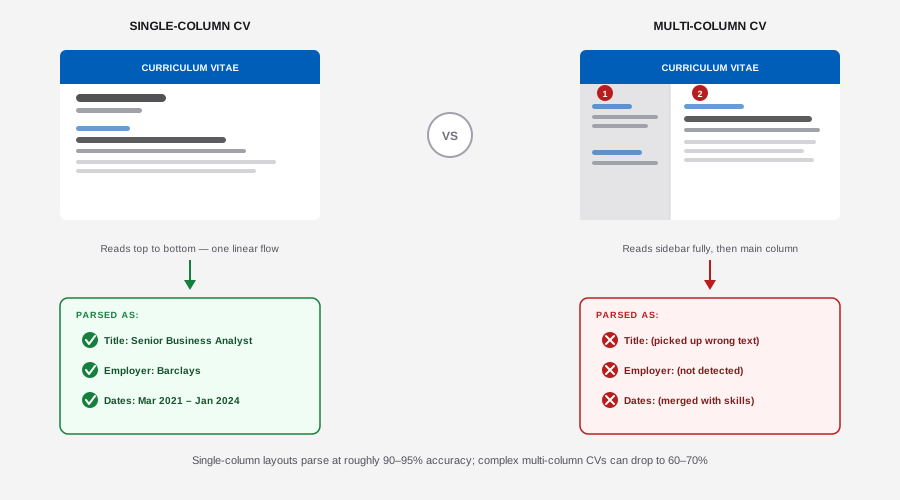
This stage is also where multi-column layouts fail. Parsers read top-to-bottom, left-to-right. When columns are built with text boxes, the parser can read all of column A and then all of column B, splitting your job titles away from the descriptions that belong to them. Single-column layouts parse at roughly 90–95% accuracy; complex multi-column, graphics-heavy CVs can drop to 60–70%, with significant data landing in the wrong fields.
Stage 3: Parsing - Breaking Sections Into Fields
Now the parser takes each segmented block and extracts structured fields: for every role, it wants a job title, an employer, a start date, an end date, and a description. This is where Named Entity Recognition does the work - deciding that "Senior Analyst" is a title, "Barclays" is an employer, and "March 2021" is a date.
Dates are the quiet killer here. The parser uses your employment dates to calculate total years of experience - one of the most heavily weighted ranking signals. If your dates are ambiguous or inconsistent (year-only ranges, mixed formats, the UK-standard DD/MM/YYYY which a parser can misread), the calculation breaks. When the ATS cannot work out your tenure, it ranks you below candidates whose dates parsed cleanly - even when your actual experience is identical or better. A qualified candidate loses to a clean date format.
Stage 4: Ranking - Where the Score Is Decided
Finally, the ATS scores your parsed record against the job's requirements and ranks you against everyone else. Modern engines use natural language processing, so they can recognise that "software engineer" and "SWE" mean the same thing rather than demanding an exact string. But this only helps if stages one to three succeeded. NLP cannot rank a field that was never extracted. If parsing failed, ranking produces a near-zero score, and the recruiter - who only ever sees the top-ranked candidates - never lays eyes on your application.
Some platforms add a further wrinkle. Workday re-parses your CV when it pre-populates the application form, so the prefill screen is effectively a live readout of what the system understood. If a title is wrong or a date is missing there, that is the record being scored - regardless of how clean your uploaded document looks. Oleeo, the platform behind Civil Service Jobs, has a different one: its anonymised screening can silently remove CV content before reviewers see it - the Civil Service CV guide covers how to write around that.
How to Survive the Pipeline
Every rule follows directly from the machinery above:
- Submit a .docx or a genuine text-based PDF - never an image-based or design-tool export with no real text layer.
- Use a single-column layout so the reading order stays linear.
- Use standard section headings so segmentation works.
- Keep dates in one consistent, unambiguous format (Jan 2021 – Mar 2024) so tenure calculates correctly.
- Use standard fonts and simple round bullets so extraction produces clean text. The best font and size for a UK CV covers which choices actually affect the parse.
- Put contact details in the document body, never in the header or footer, which some parsers skip.
None of this is about tricking the machine. It is about giving the parser text it can read cleanly, so the version of you that gets ranked is the real one. For the specific keyword side of ranking, see how to find and use ATS keywords in your CV, and for turning that into strong evidence, how to write CV bullet points that pass ATS.
FAQ
How does an ATS actually read my CV?
It runs four stages: it extracts your file to plain text, segments that text into sections using your headings, parses each section into structured fields like job title and dates, then ranks you on those parsed fields. A failure at any early stage lowers or zeroes your final score.
Why does a qualified candidate get rejected by ATS?
Usually because parsing failed, not because the person was unqualified. If the parser cannot read your file, misreads your sections, or miscalculates your experience from ambiguous dates, it scores what it misread - and ranks you below candidates whose CVs parsed cleanly.
Which parsing engines do UK employers' ATS use?
Most enterprise ATS license specialist parsing engines rather than building their own - the main ones are Sovren (now Textkernel), DaXtra, RChilli, and HireAbility. These sit inside platforms like Workday, Greenhouse, iCIMS, Trac, and Oleeo used across the UK.
Does PDF or Word parse better?
Both work if the file contains real, selectable text. A .docx is the safest baseline; a text-based PDF also parses well in modern systems. The one to avoid is an image-based or design-tool PDF, where the parser extracts no text at all and you score zero on keywords.
Do UK date formats cause ATS problems?
They can. The UK-standard DD/MM/YYYY is ambiguous to a parser (03/04 could be March or April), and year-only or mixed formats break the experience calculation. Use one consistent, unambiguous format such as "Jan 2021 – Mar 2024" throughout.
See What the Parser Sees
Every ranking decision is only as good as what the parser managed to extract. If your CV misparses, the version being scored is not the real you - it is a scrambled copy with dropped sections and miscalculated experience.
See how your CV parses - free - Shadow CV analyses it the way an ATS does and shows you exactly where it breaks. The £5 rewrite fixes it so it parses cleanly and ranks on the real content - once, with no monthly subscription.