Key Takeaways
- An entry-level CV and a senior CV should share the same format - single column, standard headings, real job titles. Only the evidence changes.
- Entry-level CVs are screened at volume against stated criteria, so mirror the advert's wording.
- Senior CVs are read for scope - team size, budget, remit - and still need searchable job titles.
Yes, but not in the way most people assume. The difference between an entry-level CV and a senior CV is not layout, length rules, or some hidden ATS setting that treats graduates differently from directors. The parser does the same job on both. What changes is who is reading, how many other CVs they are reading at the same time, and what they are trying to establish about you in the first few seconds. Get that wrong and you write a graduate CV at 20 years' experience, or a director's CV with nothing to put in it.
Do you need a different CV for entry-level and senior roles?
Two things are true at once, and holding both is the whole answer:
- The mechanics are identical. One column, standard section headings, contact details in the body rather than the document header, a real text layer in the file. Those rules come from how parsing software works, not from your seniority.
- The content is not remotely the same. An entry-level CV argues that you can do a job you have not done. A senior CV argues about the size and results of jobs you have done. Those are different arguments and they need different evidence on the page.
So: same skeleton, different substance. If you are moving between levels - a graduate stepping up, or a senior manager applying sideways - you are not rebuilding your CV. You are changing what page one spends its space on.
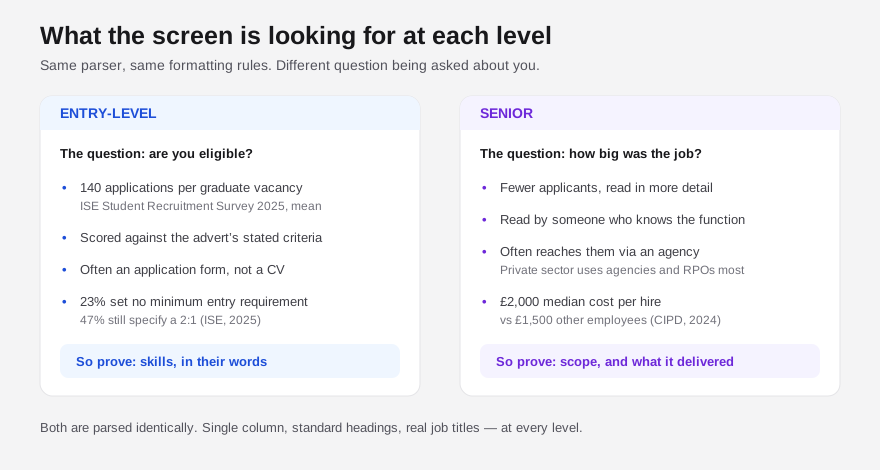
What actually changes between an entry-level CV and a senior CV
Entry-level: volume, and a checklist
UK graduate employers received a mean of 140 applications per vacancy in 2024-25, according to the Institute of Student Employers' Student Recruitment Survey 2025 - the highest figure since the ISE began collecting the data in 1991. Nobody assesses 140 applications on nuance. They assess them against the criteria written in the advert, quickly, and mostly to decide who is eligible to go further.
Two details from the same survey, reported by the ISE's joint chief executive, shape what you should write. Only 47% of employers specify a 2:1 as a minimum, and 23% set no minimum entry requirement at all. The bar has moved off the degree classification and onto evidence of skills - which is exactly where your CV has to compete.
It is also worth knowing when the CV is not the document being screened. Graduate schemes usually run on a structured application form, with a CV uploaded alongside it if at all; the form's questions, tests and video stages carry the screening weight. The same is true across much of the UK public sector, where NHS and Civil Service applications are scored against a person specification rather than a CV. Direct-entry jobs, agency roles and smaller employers are where an entry-level CV genuinely is the thing being judged.
Senior: fewer applicants, more scrutiny
Senior hiring runs on different economics. The CIPD's 2024 Resourcing and Talent Planning report puts the median cost per hire for senior managers and directors at £2,000, against £1,500 for other employees, and found private sector organisations more likely than the public or non-profit sectors to source candidates through an agency, an RPO partner, or a proactive approach to someone who was not applying at all.
That changes the reading. A senior CV is likely to be read by a hiring manager who understands the function, often after an agency consultant has already reformatted it onto a branded template and passed it on. Nobody at that level is checking whether you meet a minimum. They are working out how big your last job actually was.
One trend cuts across both ends. The CIPD report records a decline in employers' use of previous work history and educational qualifications as selection methods, which it links to the growing focus on skills-based hiring. Having held the title is worth less than it was. Showing what you did with it is worth more.
How to write an entry-level CV that survives volume screening
The job of an entry-level CV is to make eligibility and evidence obvious in about ten seconds.
- Use one page. One degree, some part-time work and a project or two do not fill two sides, and padding is visible. Our guide to how long a CV should be in the UK covers where the two-page ceiling applies and where one page is stronger.
- Put education near the top - for now. While your degree, apprenticeship or A-levels are your strongest single credential, they belong above your work history. After roughly two years in a relevant job, they move to the bottom and stay there. What each entry should say - grades, qualification levels, how much to compress - is covered in our guide to the CV education section. If your work history is empty rather than short, our guide to writing a CV with no experience covers building the whole page from education, volunteering and responsibility.
- Mirror the advert's language exactly. Screening at this level is criteria-matching. If the advert says "stakeholder management", do not write "dealing with people". The method is in our guide to finding and using ATS keywords.
- Translate the work you already have. Bar and retail shifts are not filler. Cash handling, stock control, rota cover, complaint resolution, opening and closing a site unsupervised - those are the transferable claims, and they beat a list of degree modules. Committee roles and team captaincies count the same way: hobbies and interests earn a place on an entry-level CV precisely because the work history is short.
- Quantify anything you honestly can. Team of six. 40 covers a night. A dissertation dataset of 900 responses. Numbers do the work adjectives pretend to.
The line to avoid is the profile that opens "a hard-working and motivated graduate seeking an opportunity to develop". It is the most-skipped sentence on any entry-level CV. Lead with the specialism and the evidence instead.
How to write a senior CV that shows scope
At senior level the missing ingredient is almost never experience. It is scale - and CVs are strangely shy about stating it.
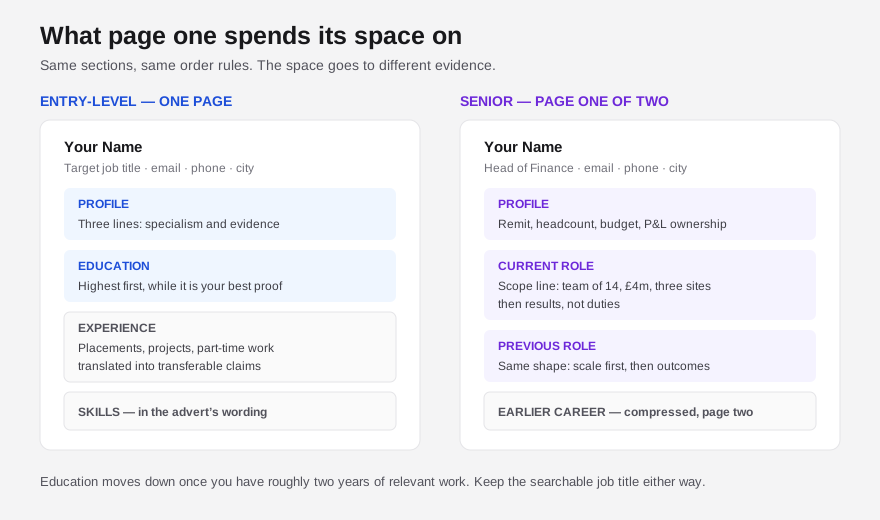
- Put scope in the profile. Not "an experienced operations leader with a strong track record", but the actual shape of the job: function, headcount, budget, region, whether you owned a P&L.
- Give every recent role its size before its bullets. A one-line context sentence under the job title - team of 14, £4m budget, three UK sites - tells a reader more than five duty bullets do.
- Compress everything older than about ten years. Title, employer, dates, or a single "Earlier career" block. Nobody is shortlisting a director on their 2008 graduate role.
- Keep the searchable job title. Internal titles like "Number one in Finance" or "Business Partner, Value Streams" are invisible to a recruiter searching an ATS database for "Head of Finance". Put the recognised title in, and the internal one in brackets if it matters. Senior candidates are found by search far more than by application, which is covered in do recruiters actually read every CV they receive.
- Two pages, three only if earned. Long consultancy project lists, clinical registrations and academic publication histories justify a third page. Twenty years of duty bullets do not.
What does not change at either level
The formatting rules are the same for a school leaver and a chief operating officer, because the software that reads the file has no idea which one you are:
- Single column. Multi-column layouts get merged line by line into nonsense.
- Standard headings - Work Experience, Education, Skills. Invented ones confuse section detection.
- Contact details in the body of the document, never in the header or footer.
- Real dates in a consistent format, on every role.
- A .docx or a text-layer PDF, not an image export.
Those come out of the parsing pipeline itself, which is broken down in what an ATS actually does with your CV. Seniority earns no exemptions. A beautifully written executive CV in a two-column template parses just as badly as a graduate one.
The mistakes each level makes
Entry-level: stretching to two pages; a generic profile; listing degree modules instead of evidence; leaving off hospitality and retail work because it feels irrelevant; using the university's careers-service template with a sidebar in it.
Senior: four pages of history; job titles with no scale attached; bullets that begin "responsible for"; assuming a headhunter will find you so the CV can stay two years out of date; stripping keywords out because "everyone knows what a CTO does" - the database search does not.
FAQ
Should an entry-level CV be one page or two?
One, in almost every case. The UK standard is a maximum of two sides of A4, but that is a ceiling rather than a target. A graduate or school leaver with one qualification and some part-time work has a stronger one-page CV than a padded two-page one, and padding is easy for a screener to spot.
Do senior CVs go through ATS software too?
Yes. The platform does not know or care about your level - a director's CV is parsed, stored and searched exactly like a graduate's. If anything the database matters more at senior level, because a larger share of senior hiring starts with a recruiter searching for candidates rather than a candidate applying.
Should education go at the top or the bottom of my CV?
Top while it is your strongest evidence - during and shortly after study, or when the qualification is a licence to practise. Bottom once you have around two years of relevant work, because your experience then makes the better case. A senior CV that still opens with A-level grades reads as a career that stalled.
Is a three-page CV acceptable for a senior role?
Sometimes. Consultants and contractors with long project lists, senior clinical staff with registrations and audit histories, and academics with publications all have legitimate reasons to run longer. If the third page is duty bullets from a decade ago, it is an editing problem rather than a seniority one.
Do I need a separate CV for each level I apply to?
Keep one master CV and cut it differently, rather than maintaining two files that drift apart. If you are applying both sideways and upwards, the difference should be which achievements get the space on page one - not a second document with a different history in it.
A CV can carry the right evidence for its level and still never reach the person screening it, if the layout scrambles on parse or the wording misses what recruiters search for. Scan your CV free and Shadow CV shows you exactly what an ATS extracts from it, which keywords for your target role are missing, and what is costing you points. The £5 rewrite fixes what the scan finds - parsed cleanly, keyword-complete, sized for the level you are applying at - once, with no subscription.