Key Takeaways
- Writing a CV with no experience is normal: only 26% of young people did any work experience last year, per Youth Employment UK's 2025 census.
- Keep the standard sections and move education to the top, as National Careers Service guidance advises - not a skills-based format.
- Your evidence is education, volunteering, projects and responsibility, written as specifics.
A-level results landed on 13 August, GCSE results follow on 20 August, and every year the same week produces a wave of people staring at a blank document, trying to write a CV with no experience to put on it. The empty space where the work history should go feels like a disqualification. It is not. Employers advertising first jobs read hundreds of CVs from people in exactly the same position, and the ones that get interviews use education, projects and volunteering as evidence - presented in a format that both the screening software and the human reader can process.
What UK Employers Actually Expect From a CV With No Experience
Less than you fear. Youth Employment UK's Youth Voice Census 2025, a survey of 8,278 young people aged 11 to 30 across the UK, found that while 76% say they value work experience, only 26% actually undertook any in the previous year. Half of respondents did not believe they had the work experience employers want. If your work history is empty, you are the majority of the applicant pool, not the outlier in it.
Employers who advertise school leaver and entry-level roles price this in. Screening at that level checks stated requirements - availability, location, right to work, sometimes a qualification - rather than career history, because there is no career history to check. What an entry-level CV has to prove is that you can be relied on to turn up, learn and deal with people, and those claims can be evidenced from school, sport, volunteering and casual work. The candidates who lose out are rarely the ones with the thinnest history. They are the ones who fill the space with adjectives instead of evidence, or who pick a CV format that screening software cannot read.
The Five Sections a First CV Needs
The National Careers Service, the government careers advice service, recommends the same core sections for everyone: contact details, an introduction, education history, work history and an optional references line. Its guidance for people early in their career adds the structural change that matters most: put your education history directly after the introduction, before any work history, so your strongest evidence leads.
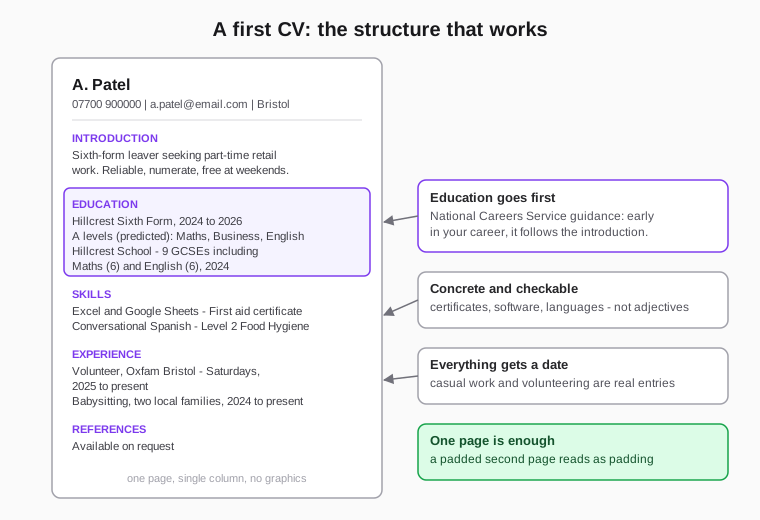
In practice, a strong first CV looks like this:
- Contact details - name, phone, email. No photo, no date of birth, no full address.
- Introduction - the NCS describes it as "a few short lines that sum up who you are and what you hope to do". Two or three sentences, specific to the kind of role you are applying for. What those lines should contain is covered in our guide to the CV personal statement.
- Education - school or college, qualifications with grades (predicted grades are fine, labelled as predicted), and dates. Add relevant coursework or projects here if they support the application. Our guide to how to put GCSEs on your CV covers each entry, including the 9-1 grade wording.
- Skills - a short list of concrete, checkable items: software you can use, a language you speak, a first aid certificate, a food hygiene certificate. Not "communication" and "teamwork" as bare words.
- Experience - any part-time or casual work, volunteering and school responsibilities, each with a date, written as what you actually did.
One page is enough. A first CV padded to two pages reads as padding, and nobody screening 200 applications for a Saturday role rewards length.
Why a Skills-Based CV Is the Wrong Fix for No Experience
Several of the most popular school leaver CV guides recommend a "functional" or skills-based format - skills grouped at the top, chronology demoted or removed - on the logic that it hides the thin work history. This is the single worst piece of advice a first-time applicant follows.
Screening software parses a CV by segmenting it into the standard sections and reading dated entries inside them. Remove the structure and the parser has nothing to anchor on; recruiters, meanwhile, have seen the format often enough to read it as concealment. The same trap is documented for career changers and older workers, and it costs a school leaver just as much.
The legitimate version of the same instinct is exactly what the National Careers Service already advises: keep the conventional sections and reorder them so education comes first. You do not need to hide an empty section behind a novel format. A short, honest, dated experience section - even one Saturday job and one stretch of volunteering - parses correctly and reads as exactly what it is.

What Counts as Experience When You Have Never Had a Job
More than you think, provided it is written as evidence rather than description. The NCS guidance for people without much work history says to focus on skills learned "through projects, work experience or volunteering", and to include interests and hobbies that demonstrate skills. A school work experience placement or a few days shadowing someone counts too, provided the entry says you observed the work rather than did it - listing work shadowing on a CV has its own wording rules. In practice, a first CV draws on five sources:
- Casual and informal work - babysitting, a paper round, helping in a family business, cash-in-hand weekend work. All of it counts, all of it gets dates.
- Volunteering - a charity shop shift, sports coaching, community events. Treat it exactly like a job entry.
- School and college projects - coursework with a measurable result, a Young Enterprise company, a coding project, a performance you organised.
- Positions of responsibility - prefect, form captain, sports team captain, student council, course rep.
- Structured awards - Duke of Edinburgh's Award, music grades, sports leadership qualifications.
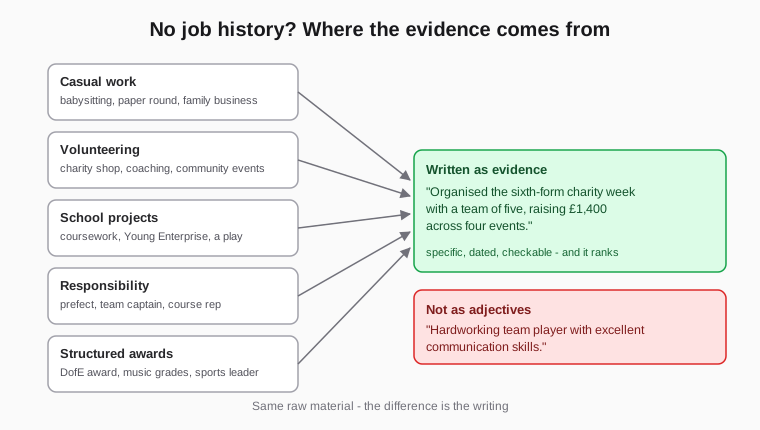
The difference between a weak first CV and a strong one is almost never the raw material. It is the writing:
Weak: "I am a hardworking team player with excellent communication skills."
Strong: "Organised the sixth-form charity week with a team of five, raising £1,400 across four events."
The first is an adjective list any of the other 200 applicants could paste in. The second is a specific, checkable claim that shows planning, teamwork and a result - without ever using those words. The same rewrite works for casual work: "Served customers on busy Saturday shifts at a market stall, handling cash and card payments and restocking between rushes" beats "customer service skills" every time. If an interest genuinely demonstrates a skill, it earns a line too - our guide to hobbies and interests on a CV covers when that section helps a school leaver and when it wastes space.
Where a First CV Actually Gets Screened
First jobs cluster in retail, hospitality, care and warehousing, and those sectors screen at enormous volume through specialist platforms. Tribepad, the applicant tracking platform Tesco uses, has processed more than two million applications a year for that retailer alone since 2014. For high-volume entry-level roles, retail and hospitality screening often leans more on the online application form and its screening questions than on deep CV parsing - which means the knockout questions about availability, age and right to work decide more outcomes than the CV does.
Two consequences follow. First, do not fear the robot rejection: a 2025 Enhancv study of US recruiters found only 8% had configured their systems to auto-reject on CV content, and UK employers use the same platforms. The realistic failure mode for a first CV is not rejection but invisibility - a document that parses badly or matches none of the advert's wording simply never surfaces. Second, mirror the advert. If it asks for "till operation", "food safety" or "customer service", use those exact phrases where they are true of you, because exact terms are what both the software and a skim-reading manager look for.
Apprenticeship applications work the same way: most providers ask for a CV alongside the application, and the same one-page, education-first structure applies.
FAQ
How long should a CV be with no work experience?
One page. The UK standard is a maximum of two sides of A4, but that is a ceiling, and a school leaver or student CV almost never needs the second side. A single well-evidenced page beats two padded ones with every screener, human or software.
What can I put on a CV at 16 with nothing to write?
More than nothing: your GCSEs with grades (or predicted grades, labelled), a two-line introduction, concrete skills such as software or certificates, and dated entries for anything you have actually done - babysitting, a sports team, volunteering, a school production, a prefect role. Specific small things outperform vague big claims.
Do I need a personal statement on a first CV?
Yes, but keep it short. The National Careers Service calls it an introduction: a few lines summing up who you are and what you hope to do. Name the kind of role you want and the strongest evidence you have for it. Skip generic openers like "hardworking and motivated individual".
Should I use a colourful CV template for my first job application?
No. Decorated templates with columns, graphics and text boxes are exactly what parsing software struggles with, and a first CV has the least content to survive a bad parse. A plain single-column document with clear headings looks less exciting on screen and performs better in every system that reads it.
Can I leave the work history section off completely?
If you genuinely have no work of any kind, lead with education and skills and include volunteering or school responsibilities as dated entries instead. Do not invent anything, and do not switch to a dateless skills-only format to disguise the gap - it parses badly and reads as concealment.
Once your first CV is drafted, run it through Shadow CV's free scan - it shows you how screening software actually reads it, which sections parse cleanly, and where the wording misses what the advert asks for. If the scan finds problems, the £5 rewrite fixes the formatting and works the right terms in naturally - once, with no subscription, priced for someone applying for their first job.