Key Takeaways
- UK retail and hospitality employers screen CVs through specialist platforms like Tribepad and Talos360, not the corporate ATS most advice assumes.
- Entry-level roles are often filtered by the online application form itself; supervisory, chef, and management roles get full CV parsing and keyword matching.
- Use single-column formatting and exact terms - "Food Hygiene Certificate Level 2", not "hygiene trained".
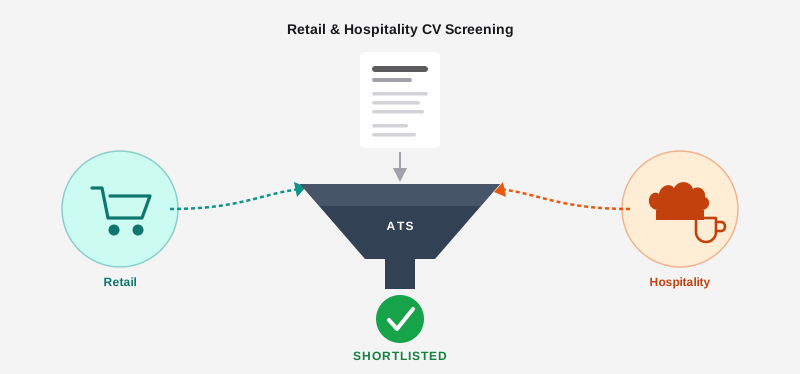
Apply for a supervisor role at Tesco, a chef position with Compass Group, or a team leader job with a Wagamama-sized hospitality group, and your CV doesn't land on a manager's desk first. It goes through a retail and hospitality applicant tracking system (ATS) - software built specifically for high-volume, multi-site hiring, and quite different from the corporate ATS most CV advice assumes you're up against.
Most ATS CV guides are written with office jobs in mind: one vacancy, a few dozen applicants, a hiring manager reading every CV that clears the filter. Retail and hospitality recruitment doesn't work that way. A single supermarket chain can process well over two million applications a year across hundreds of stores. The screening technology built for that scale behaves differently, and the advice for beating it needs to as well.
Why Retail and Hospitality Recruitment Uses a Different Kind of ATS
Large UK employers overwhelmingly use ATS software to manage recruitment, and retail and hospitality are no exception - if anything, they need it more, because of the sheer application volume. But the ATS platforms built for this sector aren't the Workday or Greenhouse-style systems used by banks and professional services firms. They're purpose-built for speed: mobile-first application forms, automated screening questions, and CV parsing designed to sift thousands of candidates for dozens of similar roles at once.
The result is a hiring funnel with two distinct layers:
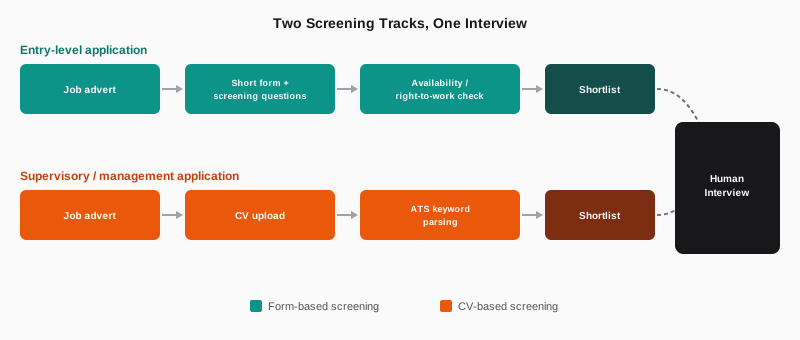
- Volume screening - short online forms, availability and right-to-work questions, sometimes a situational judgement or gamified assessment, used to filter entry-level, customer-facing roles quickly
- CV-based screening - full CV upload and keyword parsing, used for supervisory, management, chef, and head office roles where the ATS genuinely scores your CV against the job
Knowing which layer your target role sits in changes how much time you should spend optimising the document itself.
Which ATS Platforms UK Retailers and Hospitality Employers Actually Use
Retail and hospitality recruitment runs on a small set of specialist platforms, distinct from the general-purpose ATS market. Tribepad is one of the largest - the platform has processed more than two million applications a year for Tesco alone since 2014, and lists Pizza Hut, KFC, Subway, Superdry, Compass Group, Sodexo, Carpetright, Sofology, and Card Factory among its retail and hospitality clients. Talos360 serves hospitality specifically; Wagamama used it to cut time-to-hire and reduce agency recruitment costs significantly within a year of switching. Eploy and Pinpoint are also common across hospitality, leisure, and multi-site retail groups, particularly for seasonal and casual hiring.
These platforms share the parsing behaviour covered in what ATS software actually does - left-to-right text extraction, standard section headings, no tables or columns - but they're tuned for speed rather than depth. That has practical consequences for your CV.

Not Every Retail Application Screens Your CV the Same Way
Be honest with yourself about which stage you're actually being judged at. If you're applying for an entry-level, customer-facing role at a large chain, your CV may matter less than the online application form itself - many of these platforms lean on short-answer screening questions, availability matching, and right-to-work checks before a CV is even scored in depth. A polished CV won't rescue a form answer that doesn't match what the role needs. Cover letters sit even further down the pecking order at this level - whether a cover letter needs to pass ATS at all is less clear-cut than most advice suggests.
For supervisory, team leader, chef, assistant manager, and head office roles, the calculus flips. These applications go through full CV parsing and keyword matching, closer to the process described in how to find and use ATS keywords. This is where formatting and keyword integration genuinely move the needle.
If you're not sure which applies, check the application itself: a short form with tick-boxes and a couple of open questions is volume screening. A dedicated CV upload field with no accompanying long-form questions usually means the CV is doing the work.
The Keywords That Get a Retail or Hospitality CV Shortlisted
For roles where the CV is properly parsed, prioritise:
- Named systems and processes - point-of-sale (POS) systems, stock management, inventory control, till reconciliation, order fulfilment
- Compliance and safety terms - food hygiene certificate (with the level, e.g. Level 2), health and safety, COSHH, allergen awareness, DBS check where relevant
- People and service language - customer service, upselling, complaint resolution, team leadership, shift management, training and onboarding
- Availability and flexibility terms, spelled out exactly as the advert phrases them - weekend availability, early/late shifts, seasonal cover
Match the exact phrasing in the job advert rather than a rough synonym. A parser matching "food hygiene certificate" won't reliably credit "hygiene training" as the same thing.
Formatting Your CV for Mobile-First, High-Volume Screening
Most candidates now apply from a phone, and the systems above are built around that. A few formatting habits matter more here than in a slower corporate hiring process, echoing the structure covered in how to write CV bullet points that pass ATS:
- Use a single-column layout - retail and hospitality ATS platforms parse the same way corporate ones do, and columns still get scrambled
- Save and upload as a genuine text-based PDF or Word file, not a photo or scan of a printed CV
- Keep your skills section near the top - high-volume parsers weight early keyword hits more heavily when they're sorting large batches quickly
- Use plain round bullets, not icons or dashes, so mobile upload and parsing don't strip your formatting
- List your most relevant, most recent shift-based or customer-facing role first, even if it was part-time or seasonal
If you are starting a first CV or rebuilding one from scratch, our free CV builder handles points 1, 2 and 4 for you - every template is single-column with plain bullets, and it exports a clean .docx rather than an image.
Retail CV Example: Before and After ATS Optimisation
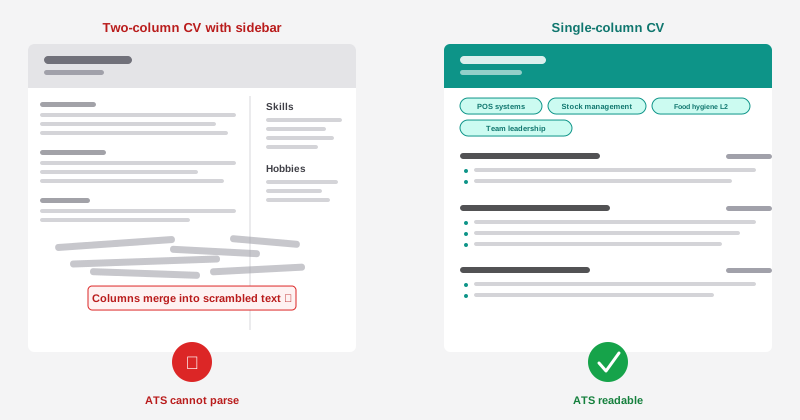
Candidate A applied for a Team Leader role at a supermarket chain with a two-column CV: a sidebar listing "Skills" and "Hobbies," and a main column with work history in a small, decorative font, no dates for the two most recent roles. The ATS parsed the sidebar and main column as one merged block of text, lost the chronology of the work history entirely, and returned no match for "stock management" - a phrase that did appear, buried inside the scrambled sidebar text.
Candidate B applied for the same role with a single-column CV: a top skills line reading "POS systems, stock management, team leadership, food hygiene Level 2," followed by reverse-chronological work history with clear dates and one line per achievement - "Managed till reconciliation and stock counts across a 12-person shift team." Every keyword landed in the right field, the dates parsed cleanly, and the CV scored high enough to reach a human reviewer.
Same candidate quality, same underlying experience. The formatting was the only variable that changed.
FAQ
Does Tesco use an ATS to screen CVs? Tesco uses Tribepad's applicant tracking platform, which has processed millions of applications annually for the retailer since 2014. Whether your CV is deeply parsed depends on the role - high-volume, entry-level roles often rely more on the online application form and screening questions.
Do I need a CV for an entry-level retail job, or just an application form? Both, in most cases. Large UK retailers typically combine a short online application form with a CV upload, even for entry-level roles. The form usually screens for availability and right-to-work first; the CV matters more as the role gets more senior.
Should I include food hygiene certificates and DBS checks on a hospitality CV? Yes, and name the exact qualification level (for example, "Food Hygiene Certificate Level 2") rather than a general phrase like "hygiene trained." ATS keyword matching favours exact terms over paraphrases.
Do retail and hospitality ATS platforms read PDF CVs? Most can, provided the PDF is text-based rather than a scanned image. If you're unsure, open the file and try to highlight the text - if you can select it, it will parse; if it's a flat image, it won't.
What's the single biggest formatting mistake for a retail CV? Two-column layouts with a skills sidebar. They look good to a human eye but consistently get scrambled by the same left-to-right parsing behaviour used across every ATS platform, retail-specific or not.
Check your retail or hospitality CV free - Shadow CV scans it against the specific ATS behaviour for your target role, including how these platforms parse skills, shifts, and certifications. The £5 rewrite makes sure nothing gets lost - once, with no subscription.