Key Takeaways
- Work shadowing counts as work experience on a UK CV. DfE statutory guidance lists it alongside placements as a meaningful experience of a workplace.
- List it in your work history with the employer, dates and the role you shadowed, labelled as shadowing.
- Describe what you observed and learned. Never write it as a job you held.
Most advice on putting work shadowing on a CV is American, and it shows. The top results talk about "shadowing hours", pre-med applications and listing the "city and state" of the hospital. None of that maps onto how shadowing works in the UK, where it usually means a few days watching a solicitor, a vet, a teacher or an engineer at work, arranged through school, a family contact or a careers programme.
It is also about to become much more common. The Department for Education's statutory careers guidance for schools in England, updated on 23 June 2026, commits to "2 weeks' worth of work experience for every young person by the end of key stage 4", and states that "from September 2026, schools should be reforming their work experience programmes" to deliver it. Work shadowing is named in that guidance as one way to give a pupil a meaningful experience of a workplace. This year's school leavers and everyone after them will reach their first CV with a handful of short, observational placements to account for.
Does Work Shadowing Count as Work Experience on a CV?
Yes, and the government's own definitions say so. The DfE guidance defines a meaningful experience of a workplace as one that lets a young person explore "what it is like to work in that environment", "the skills that are valued in the workplace", "workplace recruitment processes" and "what it takes to be successful". It then states: "This could be achieved through visits to workplaces, work shadowing or work experience."
The National Careers Service, which sets out the standard UK CV sections, is just as direct about where it goes. Its guidance on the work history section says: "You should include details of any work placements, volunteering and paid jobs you've had." A shadowing placement is a work placement. It belongs in the same section as your paid jobs, formatted the same way, with the same four elements: employer, title, dates and what you did.
What it does not do is count as employment. The entry has to be honest about that, and the honesty sits in two places: the title line and the verbs.
Where Work Shadowing Goes on Your CV
Where you put it depends on what else you have. The rule is the same one that governs any CV: lead with the evidence most relevant to the job you are applying for.
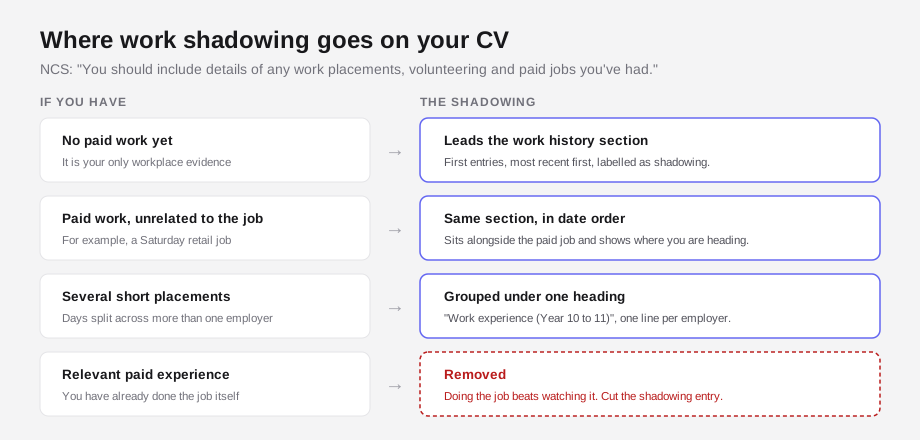
- No paid work yet. Put shadowing in your work history as your first entries, most recent first. If you are writing a first CV with no experience, this is the section that stops the page looking empty.
- Paid work, but unrelated to the job. Keep one work history section and list everything in date order. A Saturday retail job and a week shadowing an architect both belong there, and the shadowing is what makes the application look deliberate.
- Several short placements. Group them under a single heading such as "Work experience (Year 10 to 11)" with each employer as its own line. The DfE guidance lets pupils take their five placement days "with one or more employers, across any sectors", so a split placement is normal and should read as one block, not four fragments.
- Plenty of relevant paid experience. Cut it. Once you have done the job, watching someone else do it adds nothing.
The one place it does not go is a separate "Shadowing" section invented for the purpose. Several guides, Indeed's among them, recommend one, but it splits your experience into two lists and puts a heading on the page that UK recruiters do not expect. CV parsers split a document into sections by its headings, and an unfamiliar heading is the easiest one to misfile, which is covered in detail in the guide to the work experience section of a CV.
How to Write a Work Shadowing Entry
Each entry needs the same four parts as a job, with the title adjusted so nobody can mistake it for one.
- Employer. The organisation's full name, as it appears on its own website. The practice or firm by name, never "a local vets" or "a law firm".
- Title line. Say what it was: "Work shadowing: Veterinary Surgeon" or "Work experience placement: Civil Engineering". Name the role you observed, because that is the keyword a recruiter will search for.
- Dates. Month and year, even for a few days. "June 2026" is a complete date for a one-week placement.
- Two or three lines. What you saw, what you were trusted to do, and what you took from it. The Medical Schools Council's advice to would-be medics applies to every sector: "The focus is on what you learn and how you can reflect on that experience rather than the setting itself."
The last part is where most entries go wrong. Compare these two versions of the same week:
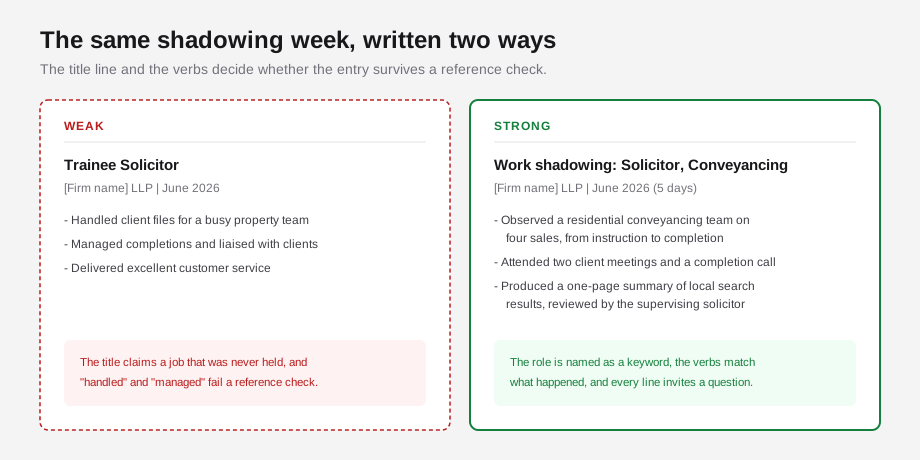
The weak version reads better at a glance and fails the moment anyone checks it. The strong version is specific enough to be believed, uses the vocabulary of the field, and gives an interviewer three things to ask about.

Observed or Did: Keeping a Shadowing Entry Honest
Shadowing is, by definition, watching. The temptation is to write it up as doing, and the verbs are where that happens: "handled", "managed" and "delivered" turn a week of observation into a job that never existed.
Use verbs that describe what actually happened:
- Observed or shadowed, for anything you watched.
- Attended, for meetings, clinics, site visits and court hearings.
- Assisted with, only for tasks where you genuinely helped.
- Produced or completed, only for a task that was yours from start to finish, such as a research summary or a mock design brief.
This matters beyond principle. A shadowing host is a natural referee for a first job, and a reference confirms what you did. If the CV says you ran client meetings and the reference says you sat in on two, the CV loses. The same line runs through all CV writing, and the guide to rewriting your CV without lying sets out where tailoring ends and fabrication starts.
The title line carries the same risk. "Work shadowing: Solicitor" is accurate. "Solicitor" or "Paralegal" on its own is a job title you did not hold, and on a CV that will be checked, a wrong job title is a false statement, not a formatting choice.
Insight Days, Virtual Work Experience and School Placements
Several other short, observational experiences sit in the same category, and they follow the same rules.
- Insight days and spring weeks. Banks, law firms and large accounting firms run these for students, often as a route to internships. List them in work history under the firm's name, with the programme's own title and the month it ran.
- Virtual work experience. Online programmes are now common, and the Medical Schools Council points medicine applicants to options such as Observe GP from the Royal College of General Practitioners. Label them clearly as virtual: "Virtual work experience: Observe GP (RCGP)". The DfE guidance treats remote activity as something that contributes "alongside, but not instead of" in-person experience, and recruiters tend to weigh it the same way.
- School work experience placements. Under the new guidance these run to a week's worth of placement in Years 10 and 11, plus a week's worth of employer activities in Years 7 to 9. The placement belongs on a CV. The Year 7 to 9 activities usually do not, unless one led to something specific.
- Shadowing inside a job you already have. Spending time with another team at your current employer is a strong move for a career change CV. Put it under your existing job as a single line ("Shadowed the data team for six weeks to learn SQL reporting"), not as a separate entry.
One exception is worth knowing. Medicine, dentistry and veterinary applications go through UCAS, where the personal statement does the work a CV would do elsewhere. The shadowing still needs to be written up with the same reflective focus, just not in CV format.
When to Remove Work Shadowing From Your CV
A shadowing entry has a shelf life. It earns its place while it is some of the best evidence you have that you understand the job. Once you have better evidence, it becomes a line a recruiter skips.
Cut it when:
- You have paid or volunteer experience in the same field. Doing beats watching.
- It is more than a few years old and you have moved on from education.
- It is in a field you are no longer applying to.
- The page is full and it is the weakest entry on it.
Keep it when it is the only direct link between you and the job, which is exactly the position of a school leaver, a graduate or a career changer.
FAQ
Does work shadowing count as work experience?
Yes. The Department for Education's careers guidance lists work shadowing alongside workplace visits and work experience as a way to give a young person a meaningful experience of a workplace. On your CV it goes in the work history section, labelled as shadowing rather than presented as a job.
How do I write work shadowing on a CV with no other experience?
Make it the first entry in your work history. Give the organisation's name, a title line such as "Work shadowing: Pharmacist", the month and year, and two or three lines on what you observed, anything you were asked to do, and what you learned about the role.
Should I put a one-day insight day on my CV?
Yes, if it relates to the jobs you are applying for. List it in work history with the firm's name and the date. If you have several, group them under one heading so they read as a pattern of interest rather than a string of one-day entries.
Is virtual work experience worth putting on a CV?
Yes, as long as it is labelled as virtual. Name the provider and the programme, and describe any task you completed. Treat it as supporting evidence: it shows interest and initiative, but it does not carry the same weight as time in a real workplace.
What verbs should I use for work shadowing?
"Observed", "shadowed" and "attended" for anything you watched, and "assisted with" only where you genuinely helped. Avoid "managed", "handled" or "delivered" unless the task was yours, because a reference from the host will confirm what you actually did.
A shadowing week is often the most relevant line on a first CV, which makes it the line that most needs to read clearly to software and to people. Scan your CV free with Shadow CV to see how your work history parses, whether the role you shadowed shows up as a keyword the job advert asks for, and where the score is slipping. The £5 rewrite fixes what the scan finds, once, with no subscription.