Key Takeaways
- Screening software reduces each job in the CV work experience section to four fields: job title, employer, start date, end date - keep all four unambiguous.
- National Careers Service guidance: employer, title, dates, and two to three lines on what you did, most recent first.
- In a promotion stack, every job title keeps its own dates.
Most advice about the work experience section stops at "list your jobs, most recent first, with bullet points". That is true, and it is not the part that decides anything. Before a recruiter reads a word of it, the work experience section of your CV is processed by parsing software that reduces each job to a handful of structured fields - and the software's output, not your carefully written page, is what gets searched, ranked and filtered. Write the section for both readers and it does its job twice; write it only for the human and the machine can lose half of it on the way through.
What the Work Experience Section of a UK CV Must Include
The National Careers Service, the government's careers advice service, calls this section "work history" and its guidance asks for four things per job: the employer's name, the job title, the dates you worked there, and what you did - usually two to three lines, using the STAR method. Jobs go most recent first.
Two details in that guidance are worth more than they look. First, the section is not restricted to salaried employment - the NCS explicitly includes work placements and volunteering alongside paid jobs, which matters if you are writing a CV with little or no work history, and it covers school placements and work shadowing as well. Second, "what you did" gets two to three lines, not ten. The section is a set of dated, verifiable records with a short evidence block under each - not a memoir.
The government's list is also, almost exactly, the list of fields the screening software extracts. That is not a coincidence, and it is why the standard structure is not just convention.
How ATS Software Reads Your Work Experience Section
Parsing software does not read the section - it dismantles it. The CV is segmented into sections, and each job in the work experience section becomes a structured record. Textkernel, one of the specialist parsing engines that sit inside the platforms UK employers use, publishes its developer documentation openly: each position is extracted as a record holding the job title, the organisation, a start date and an end date, from which the software automatically calculates the role's duration in years and months, flags whether it is your current job, and - where the employer has the option enabled - maps your title to a standardised occupation code. The same pipeline handles the rest of your CV.
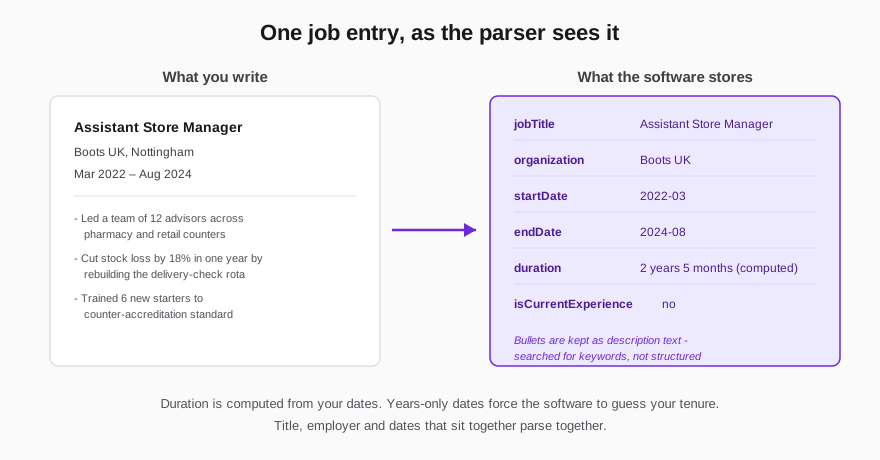
Four practical rules follow directly from that record structure:
- Use a standard heading. "Work Experience" or "Employment History" segments reliably. "My Journey So Far" is a gamble that gains nothing.
- Write real, searchable job titles. Recruiters run database searches on exact titles, and a CV that never surfaces in those searches fails without ever being rejected. "Customer Service Advisor" is a search term; "Happiness Hero" is not.
- Date every job with month and year. The software computes your tenure from the dates. Years-only dates blur it - and can quietly manufacture overlaps or gaps that are not really there. The blurring costs most on short contracts and agency assignments, where "2024 - 2025" could be one month or twenty-three.
- Keep each job's fields together. A title in a sidebar, dates in a header, or an employer three lines from its title all invite the parser to attach the wrong value to the wrong record.
How to Format Each Job Entry
A clean entry puts the four fields on one or two lines, then the evidence under them:
Assistant Store Manager - Boots UK, Nottingham | Mar 2022 – Aug 2024
- Led a team of 12 advisors across pharmacy and retail counters
- Cut stock loss by 18% in one year by rebuilding the delivery-check rota
- Trained 6 new starters to counter-accreditation standard
Title first or employer first is a style choice - recruiters and parsers handle both - but pick one and keep it identical for every job. Consistency is what lets the software, and a skimming human, find the same field in the same place each time. That skim is brief: eye-tracking research by the US job site Ladders found recruiters spend about 7.4 seconds on their first pass, most of it on your current and previous roles - the top entry of this section carries more of the decision than everything else on the page.
The bullets underneath are where the two to three NCS lines become interview evidence. Lead with what changed because you were there, not with a duty restated from your job description - the action verb, task, measurable outcome formula is the difference between "responsible for the day-to-day running of the store" and the entry above. Write your current role in the present tense, finished roles in the past tense, and skip "I" - the entry is already about you.

How to Show Promotions and Multiple Roles at the Same Company
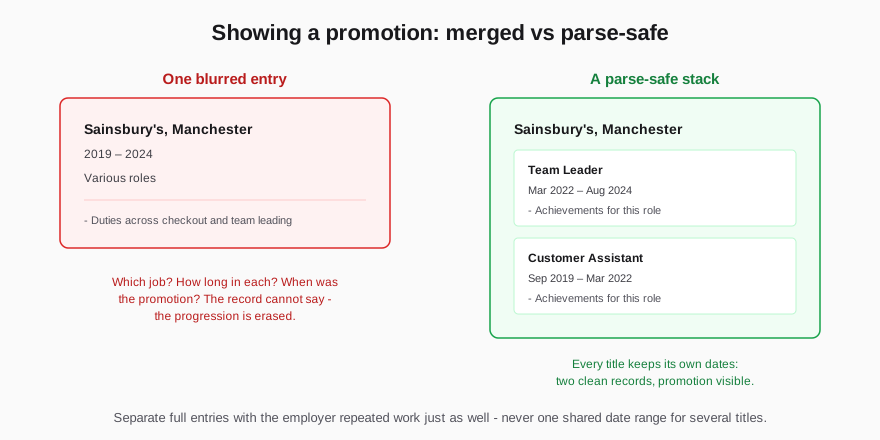
A promotion is some of the strongest evidence a CV can carry - an employer who knew your work chose to give you more of it. The formatting question is where people go wrong, usually by merging everything into one blurred entry: "Sainsbury's, 2019 – 2024, various roles". That erases the progression and hands the parser one record where there should be two.
You have two safe formats. Separate entries - each role written out in full, employer repeated - always work, and suit roles that were genuinely different jobs. Or stack the roles under the employer's name once, which reads elegantly and keeps the story in one place. The rule that keeps a stack safe is simple: every job title keeps its own date range. One shared range across three titles leaves the software unable to say which job you held when, or how long you held your most senior title - the exact facts the promotion was supposed to prove.
If you left a company and later returned, list it twice with the other employment in between - a repeated employer with clean dates is normal, and it preserves the timeline the software rebuilds.
How Far Back Should Your Work Experience Section Go?
Full entries with bullets for roughly the last ten to fifteen years; older roles compress to a single line each - title, employer, dates - or one "Earlier career" block that keeps every title and date on the page. Compression is the honest version of cutting: the tenure calculation stays intact and nothing in the timeline goes missing. Deleting old roles or stripping their dates is the move that backfires, for the reasons covered in our guide to writing a CV over 50.
Relevance trims the list too. The Saturday job from 2009 earns its place on a first CV and loses it once stronger evidence exists. What never gets trimmed is the shape of the record: whatever you keep, keep it dated. And check the sector before trimming at all - in regulated adult social care, the employer must hold your full employment history, so a care assistant CV compresses old roles but never drops them.
FAQ
What order should jobs go in on a CV?
Reverse chronological - most recent first, per National Careers Service guidance. It is the one order every recruiter and every parser expects, and it puts your strongest evidence where the 7.4-second first skim actually lands. Formats that reorder or group jobs by theme (the "functional CV") remove the dated structure the software segments on.
Should you include every job you have ever had?
No. Include what is relevant and recent enough to support your application, and compress the rest rather than deleting it. What you should not do is leave unexplained holes: a missing year reads worse than an unimpressive job, and dates are the one field you should never quietly drop.
How do you list temp or agency work on a CV?
Name the agency as the employer, since it was, and stack the assignments beneath it with their own dates - the same pattern as a promotion stack: "Warehouse Operative (via Adecco)" with client placements listed under it. A long assignment at one client can stand as its own entry naming both. Either way, keep the dates continuous so the record shows steady work rather than a scatter of fragments. Site trades use this stacking constantly - our construction CV guide shows the same pattern with contractors and projects named under one agency entry, and our warehouse CV guide applies it to distribution centre work placed through agencies.
Do you need months on CV dates, or just years?
Use months. Screening software calculates how long you held each role from the dates, and years-only entries force it to guess - "2023 – 2024" could be two months or two years. Recruiters read years-only dates the same way, and tend to assume the missing months are hiding something. If the months are genuinely lost, you can read them off your own HMRC payroll record rather than rounding to the nearest year.
What counts as work experience if you have not had a paid job?
The National Careers Service explicitly includes work placements and volunteering in the work history section alongside paid work. A regular volunteering commitment with an organisation, a title, dates and results is a legitimate dated entry - format it exactly like employment and keep the label honest. Our guide to where volunteering goes on a CV covers how to label an unpaid role and when it deserves its own section instead.
The work experience section is where parsing failures cost the most, because it is where the facts that rank you live - titles, employers, dates, tenure. Run your CV through Shadow CV's free scan and see the section the way the software sees it: which jobs it extracted, which dates it read, and where an entry silently fell apart. If something is broken, the £5 rewrite rebuilds the section so every role parses and reads properly - once, no subscription.