Key Takeaways
- Your PAYE employment history sits in your personal tax account: five years of employers, dates and pay, free and available in minutes.
- For anything older, a subject access request to HMRC is free and has no five-year limit.
- No record holds your job titles or duties, so those still have to come from your own paperwork.
A CV needs dates, and most people write them from memory. That holds up until a screening form asks for ten years with no gaps, or a start date you have carried around for a decade turns out to be four months off. Neither problem needs guesswork. Your employment history has been recorded every time an employer ran payroll, and most of it is free to read this afternoon.
What follows is where that record lives, how to get the parts of it you are entitled to, and how to turn a payroll printout into work-history dates a recruiter can verify.
Where your employment history is actually recorded in the UK
There is no national register of who worked where that anyone can search by name. What exists instead is a byproduct of tax collection. Every time a UK employer pays you through PAYE, they file a submission to HMRC naming themselves and what they paid you, and those submissions accumulate against your National Insurance number. Nobody set out to build an employment history. One exists anyway.
That distinction matters for two reasons.
The first is durability. Employers are only required to keep their own payroll records for, in GOV.UK's words, "3 years from the end of the tax year they relate to" - with a penalty of up to £3,000 for not keeping them. A company that employed you in 2016 may have destroyed its file entirely, lawfully, years ago. HMRC's copy routinely outlasts the employer's.
The second is coverage. The record is built from PAYE, so it captures employment and nothing else. A period of self-employment produces no PAYE submissions at all and appears in the record as blank space, which is a separate problem with its own set of documents.
How to get your employment history from HMRC for free
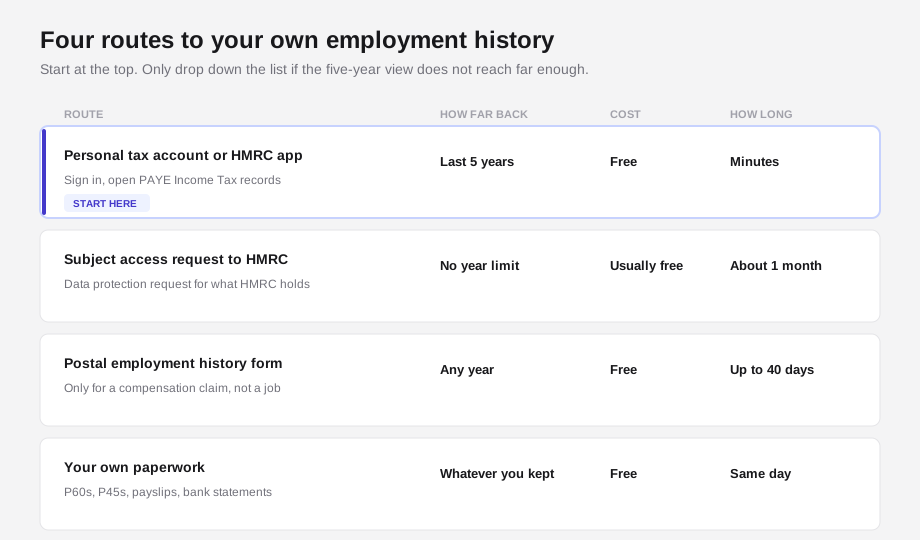
GOV.UK publishes two routes, and they are not equally useful.
The one to use is your personal tax account or the HMRC app. Sign in, open the PAYE Income Tax records, and the employment history is there. GOV.UK describes the scope plainly: you can "check your income from work in the previous 5 years". There is no form, no stated reason required and no fee, and it takes minutes rather than weeks.
The second route is the postal application on GOV.UK's "Get proof of employment history" page. It covers any year rather than only the last five, which sounds better until you read what it is for. GOV.UK is explicit: "Use this form to get confirmation of your employment history to make a claim for compensation." The form itself is titled for a claimant, and the examples given are industrial injury, road traffic accidents and medical negligence. It is not a general-purpose route for a job application, and it is slow - GOV.UK tells applicants to chase the National Insurance helpline "if you have not heard from HMRC after 40 days".
One quirk catches people out. GOV.UK warns that "you cannot check your Income Tax for last year if you paid any part of your Income Tax last year through Self Assessment." Any year in which you did some freelancing alongside a job can therefore display differently from the ones either side of it.
What the HMRC record shows, and what it leaves out
The PAYE record is narrow by design. GOV.UK's description of the same data, in its guidance for the agent-facing Income Record Viewer, lists what is held per job: "time in employment, their PAYE reference, the pay and tax details for each of their jobs", alongside the employer's name. That is the whole of it.
So the record will settle:
- Which organisations ran payroll for you, under their registered names
- When each employment started and ended
- What you were paid and what tax came off
And it will settle none of this:
- Your job title
- What you actually did
- Why you left
- Which client site an agency sent you to
That last one surprises people with contract histories. An agency assignment is recorded against the agency, because the agency ran the payroll. Six months on site at a well-known manufacturer appears in your record as six months at a staffing company you may barely remember signing with.

How to go back further than five years
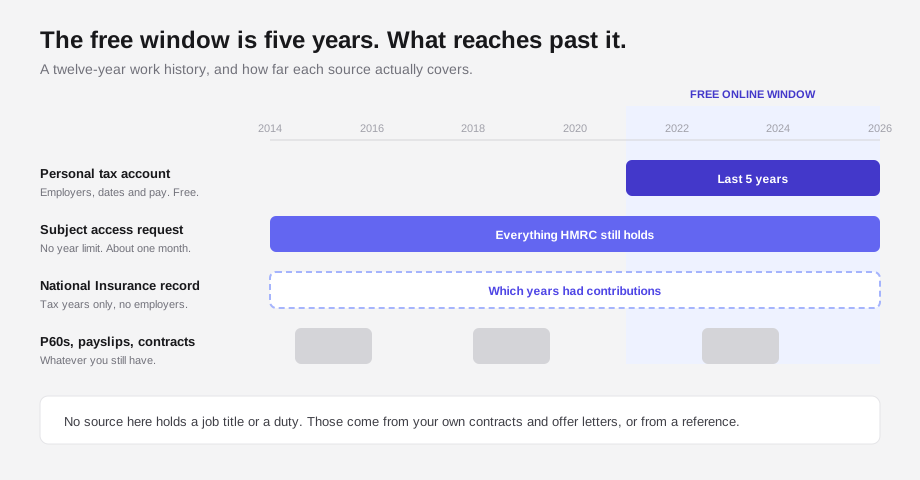
Five years covers a lot of CVs and not all of them. If you need 2014, there are three options and they are not in the order most people try them.
- Make a subject access request to HMRC. This is the route almost nobody mentions and the one that fits a job seeker best. HMRC's own guidance states: "You have the right to request a copy of the personal information we hold about you." There is "usually no fee", HMRC "should reply within one month", and it is not capped at five years. Requests go in through the Data Protection Subject Access Request form on tax.service.gov.uk, or by post to Subject Access Requests, HM Revenue and Customs, BX9 1AN. Have your full name, National Insurance number, date of birth and your addresses for the last five years ready.
- The postal employment history form, covered above, if and only if you are genuinely making a compensation claim. Do not submit a claim form to date a CV.
- Your National Insurance record. Free on GOV.UK, and it shows what you have paid and "any National Insurance credits you've received", year by year, along with where the gaps fall. It is organised by tax year rather than by employer, so it will tell you which years you were working without telling you who for. That is still enough to bound a period you cannot otherwise place.
Filling the gaps the payroll record cannot
Where the official record stops, ordinary paperwork takes over. Working through these in order tends to close a timeline faster than trying to remember it:
- P60s and P45s. A P60 names the employer and covers a full tax year; a P45 carries a leaving date, which is the single hardest date to reconstruct.
- Payslips. Even one from early in a job and one from late in it brackets the employment to the month.
- Old bank statements. The salary credit names whoever paid it, which is often the legal entity rather than the brand you remember.
- Contracts and offer letters. These are the only documents in this list that carry your job title.
- Companies House. Directorships and company appointments are free to search, public and permanent, with exact appointment and resignation dates.
- Your own inbox. Searching old mail for "offer" or "start date" recovers more than most people expect.
Turning a payroll record into CV dates
Getting the record is the easy half. Putting it on a CV takes a few decisions.
Use months and years, not years alone. Year-only dates read as concealment to recruiters, and now that you have the actual months there is no reason to round.
Match the employer name to something checkable. The payroll entity is frequently not the name on the building, so if your record says "NGR Trading Services Ltd" and everyone knows the place as Northgate Retail, write the trading name with the legal entity in brackets. That reads as accuracy rather than a discrepancy.
Expect short jobs you had forgotten to resurface. A six-week assignment that fell inside a period your CV presents as continuous has to be dealt with honestly, and grouping it with the agency that engaged you is usually the cleanest way to list it. Genuine gaps are the same story: now that you can see exactly where they start and end, a one-line explanation costs far less than a date quietly stretched to cover them.
Finally, remember what the record cannot vouch for. Job titles and duties are confirmed by references or not at all, which is worth knowing before you decide how a role is described. The mechanics of that, and what an employer can and cannot verify about your work history, run on a different set of rules from the one you have just used.
FAQ
How far back does my HMRC employment history go?
The free online view in your personal tax account covers the current and past five years of PAYE employment. HMRC holds older data than that, but it is not in the online view - reaching it takes a subject access request, or the postal form if you are making a compensation claim.
Is there a fee for getting my employment history?
No. The personal tax account view is free, and HMRC's guidance on subject access requests states there is "usually no fee to pay to access your personal information". HMRC reserves the right to charge or refuse where a request is unfounded or excessive, which a single request for your own employment record will not be.
Will my self-employed work show in the record?
No. The record is built from PAYE submissions filed by employers, so a sole trader period generates nothing and shows as a blank stretch. Self Assessment paperwork covers it instead, and a year in which you had both a job and freelance income can display oddly because GOV.UK says you cannot check last year's Income Tax online if any part of it went through Self Assessment.
How long does an HMRC employment history request take?
The online view is immediate. A subject access request "should" get a reply within one month, extending to three months where a request is complex or you have made several. The postal compensation-claim form is the slowest: GOV.UK tells applicants to chase it after 40 days.
Does the record show my job title?
No. GOV.UK's description of the PAYE data covers time in employment, the employer's PAYE reference, and pay and tax for each job. Job titles, duties and reasons for leaving are not in it, which is exactly why references exist.
Check the CV you built from it
Accurate dates keep a CV out of trouble; they do not get it read. That still comes down to whether the parsing and the keywords hold up. Scan your CV free - Shadow CV runs it the way an ATS does and shows you where the work history is being misread and which of the role's keywords are missing. The £5 rewrite fixes both, once, with no subscription.