Key Takeaways
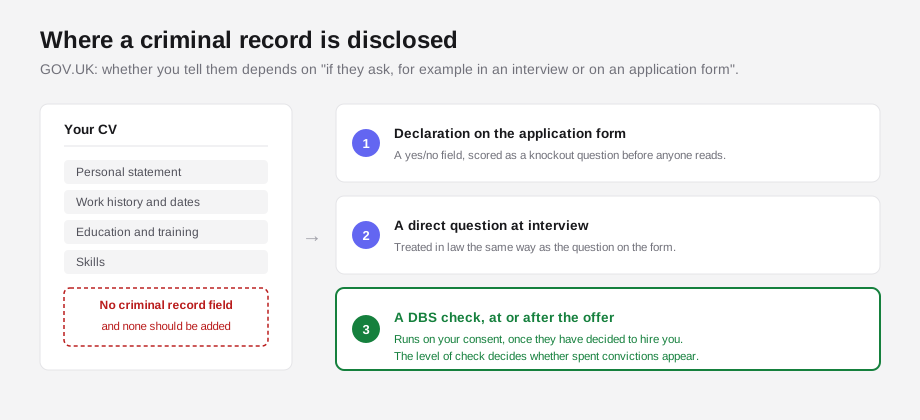
- A criminal record does not go on your CV. GOV.UK puts the question on the application form, at interview, or in a criminal record check.
- Once a conviction is spent, a question about previous convictions is treated in law as not relating to it.
- Exempt roles are the exception, where a standard or enhanced DBS check shows spent convictions.
GOV.UK's guidance on telling an employer about a criminal record lists exactly what decides whether you have to say anything: whether they ask, "for example in an interview or on an application form", when you got it, what sentence you received, and which criminal record check they might request. The CV is not on that list. That absence is the answer to most of what people are asking when they ask what to put about a criminal record on their CV. The declaration is a separate document, asked at a separate stage, under rules that do not touch a CV at all.
The question comes up more often than the silence around it suggests. A Ministry of Justice extract of Police National Computer data, reported in October 2024, recorded 9.4 million people of working age with a nominal record against a working-age population of 42.4 million, roughly one in four. The MoJ called that an estimate with limitations rather than a precise count, but the order of magnitude is not in dispute.
Where the criminal record question actually gets asked
Three places, and a CV is none of them.
- A declaration on the application form. Usually a yes/no field, sometimes with a free-text box. This is the one that produces a rejection within minutes of applying, because it is a knockout question the software can score without a human reading anything. How to tell whether your CV passed ATS screening covers how to recognise that pattern from the outside.
- The interview. An employer may ask directly. A question asked in an interview carries the same legal treatment as one on a form.
- A criminal record check, at or after the offer. The DBS check runs on your consent, once the employer has decided they want you.
A growing number of UK employers have moved the first of those. Business in the Community's Ban the Box campaign asks employers to commit to "removing any tick box from job application forms that ask about criminal convictions" and to "considering applicants' skills, experience and ability to do the job before asking about criminal convictions". BITC puts the campaign's reach at more than a million roles in its June 2026 factsheet. Where an employer has signed up, the question moves later in the process, which is the argument for leaving it off the document that is read first.
When a conviction becomes spent, and what that changes
The Rehabilitation of Offenders Act 1974 does more work here than most CV advice credits it with. Section 4(2) says that where a question about previous convictions is put to someone outside court proceedings, "the question shall be treated as not relating to spent convictions", and no legal liability follows from failing to disclose one. Section 4(3) goes further: a spent conviction "shall not be a proper ground for dismissing or excluding a person from any office, profession, occupation or employment, or for prejudicing him in any way in any occupation or employment".
That is a stronger position than "you do not have to mention it". A spent conviction is not a thing you are concealing. In law, for non-exempt jobs, the question was never about it.
When a conviction becomes spent is where a lot of published advice is out of date. The Police, Crime, Sentencing and Courts Act 2022 shortened the rehabilitation periods, and GOV.UK states that its current table aligns with "legislation that came into force on 28 October 2023". Pages written before that date, and pages that copied them since, still quote the longer periods.
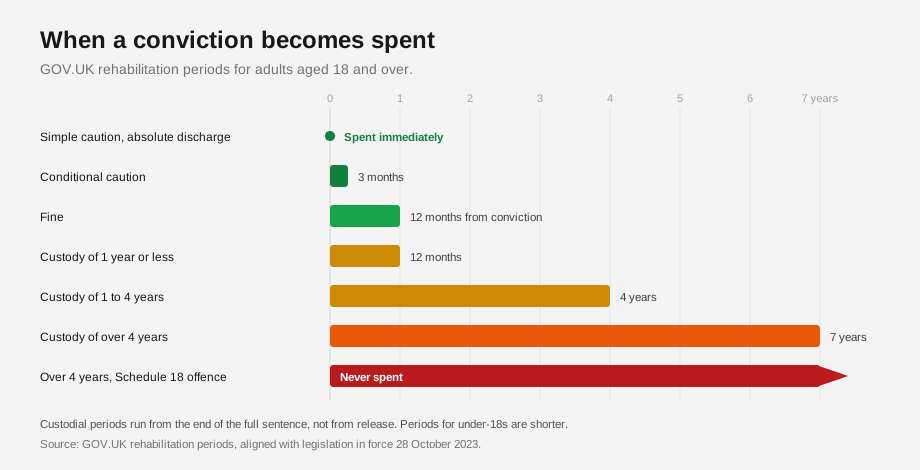
A community or youth rehabilitation order sits outside the chart: it is spent on the order's end date, or two years from conviction if the order gives none. Periods for under-18s are shorter throughout.
Two details decide which row applies, and both are easy to get wrong. The clock on a custodial sentence runs from the end of the full sentence, not from release. And the period attaches to the sentence you received, not the offence you were charged with.
Scotland and Northern Ireland run their own versions of this framework, and GOV.UK says so directly. If you are applying there, check the rules for that jurisdiction rather than assuming the England and Wales table applies.
The jobs where a spent conviction still shows up
The protection in section 4 is disapplied for roles listed in the Rehabilitation of Offenders Act 1974 (Exceptions) Order 1975: work with children or vulnerable adults, healthcare, the legal profession, financial services and policing among them. For those, an employer may lawfully ask about spent convictions and run a higher level of check.
Which check applies decides what an employer sees. GOV.UK describes the four DBS levels precisely: a basic check "shows unspent convictions and conditional cautions", a standard check "shows spent and unspent convictions and cautions", an enhanced check adds "any information held by local police that's considered relevant to the role", and an enhanced check with barred lists adds whether you are barred from that work. How these sit alongside reference and qualification checks is covered in what an employer can actually check about your employment history.
Even on standard and enhanced certificates, older and minor records are filtered out rather than disclosed. Under the rules that took effect on 28 November 2020, youth cautions, warnings and reprimands are no longer automatically disclosed, and the multiple conviction rule was removed. For an adult, a caution for a non-specified offence is filtered after six years and a conviction for a non-specified offence after 11 years.
The test before you apply is one question: is this role exempt? The advert usually says so, in the same small print that carries the closing date. If it names a standard or enhanced DBS check, assume spent convictions are in scope.

What to put on your CV about a criminal record
Nothing. Unlock, the charity that advises people with convictions, puts it directly: "A CV is designed for you to sell yourself as the best person for the job - you shouldn't normally include any information about your criminal record on your CV."
Leaving it off is not the same as hiding it. The CV is a document about what you can do; the declaration is a separate question, answered honestly when asked. Volunteering it early costs you the shortlist and buys nothing, because the employer who needs it will ask in a form built to collect it, with space to explain.
Three things follow from that:
- Do not add a disclosure section, a heading, or a line in your personal statement. It goes in the same category as the other personal details that do not belong on a UK CV, covered in what to remove from your CV.
- Answer the form truthfully when it comes. A false answer on a declaration is a much larger problem than the record itself, and it is grounds for dismissal later.
- Prepare a short written account before you need it. Two or three factual sentences: what happened, when, and what has changed since. Where an application invites an explanation, that paragraph is what goes in the box.
Key point: A CV that says nothing about a criminal record has not concealed anything. The disclosure point is the declaration field and the criminal record check, and both arrive with their own question.
The gap in your work history is the real CV problem
A custodial sentence leaves a hole in the dates, and the dates are the part of a CV that software reads most literally. A parser builds your work history from start and end dates and computes total years of experience from them. An unexplained multi-year gap triggers no conviction alert, because no mainstream ATS has one. It does something quieter: it shortens the tenure figure the ranking uses, and leaves a human reader with an unanswered question.
Unlock suggests recording the period as unavailable for work, or listing qualifications completed during it. Either is accurate, and study completed inside is genuinely CV content. What matters mechanically is that the section stays continuous and parseable, with employer, title and dates in the same shape for every entry. How gaps are actually read, and why they are now the majority experience rather than a red flag, is covered in how to explain employment gaps on your CV.
If your circumstances are complicated, Unlock and Nacro both run free helplines. This post covers what the rules are, not what you should say about your own record.
FAQ
Do I have to put a criminal record on my CV?
No. There is no requirement to mention a criminal record on a CV, and GOV.UK's own list of where the question arises names the application form, the interview and the criminal record check. Answer the declaration honestly when it comes.
Do I have to tell an employer about a spent conviction?
For most jobs, no. Section 4(2) of the Rehabilitation of Offenders Act 1974 says a question about previous convictions is treated as not relating to spent convictions, and you incur no liability for not disclosing one. The exception is roles covered by the Exceptions Order 1975, where an employer may ask about spent convictions and a standard or enhanced DBS check will show them.
How long before my conviction is spent?
It depends on the sentence, and the current periods took effect on 28 October 2023. A fine is spent 12 months from conviction, custody of a year or less 12 months after the sentence ends, one to four years four years after it ends, and more than four years seven years after it ends. Check the GOV.UK rehabilitation periods table for your exact disposal.
Can an employer withdraw a job offer because of a criminal record?
For a spent conviction in a non-exempt role, section 4(3) says it is not a proper ground for excluding someone from employment. For an unspent conviction, or a record disclosed on a check for an exempt role, an employer can take it into account, but is expected to weigh its relevance to that role rather than reject automatically.
Should I explain a prison sentence in my CV's employment gap?
Not on the CV itself. Keep the work history continuous and factual, listing any qualifications gained during the period, and hold the explanation for the declaration or interview where you have room for context. A gap alone is common enough that it is not the signal people fear.
Whether a record is spent decides what you declare. It decides nothing about the rest of the CV, which still has to parse cleanly, carry the keywords from the advert, and survive a ranking before a human opens it. Run your CV through Shadow CV's free scan to see the version the software builds from your file, including how it reads your dates and where the score is leaking. The £5 rewrite fixes what the scan finds, once, with no subscription.