Key Takeaways
- No ATS sends a pass or fail notification - you have to read the signals instead.
- A rejection within minutes means a knockout question, not your CV. Any human contact, including a personalised rejection, means your CV passed ATS screening.
- Weeks of silence usually means your CV never surfaced in the recruiter's search - fixable with formatting and keywords.
You applied two weeks ago and heard nothing. Was your CV read and rejected, or did it never reach a human at all? The frustrating truth about ATS screening is that the system will not tell you: no mainstream Applicant Tracking System sends candidates a "your CV failed parsing" email. But the process does leak information - in the timing of rejections, in portal status changes, and in the type of silence you get. Here is how to read each signal, and what an "ATS checker" can and cannot tell you before you apply.
What "passing ATS screening" actually means
Around 98% of large UK employers run applications through an ATS - Workday, Greenhouse, Oleeo, Trac, and similar platforms - and a typical UK vacancy attracts an average of 118 applications. The system parses your CV into a database record: name, job titles, skills, dates, qualifications. Recruiters then search and filter those records rather than reading every application.
So "passing" is not a single automated verdict. It is three things happening in sequence:
- Your CV parsed correctly - the software extracted your details into the right fields instead of jumbled text. (Our deep-dive on how ATS parses your CV covers exactly where this goes wrong.)
- You cleared any knockout questions - the yes/no eligibility checks on the application form, such as right to work in the UK.
- You surfaced when the recruiter searched or sorted - your parsed record matched the keywords and criteria they filtered by, so a human actually opened your application.
Fail any of the three and the outcome looks identical from your side: silence. Which is why the signals below matter - they tell you which stage you fell at, or whether you got through.
The signals your CV passed ATS screening
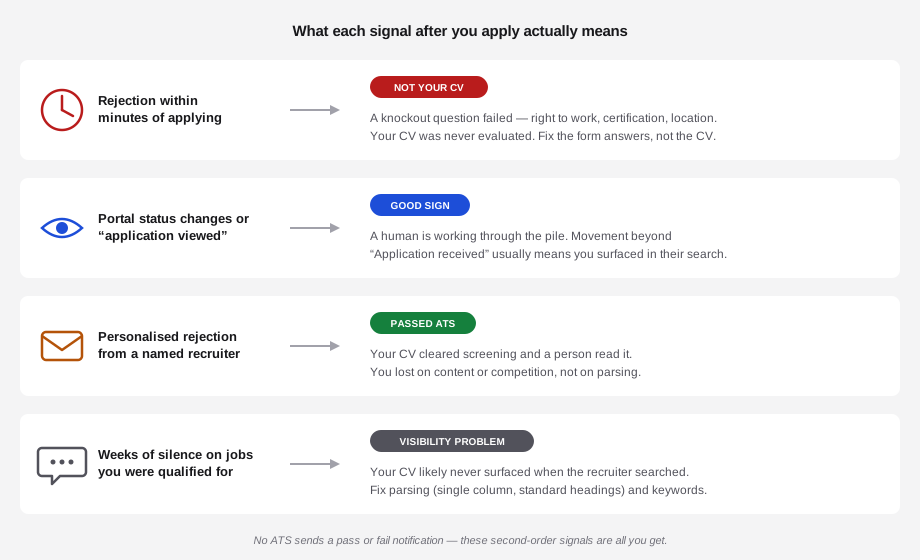
Any evidence that a human engaged with your application means your CV cleared the software. In practice, that looks like:
- A recruiter contacts you. An interview invitation, a screening call, or a request for more information is the obvious one - parsing, knockouts, and search all worked.
- A personalised rejection. If a named recruiter emails you something specific to your application ("we went with candidates who had more payroll experience"), your CV was read by a person. It passed screening; it lost on content or competition.
- Your portal status changes. Employer portals on platforms like Workday show statuses such as "Under review", "In process", or "Shortlisted". Exact wording varies because each employer configures its own labels, but movement beyond "Application received" generally means a human is working through the pile - and a status that changes to interview or assessment stages means you surfaced.
- Your application is marked as viewed. LinkedIn's "application viewed" notification and similar job-board indicators are weak but real signals that someone opened your details.
The signals your CV never made it
The negative signals are just as readable - and they point at different problems with different fixes.
Rejection within minutes is a knockout, not your CV. In a 2025 Enhancv study of 25 recruiters, every single one used knockout questions - automated eligibility checks like right to work, essential certifications, or location. Those recruiters were US-based, but they run the same platforms UK employers use, and knockout screening works identically here. An email that arrives seconds after you submit means you answered a knockout question the wrong way. Your CV's formatting and keywords were never the issue, and no rewrite would have changed the result.
Weeks of silence usually means you never surfaced. True content-based auto-rejection is rare - only 8% of recruiters in the same study had configured their ATS to reject on CV content or match scores. (Believing otherwise is the most expensive ATS myth going, because it sends you fixing rejection when your actual problem is invisibility.) What actually happens is quieter: your CV sits in the database, but the recruiter's search for "management accountant" or "SEN teaching assistant" never returns it, because your CV parsed badly or does not contain the terms they searched. Harvard Business School's 2021 Hidden Workers research - which surveyed employers in the UK as well as the US and Germany - found 88% of employers believe qualified candidates get screened out exactly this way. If this pattern sounds familiar across many applications, our guide to why your CV isn't getting responses works through the causes one by one.
A generic rejection weeks later is ambiguous. A template email ("we have decided to progress other candidates") could mean a human skimmed and passed, or that the role closed and everyone unprocessed was bulk-rejected. One generic rejection tells you little. A consistent pattern of them across applications you were qualified for points back at visibility - parsing and keywords.
Can an ATS checker tell you if your CV will pass?
Search "did my CV pass ATS" and you will find dozens of tools offering an ATS score, many implying that 80% or above means you are safe. Two honest corrections to that marketing:
- Employers never see a third-party score. An ATS checker is separate software making an estimate. There is no universal pass mark, because there is no universal test - each employer configures its own search terms, filters, and criteria per vacancy.
- A score without a target role is close to meaningless. Whether you "pass" depends on how well your CV matches what a specific recruiter searches for on a specific job. The same CV can surface instantly for one vacancy and stay invisible for another.
What a good scan genuinely can tell you is the part that holds across every employer:
- Whether your CV parses cleanly - whether columns, tables, headers, or graphics turn your work history into jumbled text in the database. This is checkable before you apply, and it is the failure the Hidden Workers research flags as costing qualified candidates interviews.
- Which keywords you are missing for your target role - the searchable terms recruiters actually filter by. Our guide to finding and using ATS keywords shows how to identify them from the job advert itself.
Even inside real ATS platforms, match scores are advisory: the Enhancv study found 44% of ATS platforms offer AI "fit scores", but more than half of recruiters ignore the feature entirely and most of the rest treat it only as a guide before checking manually. Chasing a number is the wrong goal. Being parseable and searchable is the right one.
How to turn the silence into signals
If your pattern is instant rejections, re-read the application form questions - the fix is eligibility and honesty, not your CV. If your pattern is long silence on jobs you were qualified for, the fix is visibility:
- Make it parse. Single column, no tables or text boxes, contact details in the document body, standard headings (Experience, Education, Skills).
- Match the search terms. Mirror the job description's exact wording for skills your experience genuinely supports - recruiters search the advert's language, not synonyms.
- Put a clear job title under your name. Title searches are one of the most common recruiter filters.
None of this is a trick, and none of it hurts you with human readers - the full argument is in our honest take on whether you really need an ATS-friendly CV.
FAQ
Does an ATS notify you if your CV fails screening?
No. No mainstream ATS sends candidates a parsing or screening result. Rejection emails are triggered either by knockout questions on the application form or by a human recruiter's decision. If your CV parsed badly, you simply hear nothing - which is why silence is the signal to investigate.
What does "Under review" mean on a job application portal?
It means your application is in the recruiter's active pile rather than auto-rejected, but the exact meaning varies because each employer configures its own status labels. Movement between statuses is the informative part: a change usually means a human touched your application.
I was rejected within minutes of applying. Was it my CV?
Almost certainly not. Rejections that arrive seconds or minutes after submission come from knockout questions - automated eligibility checks such as right to work, required certifications, or location. Your CV's content and formatting are not evaluated that fast. Check the form questions before rewriting anything.
Is there an ATS score that guarantees my CV will pass?
No. Third-party checker scores are estimates that employers never see, and real ATS platforms have no universal pass mark - each employer sets its own search terms and filters per vacancy. Use a scan to confirm your CV parses cleanly and covers the role's keywords, not to chase a number.
Can I ask the employer whether my CV passed the ATS?
You can ask for feedback, and for public-sector employers like the NHS and Civil Service you will often get structured scoring feedback. Most private-sector recruiters will not tell you whether your CV surfaced in their search - high application volumes make individual feedback rare. Testing your CV before you apply is more reliable than asking afterwards.
The one signal you never get is the one that matters most: whether your CV parsed into something a recruiter can find. Scan your CV free - Shadow CV shows you exactly what an ATS extracts from it, which keywords are missing for your target role, and what is keeping you invisible. The £5 rewrite fixes what the scan finds - once, with no subscription.