Key Takeaways
- Most ATS platforms do not automatically reject your CV - human recruiters make the decisions, and only around 8% of systems auto-reject on CV content.
- You still need an ATS-friendly CV, because a badly parsed CV never surfaces when recruiters search the database - it isn't rejected, it's invisible.
- Clean formatting and matched keywords are what keep you findable.
You have probably heard the claim: 75% of CVs are rejected by ATS software before a human ever reads them. It is repeated on LinkedIn, TikTok, and by companies selling CV services. Here is the honest answer: that specific claim is mostly myth - but you do still need an ATS-friendly CV, for a quieter and better-documented reason. Understanding the difference will save you from both complacency and panic.
What ATS software actually does with your CV
An Applicant Tracking System is, at its core, a searchable database. When you apply for a job with a UK employer using Workday, Greenhouse, Oleeo, or Trac, the system parses your CV into structured fields - name, contact details, job titles, skills, dates - and stores it alongside every other application.
Around 98% of large UK employers use an ATS, and a typical UK vacancy attracts an average of 118 applications. No recruiter reads 118 CVs top to bottom. Instead, they search and filter the parsed data: by keyword, by job title, by qualification. The candidates who surface get read. The candidates who don't, don't.
That distinction - searched, not read - is the single most important thing to understand about modern recruitment. If you want the full picture of how the parsing pipeline works, our technical deep-dive on how ATS parses your CV walks through all four stages.
The auto-rejection myth, honestly examined
The "75% auto-rejected" figure has no solid primary source - it traces back to the marketing of a company that closed in 2013, one of six ATS myths that push job seekers into fixing the wrong thing. When researchers and recruiters have actually been asked, the picture looks very different:
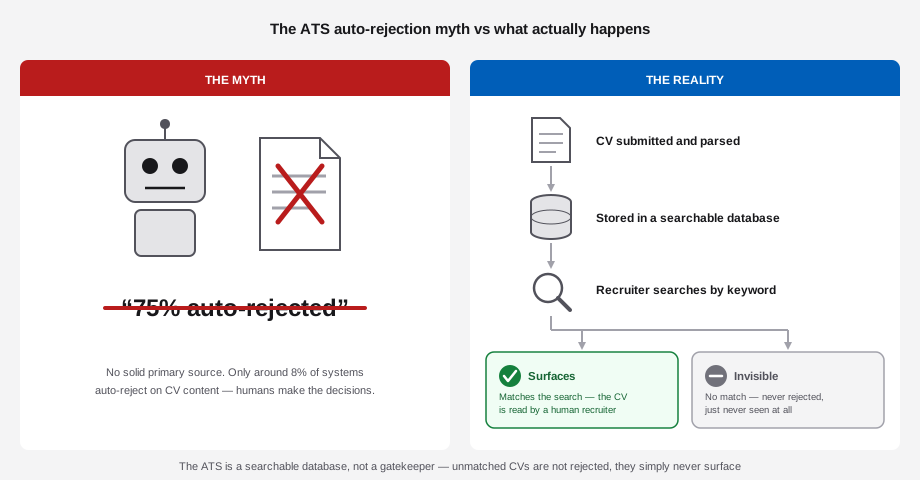
- A 2025 study by Enhancv interviewed 25 recruiters across company sizes and found only 8% had configured their ATS to auto-reject applications based on CV content or match scores. The other 92% said rejections are made manually by a human. Those recruiters were US-based, but they run the same platforms UK employers use, and the configuration options are identical here.
- The genuine automatic filters are knockout questions - the yes/no eligibility checks on application forms, such as right to work in the UK, essential certifications, or location. Every recruiter in the study used these. They act on your form answers, not your CV formatting.
- The often-cited Harvard Business School "Hidden Workers" research (2021) found that more than 90% of employers use their ATS to rank and filter candidates - but ranking and filtering is not the same as automatic rejection. A human still decides.
So if a recruiter never calls, it usually is not because a robot binned your CV. It is because your CV never came up when they searched - or because you fell at a knockout question before your CV was even considered.
Why you still need an ATS-friendly CV
Here is where the myth-busting stops and the practical reality begins. The same Harvard research found that 88% of employers believe they lose highly qualified candidates because those candidates' CVs are not ATS-friendly - they don't match the criteria or keywords the system is set to search for.
Both things are true at once. The ATS rarely rejects you. And ATS-unfriendly CVs still cost qualified candidates jobs. The mechanism is invisibility, not rejection:
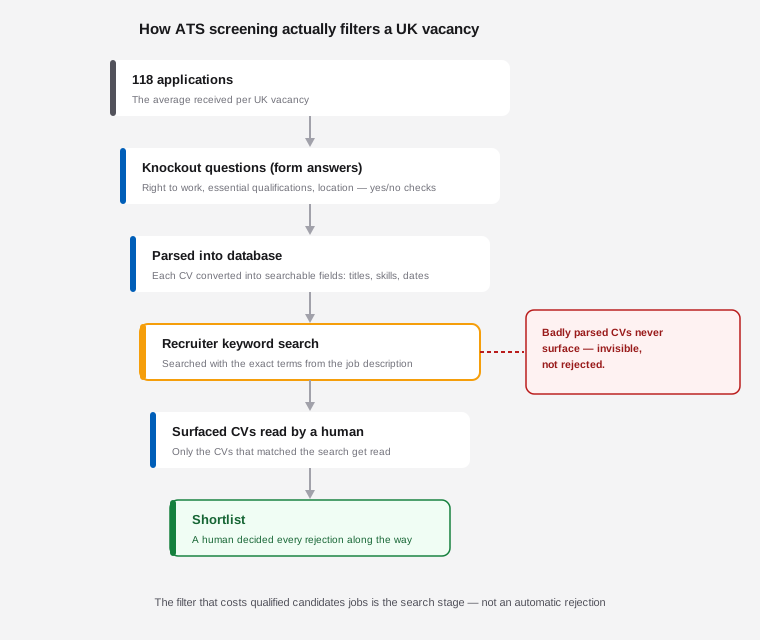
- Parse failure makes you unsearchable. A two-column layout gets merged left-to-right into jumbled text by most parsers. Contact details in the document header are often skipped entirely. Content in tables can be lost. If your job titles and skills parsed into garbage, a recruiter's search for "management accountant" or "SEN teaching assistant" will never return your application.
- Missing keywords keep you buried. Recruiters search the database using the exact terms from the job description. If the advert says "stakeholder management" and your CV says "worked with senior colleagues," you don't match the search - regardless of whether you have the experience. Our guide to finding and using ATS keywords covers how to fix this systematically.
- Ranking pushes you down the pile. Even where nothing is rejected, most systems rank candidates by match. With 118 applicants and a tired human reviewing the top of the list, ranking 90th is functionally identical to rejection.
The outcome for the job seeker is the same either way: silence. Which is why "the ATS rejected me" and "the ATS never surfaced me" feel identical from the outside - but only one of them is something you can fix with formatting and keywords.
Who genuinely needs to care - and who can relax
Not every application in the UK passes through ATS screening in the same way. Be honest with yourself about where your applications are actually going:
You need an ATS-friendly CV if you are applying to:
- Large UK employers - FTSE 100 companies, the big banks, the Big 4, major retailers - where ATS screening is standard
- The NHS or Civil Service, where structured systems score applications against person specifications (see our NHS ATS CV guide for the specifics)
- Any role via a job board like Reed, Totaljobs, or LinkedIn Jobs, where applications route into the employer's ATS
- Recruitment agencies, which run their own candidate databases and search them constantly
You can worry less if you are:
- Applying to a small local business where the owner reads every CV personally
- Being referred directly by someone who hands your CV to the hiring manager
- In a field where portfolios or work samples drive hiring decisions more than CVs
For most UK job seekers applying to advertised vacancies, the first list is where the volume is. And here is the thing the myth-busters sometimes underplay: an ATS-friendly CV costs you nothing with a human reader. Clean single-column formatting, standard headings, and concrete keyword-rich bullet points are exactly what recruiters say they want to see anyway. There is no trade-off.
What "ATS-friendly" actually means (and what it doesn't)
ATS-friendly is not a secret trick, white text stuffed with keywords, or a magic template. It is a short list of unglamorous rules:
- Single-column layout - no tables, no text boxes, no multi-column designs
- Contact details in the document body, never in the header or footer
- A clear professional title directly below your name
- Standard section headings: Experience, Education, Skills
- Standard round bullets, not arrows or icons
- The role's real keywords, used naturally in your bullet points where your experience genuinely supports them
What it does not mean: keyword stuffing (recruiters spot it instantly and it reads badly), hidden text (parsers extract it into plain view, which looks dishonest), or obsessing over a third-party "ATS score" (employers never see those scores - they are self-check tools, nothing more).
If your CV already follows the rules above and you are still getting silence, formatting probably is not your problem - our post on why your CV isn't getting responses diagnoses the other common causes.
FAQ
Does ATS software automatically reject CVs in the UK?
Rarely on CV content. The best available data is a 2025 Enhancv study of US recruiters, which found only around 8% had configured their ATS to auto-reject based on CV content or match scores; the same platforms and configuration options are used by UK employers. The genuine automatic filters are knockout questions on application forms - right to work, essential qualifications, location. Human recruiters make the decisions on CVs themselves.
If the ATS doesn't reject me, why does an ATS-friendly CV matter?
Because recruiters search the ATS database rather than reading every application. If your CV parsed badly or doesn't contain the keywords they search for, it never surfaces - it isn't rejected, it's invisible. 88% of employers say they lose qualified candidates exactly this way.
Is a PDF CV safe for ATS?
Generally yes - modern ATS platforms parse text-based PDFs and Word documents. The risk isn't the file format but the layout inside it: columns, tables, headers, and graphics cause parse failures in any format. A scanned or image-based PDF, however, contains no readable text and will fail.
Do ATS-friendly CVs look worse to human recruiters?
No - the opposite. Recruiters consistently say they prefer clear, skimmable, single-column CVs with concise bullet points. The formatting that parses cleanly is the same formatting a busy human can scan in 30 seconds. There is no trade-off between ATS-friendly and human-friendly.
Should I pay for an ATS-friendly CV rewrite?
Only if it is honest about what it does. Avoid anything promising to "beat the ATS" with tricks - there is no trick. A legitimate rewrite fixes parsing problems, integrates the keywords your real experience supports, and keeps everything truthful. That is a formatting and language job, not a loophole.
Shadow CV shows you exactly what an ATS parser extracts from your CV - the jumbled columns, the skipped headers, the missing keywords - then rewrites it so you surface when recruiters search, for £5, once, with no subscription. See your CV through the ATS's eyes - free scan, no account needed.