Key Takeaways
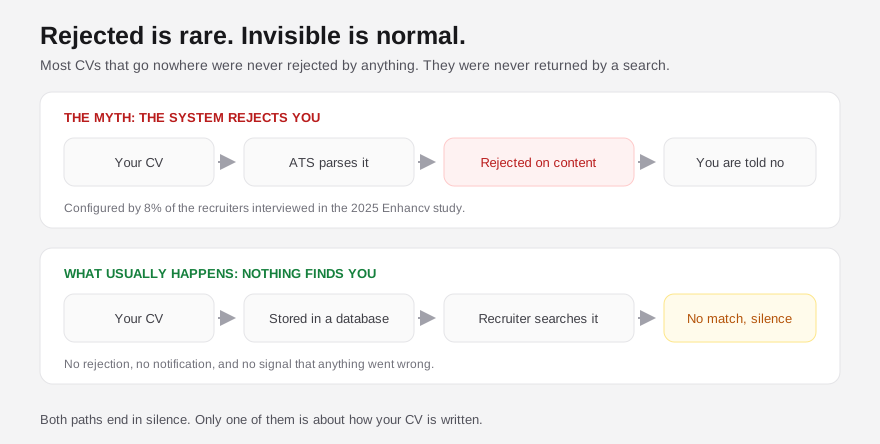
- The biggest ATS myths overstate automatic rejection and understate invisibility - most CVs are not rejected by software, they are never surfaced to a recruiter at all.
- Hidden keywords, plain-text CVs and chasing checker scores fix problems you do not have.
- Parse cleanly, use the employer's own wording, and you have covered what matters.
Bad ATS advice is worse than no ATS advice, because it feels like action. You spend an evening stripping every bit of formatting out of your CV, or hiding keywords in white text, and you finish convinced you have solved something. The applications still go nowhere, because the ATS myths that circulate in UK career advice mostly point at the wrong problem. ATS software is standard at large employers - Jobscan detected one at 97.4% of Fortune 500 companies in 2026 - so the software is real and it does shape your chances - just not in the way the folklore says.
Here are six myths worth unlearning, and what actually happens instead.
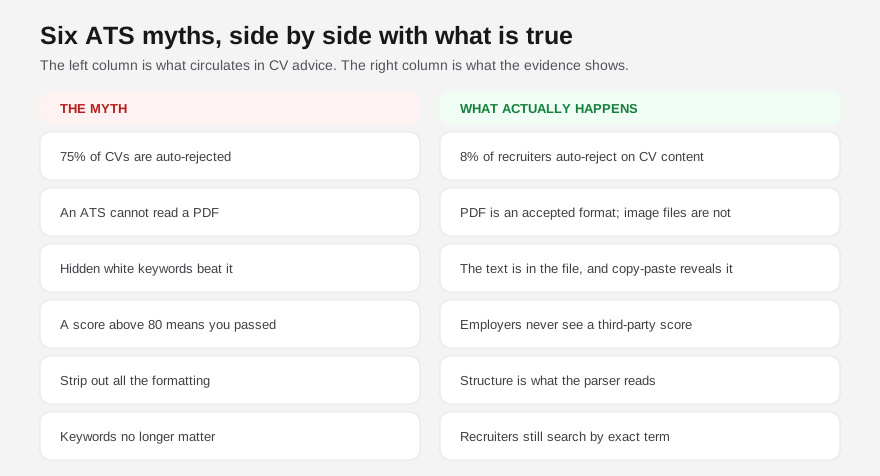
Myth 1: 75% of CVs are auto-rejected before a human sees them
This is the most quoted statistic in CV advice and the least supported. The figure comes from the marketing of Preptel, a CV-optimisation company that promoted it around 2012, shut down in 2013, and never published a study, a dataset or a method behind it. It then travelled through blog after blog, each one citing the last, until it acquired the authority of a fact.
When someone has actually asked recruiters, the picture is different. A 2025 Enhancv study that interviewed 25 US-based recruiters and talent acquisition professionals found only 8% had configured their ATS to auto-reject applications based on CV content or match scores. The rest reject manually, or use knockout questions on the application form - right to work, essential qualifications, location - which are genuine automatic filters, but have nothing to do with how your CV is written.
That does not mean automated rejection never happens. In March 2026 the ICO reported that many UK employers running automated recruitment are making solely automated decisions without recognising it, citing a survey of 1,000 UK HR professionals in which 37% automated rejections entirely. The 75% figure remains invented; the narrower, better-evidenced claim is that solely automated rejection is real and concentrated at the bottom of the score distribution - and where it happens, you can ask for a human review.
Why this myth hurts you: it frames the ATS as an adversary to be tricked, which leads directly to myths 3 and 4. The real failure mode is quieter and covered in our honest look at whether you need an ATS-friendly CV: your CV is not rejected, it simply never appears in the recruiter's search results.
Myth 2: applicant tracking systems cannot read PDFs
Greenhouse, one of the ATS platforms used widely by UK employers, lists its accepted candidate upload formats as .doc, .docx, .pdf, .rtf and .txt. PDF is on the list. It has been on the list for years.
What is true is narrower and more useful. A PDF exported from Word or Google Docs contains a real text layer and parses fine. A PDF that is really an image - exported from a design tool, scanned, or produced by photographing a printed page - has no text to extract, and the parser gets nothing. Greenhouse names exactly this in its parse-failure documentation: a CV uploaded as an image rather than a document.
There is a second trap that has nothing to do with format. Greenhouse accepts uploads up to 100MB but states it cannot parse a CV larger than 2.5MB. A CV heavy with embedded images can upload with every sign of success and never be parsed at all. Which format to send in which situation - direct application, agency, job board - is a separate question, answered in our guide to whether your CV should be a PDF or a Word document.
Why this myth hurts you: it sends people converting perfectly good files back and forth while ignoring the thing that actually breaks the parse - layout. The mechanics are set out in detail in what an ATS actually does with your CV.
Myth 3: hidden white-text keywords beat the filter
The trick is to paste the job advert's keyword list into your CV in white text on a white background, invisible to a human, readable to the machine. It resurfaces on social media every few months as a clever hack.
It is not clever, for a simple mechanical reason: the text is in the file. Colour is a display instruction, not a deletion. Anyone who selects all and pastes your CV into a plain document - which recruiters do routinely to strip formatting - sees the hidden block immediately. Some ATS platforms flag text whose colour matches the background as suspicious formatting. And if the hidden keywords describe skills you do not have, you have moved from optimisation into fabrication, which is a different problem entirely.
The upside is capped even when it works. Getting surfaced for a role you cannot do wastes an interview slot and your afternoon.
Key point: Every myth on this list shares one assumption - that the ATS is a test to be passed. It is a database to be found in. Those call for completely different tactics.
Myth 4: an ATS score tells you whether you passed
Third-party ATS checkers hand you a number out of 100 and imply a pass mark sits somewhere around 80. Employers never see that number. It is generated by separate software making an estimate, against no standard, for a vacancy it knows nothing about.
Scores inside real ATS platforms are not much more decisive. The same Enhancv study found 44% of recruiters had an AI or "fit" score available in their ATS, most commonly in Lever, Greenhouse, Teamtailor or Phenom. Of those who had it, most treated it as a guide and checked candidates manually anyway, and 56% either ignored the feature or did not have it. There is no universal pass mark because there is no universal test - each employer configures its own search terms and criteria per vacancy.
Why this myth hurts you: it turns a diagnostic into a target. A score is useful for spotting that your CV failed to parse or missed the role's core vocabulary. It is useless as a thing to maximise. How to tell whether your CV passed ATS screening works through the signals that carry real information.
Myth 5: ATS-friendly means stripping out all formatting
This is the over-correction, and it produces genuinely worse CVs: no bold, no section headings, everything in one undifferentiated block of Arial, on the theory that formatting confuses the parser.
Formatting is how the parser works out what your CV says. It reads structure - a heading called "Work Experience", a date range, a job title, a bullet under an employer - and uses that structure to file each piece of information in the right field. Remove the structure and you have not made the CV easier to read; you have removed the signposts. A CV formatted differently from one section to the next appears on Greenhouse's own list of parse failures.
What actually causes trouble is a narrow set of layout features: multiple columns, tables, text boxes, contact details in the header or footer, and graphics. Bold text, standard headings and ordinary bullet points are all safe. Two sides of A4, one column, real text.
Myth 6: keywords do not matter because modern systems understand meaning
Semantic matching exists, and some platforms do it reasonably well. It does not change what the recruiter does, which is type specific terms into a search box and read what comes back. If the vacancy calls it "management accounting" and your CV says "financial reporting", a Boolean search for the former will not return you - regardless of how similar the two are in principle.
This is why the wording on the advert matters more than the wording you prefer. Mirror the employer's terms where they honestly describe what you did, and include both forms where a field has two names (CIPD and "Chartered Institute of Personnel and Development", SEO and "search engine optimisation"). Our guide to finding and using ATS keywords covers where in the CV each term carries the most weight.
What is actually worth your time
Strip the myths away and the list of things that matter is short:
- Make sure the file parses. Single column, no tables or text boxes, contact details in the body, a real text layer, under 2.5MB.
- Use the employer's vocabulary. Job title, core skills and qualifications in the words the advert uses.
- Put the important material high. Recruiters skim the top third first, and so does anyone scanning search results.
- Check the output, not the score. If the parsed version of your CV is missing your job titles or dates, nothing else you do will help.
None of that involves outsmarting anything.
FAQ
Does an ATS automatically reject my CV in the UK?
Rarely on the basis of CV content. The best available data is a 2025 Enhancv study of US recruiters, which found only 8% had configured content-based auto-rejection; UK platforms and practice are broadly comparable. The genuine automatic filters are knockout questions on the application form covering right to work, essential qualifications and location.
Is it safe to send a PDF CV to a UK employer?
Yes, for a text-based PDF exported from Word or Google Docs. Greenhouse and other major platforms accept PDF alongside .doc, .docx, .rtf and .txt. What fails is a PDF that is really an image, and any file over the 2.5MB parse limit.
Can recruiters tell if I have hidden keywords in white text?
Easily. The text is still in the file, so it appears the moment anyone copies the CV into a plain document - something recruiters do routinely to strip formatting. Some ATS platforms also flag text coloured to match the background.
What ATS score do I need to pass?
There is no pass mark, because there is no single test. Third-party checker scores are estimates employers never see, and match scores inside real ATS platforms are advisory - most recruiters who have the feature treat it as a guide rather than a decision.
Do I still need keywords if the ATS understands context?
Yes. Recruiters search the database with specific terms, and a search returns what matches those terms. Semantic matching does not change what a recruiter types into the search box.
Check what your CV actually does
The fastest way past all six myths is to stop guessing what the software sees. Run a free scan of your CV - Shadow CV parses it the way an ATS would, shows you what survived the parse, and lists the keywords your target role expects but your CV does not contain. If the scan finds real problems, the £5 rewrite fixes the parsing and works the missing terms in naturally, once, with no monthly subscription.