Key Takeaways
- An NHS ATS CV must mirror the exact wording of the job's person specification - Trac and NHS Jobs score every application against its essential criteria before a human reviews it.
- Use single-column formatting, standard headings, and include your professional registration number.
- Tailor every application; a generic CV consistently scores lower.
Applying for an NHS job is not like applying anywhere else. The NHS is the UK's largest employer - and it uses a tightly structured recruitment process that filters candidates through an Applicant Tracking System (ATS) before a human ever sees your name.
Get the format wrong, miss the right keywords, or ignore the person specification, and your CV goes straight into the rejection pile - automatically, before anyone has read a word.
This guide explains exactly how the NHS ATS works in 2026, what you need to include in your CV, and how to match your experience to the criteria that matter.
For background on how ATS software works across the board, read how an ATS reads your CV and what it scores.
How the NHS Recruits: Trac and NHS Jobs
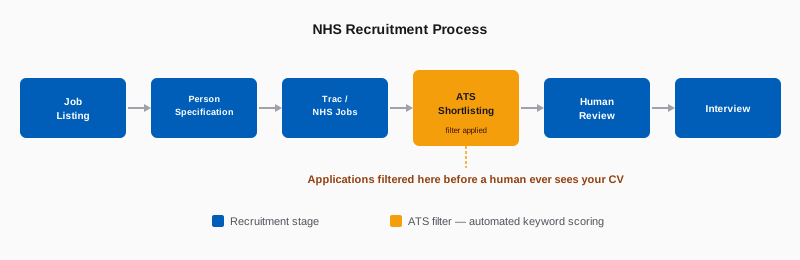
Most NHS Trusts in England and Wales use one of two systems to process applications:
- NHS Jobs - the central NHS recruitment portal at jobs.nhs.uk
- Trac - a specialist NHS recruitment platform used by the majority of NHS Trusts
Both systems are ATS platforms. When you apply, your application is scored electronically against the criteria in the job's person specification before it reaches a recruiter. If your application doesn't demonstrate the essential criteria clearly enough, the system - or a recruiter following the system's shortlisting matrix - will filter you out.
This matters for your CV in a specific way: unlike a private sector application where your CV leads, NHS applications are built around an application form and a Supporting Information section. Your CV is supplementary - but it still needs to pass the ATS filter and, crucially, support your Supporting Information with hard evidence.
Key point: The NHS person specification is the algorithm. Every essential criterion is a keyword gate. Miss it, and you are out.
What the NHS ATS Is Actually Looking For
The Person Specification
Every NHS vacancy comes with a Person Specification - a document listing the Essential and Desirable criteria for the role. These criteria fall into categories such as:
- Qualifications and training
- Experience
- Skills and knowledge
- Personal qualities
- Values and behaviours (aligned to the NHS Constitution)
The ATS - and the recruiter following the shortlisting matrix - scores your application against each Essential criterion. You must provide clear evidence for every single one. If you leave an Essential criterion unanswered, you will not be shortlisted, regardless of how experienced you are.
Keywords That Pass the Filter
The ATS scans for language that matches the person specification. This means:
- Use the exact phrases from the person specification, not your own paraphrases
- If the spec says "experience of working in a multidisciplinary team," use that phrase - not "team environment" or "collaborative role"
- Repeat high-priority criteria naturally across your CV and Supporting Information
- Include your qualifications exactly as listed (e.g. "NMC registered" not just "registered nurse")
For a deeper look at finding and using the right keywords, read How to find and use ATS keywords in your CV.
How to Format Your CV for NHS ATS Compatibility
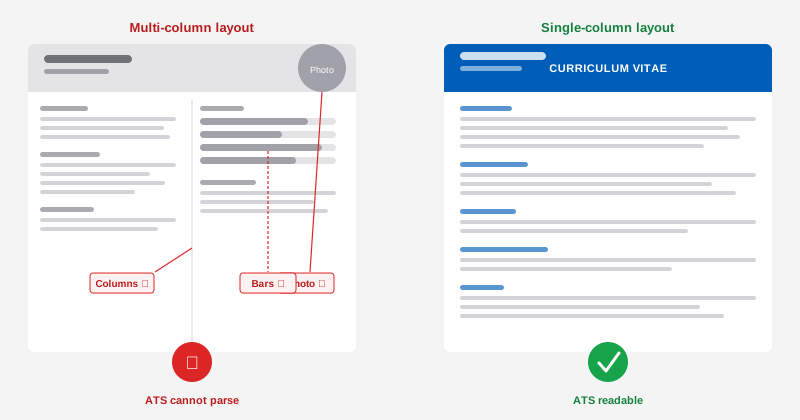
NHS ATS systems parse plain text. Anything that confuses the parser - graphics, tables, text boxes, columns - risks your content being scrambled or dropped entirely.
Formatting Rules
Do:
- Use a single-column layout
- Use standard fonts: Arial, Calibri, or Times New Roman at 11–12pt, the range UK guidance sets out for CV font size
- Use standard section headings: Personal Statement, Work Experience, Education, Skills, References
- Save as a PDF or Word document (.docx) - check the job listing for preference
- Keep it to two pages maximum (one page for early-career roles)
Don't:
- Use tables, text boxes, or columns - these break ATS parsing
- Include photos, logos, or decorative graphics
- Use headers and footers for key content (some parsers skip these)
- Use fancy section headings like "My Journey" or "What I Bring" - stick to standard titles the ATS recognises
If your current CV breaks several of these rules at once, rebuilding is usually faster than patching it. Our free CV builder only produces single-column, parse-safe layouts with standard headings, and exports to .docx - so the formatting rules above are handled for you.
CV Structure for NHS Applications
-
Personal Details - Name, phone, email, NMC/HCPC/GMC registration number (if applicable)
-
Personal Statement (4–6 lines) - Brief summary tied to the role, mirroring language from the person specification
-
Work Experience (reverse chronological) - Job title, Employer, Dates. Three to five bullet points per role, each demonstrating a person spec criterion.
-
Education and Qualifications - All relevant qualifications with full titles (e.g. BSc (Hons) Nursing)
-
Professional Registration - Registration body, PIN/number, renewal date
-
Skills and Training - Mandatory training (BLS, safeguarding levels, manual handling) and IT systems (SystmOne, EMIS, EPR as relevant)
-
References - Two professional referees, including your most recent NHS line manager
Two of those sections carry their own detailed guides: what your personal statement should actually say in its four to six lines, and how to explain any employment gaps in your work history as dated entries rather than silent holes - NHS pre-employment checks review your history, so a gap left unexplained gets queried later anyway.
Writing Bullet Points That Pass ATS and Impress Recruiters
Your bullet points need to do two things simultaneously: trigger the ATS keyword match, and give a human recruiter evidence they can tick against the shortlisting matrix.
The formula that works is: Action verb + specific task + measurable outcome or context
Examples by NHS Role Type
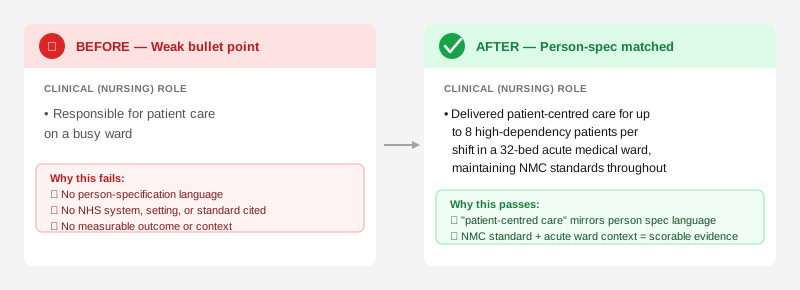
Clinical (Nursing, AHP):
- ❌ "Responsible for patient care on a busy ward"
- ✅ "Delivered patient-centred care for up to 8 high-dependency patients per shift in a 32-bed acute medical ward, maintaining NMC standards throughout"
Administrative:
- ❌ "Answered phones and dealt with queries"
- ✅ "Managed a high-volume NHS appointment scheduling system (SystmOne), processing 60+ calls daily and reducing appointment DNA rates by 12%"
Managerial (Band 7+):
- ❌ "Led a team of staff"
- ✅ "Line-managed a multidisciplinary team of 14 across two community sites, conducting monthly 1:1 appraisals and delivering mandatory training compliance above Trust target"
Notice how each improved example:
- Uses terminology from NHS person specifications
- Includes a specific NHS system, setting, or standard
- Provides a measurable context or outcome
For more on writing ATS-effective bullet points, read How to write CV bullet points that pass ATS.
NHS Values: The Hidden ATS Criteria
Every NHS role - clinical or non-clinical - requires candidates to demonstrate the NHS Constitution values:
- Working together for patients
- Respect and dignity
- Commitment to quality of care
- Compassion
- Improving lives
- Everyone counts
Many person specifications include a behavioural criterion phrased as "demonstrates commitment to NHS values" or "evidence of patient-centred approach." This is an ATS keyword gate that many candidates miss because it doesn't feel like a skills criterion.
How to address it: Include one bullet point per role that explicitly references patient-centred care, dignity, or collaborative working - using that language directly.
The same criterion usually appears again in the supporting statement, where you have room to evidence it properly rather than in a single bullet. Our NHS nurse supporting statement guide works through mapping each person-specification criterion - values included - to evidence a shortlisting panel can score.
Common Mistakes That Get NHS CVs Rejected
1. Generic CV, Not Tailored to the Banding
NHS roles are banded (Band 2 through to Band 9). The expectations at Band 5 are materially different from Band 6. A generic CV that doesn't reflect the level of responsibility, autonomy, and clinical decision-making expected at your target band will be scored low by shortlisters - even if it passes the initial ATS filter.
2. Missing the Person Specification Entirely
It is surprisingly common to see candidates apply with a CV written for a private sector role, with no reference to the person specification. Every bullet point should, where possible, trace back to an Essential criterion.
3. Ignoring Registration and Compliance Details
If the role requires NMC, HCPC, or GMC registration, your registration number must appear prominently. If mandatory training is listed in the person specification (safeguarding level 3, BLS, information governance), it must appear in your CV. These are non-negotiable ATS filters.
4. Using Private Sector Terminology
Phrases like "P&L responsibility," "commercial acumen," or "revenue targets" have no place in an NHS CV. Use NHS-native language: "budget management within NHS financial governance frameworks," "service improvement," "pathway redesign."
5. Submitting a CV Designed for Design, Not Parsing
Multi-column CVs with infographic skill bars, profile photos, and decorative layouts are popular on sites like Canva. They look impressive to a human but are unreadable to an ATS. Stick to plain, structured formatting.
Check your CV's ATS compatibility - free scan, no account needed.
NHS CV Checklist Before You Submit
Run through this list against the person specification before every application:
- Every Essential criterion is evidenced - each one traceable to a specific bullet point or your Supporting Information.
- The wording matches the person specification - the spec's exact phrases, not your paraphrases.
- Registration details are prominent - NMC/HCPC/GMC number and renewal date, if the role requires them.
- Mandatory training is listed - safeguarding level, BLS, information governance, exactly as the spec names them.
- NHS values appear in your bullets - at least one bullet per role referencing patient-centred care, dignity, or collaborative working.
- Formatting is parseable - single column, standard headings, no tables, text boxes, or graphics.
- Length is right for the band - two pages for most roles, one for Band 2–3.
If any item fails, fix it before submitting - Trac scores what it parses, and the shortlisting matrix has no column for "probably meant to include it".
FAQ
Does the NHS actually use ATS to filter CVs?
Yes. The NHS uses two primary ATS platforms - NHS Jobs and Trac - across its Trusts in England and Wales. Applications are shortlisted against the person specification, often using an electronic scoring matrix. CVs that don't match the essential criteria language are filtered out before a recruiter reviews them.
What is the Trac system in NHS recruitment?
Trac is a specialist NHS Applicant Tracking System used by the majority of NHS Trusts. It handles vacancy posting, application collection, shortlisting, interview scheduling, and pre-employment checks. When you apply via Trac, your application is scored against the person specification criteria during the shortlisting phase.
How long should an NHS CV be?
Two pages maximum for most roles. One page for early-career or Band 2–3 roles. Senior roles (Band 8+) may run to three pages if there is substantial experience to evidence - but keep it tight and evidence-focused. For the general UK standard and how to cut to two pages without losing keywords, see how long a CV should be in the UK.
Do I need to tailor my CV for every NHS job?
Yes - every time. The person specification changes role-by-role and Trust-by-Trust. The essential criteria, the NHS values language, the specific systems and qualifications required all vary. A generic CV will consistently underperform a tailored one in ATS shortlisting.
What's the difference between an NHS CV and a private sector CV?
NHS CVs are structured around person specification criteria rather than achievements alone. They must use NHS-native terminology, include professional registration details, reference NHS values, and list mandatory training compliance. The formatting must be ATS-parseable - no design-heavy layouts.
Get Your NHS CV ATS-Ready
Writing an NHS CV that passes the ATS filter and impresses a recruiter takes time, knowledge of NHS systems, and careful attention to the person specification. Miss any of it and you won't even reach the shortlist.
Scan your NHS CV free - Shadow CV checks it against ATS requirements and shows you exactly what's costing you points. The £5 rewrite makes it formatted correctly, keyword-rich, and ready to submit - once, with no monthly subscription.