Key Takeaways
- Remove personal details that invite bias and do no work: age, date of birth, marital status, nationality, a photo, and your full postal address.
- Cut filler lines, duty-only bullets, and old roles that no longer support your application.
- Never remove the keywords, dates, employer names, or contact details the system needs to rank you.
Most CV advice tells you what to add. The faster improvement is usually subtraction: a UK CV carries a surprising amount of material that no recruiter reads, no Applicant Tracking System scores, and no employer is allowed to consider anyway. Knowing what to remove from your CV frees the space that decides whether your strongest evidence sits in the top third of page one or three inches below it.
The National Careers Service - the government's own careers guidance - is direct about the personal details question. Its CV guidance states you should not include "your age, your date of birth, whether you're married or your nationality." That single sentence disposes of four things that still appear on a large share of the CVs we scan. Removing them is not the same as concealing your age, though, and the distinction matters if you are over 50 - the popular next step of stripping the dates out of your work history breaks the parser rather than the assumption.
What to remove from your CV: the short list
Everything below falls into four groups. The first two are near-universal deletions. The third depends on your history, and the fourth is about formatting rather than content.
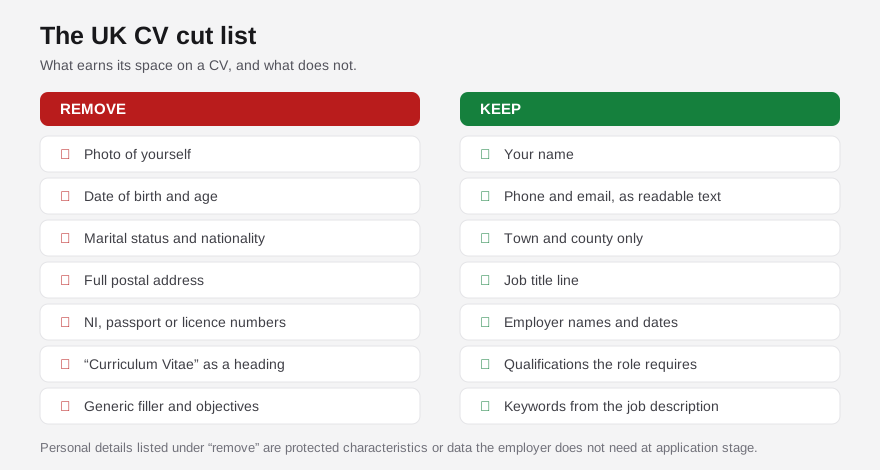
- Personal details that identify a protected characteristic rather than a skill
- Filler lines that occupy space without making a claim
- History that no longer supports the job you are applying for
- Formatting elements that break the parse before anyone reads a word
Personal details that should not be on a UK CV
The UK convention here is different from much of continental Europe, and it is not simply etiquette - it follows from equality law.
Age, disability, gender reassignment, marriage and civil partnership, pregnancy and maternity, race (which includes nationality), religion or belief, sex and sexual orientation are the nine protected characteristics under the Equality Act 2010. An employer cannot lawfully make a recruitment decision on any of them. Putting them on your CV does not help you and hands the employer information they have to actively disregard. Disability is the one with its own formal routes for disclosure, and those sit on the application form: whether to disclose a disability on your CV covers where they are and what each one does.
Remove these:
- Your photo. UK employers do not expect one, and many large ones actively strip identifying material before shortlisting. The Civil Service anonymises applications for all roles below Senior Civil Service level, so a photo either gets removed or flags your application as unfamiliar with the process.
- Your date of birth and age. Explicitly named in the National Careers Service guidance as something to leave out.
- Marital status and nationality. Also named in that guidance. Your right to work is a separate question the employer will ask directly on the application form, and the one line about it that does belong on a CV is not your nationality.
- Any mention of a criminal record. It follows the same logic and is asked the same way, on a declaration field or at interview rather than inferred from your CV. What you actually have to declare, and when turns on whether the conviction is spent and whether the role is exempt.
- Your full postal address. A town and county is enough - "Leeds, West Yorkshire". The full address gives away nothing useful and is more personal data than the application needs.
- Your National Insurance number, passport number, or driving licence number. These belong in onboarding paperwork, never on a document you email to strangers.
- Gendered titles. "Mr", "Mrs", "Ms" before your name serve no purpose on a CV.
Key point: A driving licence is worth mentioning when the job requires one - "Full UK driving licence" as a line in your skills section. The licence number is not.
The filler lines that quietly waste space
These are the phrases that appear on CV after CV and carry no information a recruiter can act on.
"Curriculum Vitae" as a heading. The recruiter knows what they opened. Your name is the heading.
Generic self-description. "Hardworking team player with excellent communication skills who thinks outside the box." Every candidate writes some version of this, which is precisely why it does not distinguish you. Replace it with a profile that names your specialism, your years in it, and one concrete claim. The same adjectives tend to reappear further down in a skills list, where they do no more work - which skills genuinely belong in that section is a question worth settling before you cut anything else.
The objective statement. "Seeking a challenging role in a forward-thinking organisation where I can develop my skills." This describes what you want. The employer is reading to find out what you offer.
Referees' contact details. Here the guidance is more nuanced than the internet suggests. The National Careers Service actually advises against listing referees' contact details and suggests writing that references are available on request instead. So the line is not a mistake - but it is also doing no work, because every UK employer already assumes references come later. If space is tight, the phrase is a safe cut. If you have room, leaving it in costs you nothing. What matters is that you do not publish a former manager's phone number to every employer you apply to - when UK employers actually take up references, it is at the offer stage, through a form that asks for them.
Skill ratings and star bars. Five stars next to "Excel" is self-assessment presented as measurement, and the graphic itself is usually invisible to the parser. Name the skill and evidence it in a bullet instead.
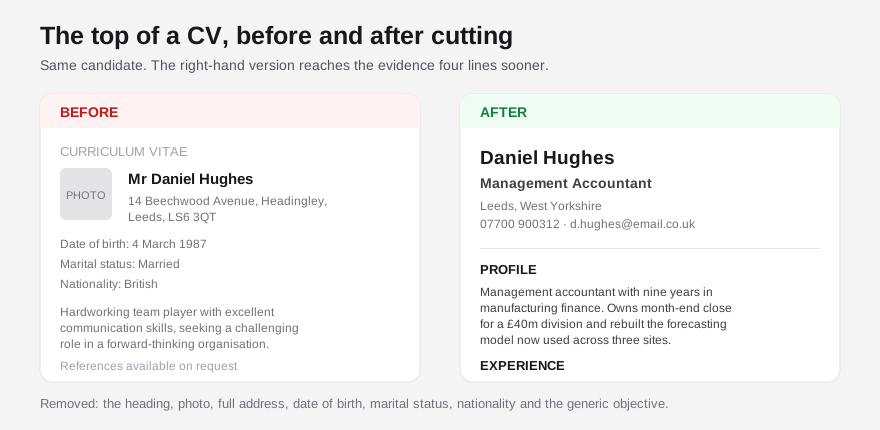
Applied to the top of a real CV, the difference is roughly a third of page one:

What to cut from your work history
This is where most CVs regain a genuine half-page.
- Roles older than 10 to 15 years. Compress them into a single "Earlier career" block with job titles, employers, and dates. The detail from 2008 rarely earns the space it takes.
- Early jobs unrelated to your target role. If you have ten years in accountancy, the Saturday retail job can go - unless you are early enough in your career that it is real evidence of reliability.
- Duty-only bullets. "Responsible for managing the team inbox" states a task, not a result. Our CV bullet points guide covers the action-plus-outcome formula that replaces these.
- Module lists and individual GCSE grades. Once you have a degree and a few years of experience, "9 GCSEs including English and Maths (grades A–C)" is a single line, not a table. The compressed formats for each career stage are in our CV education section guide.
- Every training certificate you have ever collected. Keep the ones that are relevant, current, or legally required for the role. A 2011 half-day workshop is padding.
- Hobbies that reveal nothing. "Socialising with friends, reading, cinema" is filler. A hobby earns its place when it demonstrates something the job values - a committee role, a sports team you captain, a technical side project.
Cutting length is not the whole point, but it helps: the two-page UK standard exists because attention is finite, and everything you delete moves your strongest material closer to the top.
Formatting elements to remove so the ATS can read your CV
Some deletions are not editorial at all. They are about whether the text survives extraction.
- Tables and multi-column layouts. Most parsers flatten a two-column CV by reading left to right across both columns, producing interleaved nonsense.
- Text boxes and shapes. Text inside a drawing object frequently does not come out in the extracted text at all.
- Contact details in the document header or footer. Some parsers ignore the header region entirely, which means your phone number and email vanish.
- Icons, logos, and decorative graphics. An envelope icon is not an email address to a machine - the address next to it needs to be readable text.
- Unusual fonts and non-standard bullet symbols. Standard bullets and common fonts extract reliably. Decorative characters can come through as replacement symbols.
ATS software is standard at large employers, so this is not a niche concern. Our breakdown of what an ATS actually does with your CV walks through the extraction stage where these elements fail.
What you should never remove
Trimming can go too far. Four things stay, regardless of how tight the page is getting.
- Keywords from the job description. These determine whether you appear in a recruiter's database search at all. Cut adjectives and repetition, never the terms the advert uses for skills you genuinely have.
- Employment dates. Removing dates to hide a gap or your career length is the change most likely to be read as concealment - and gaps are far more normal than they were a decade ago.
- Employer names and job titles. These anchor the whole document, and job titles are among the most searched fields in an ATS.
- Your contact details. Obvious, and yet a phone number stranded in a document header is functionally a missing phone number.
The line between tightening a CV and misrepresenting one matters here. Our guide on rewriting your CV without lying covers where that boundary sits.
FAQ
Should I put a photo on my CV in the UK?
No. UK employers do not expect a photo, and many large organisations anonymise applications before shortlisting - the Civil Service does this for every role below Senior Civil Service level. A photo adds a file size and a bias risk without adding any evidence of your ability to do the job.
Do I need to put my date of birth on my CV?
No. National Careers Service guidance explicitly says not to include your age or date of birth. Age is a protected characteristic under the Equality Act 2010, so an employer cannot lawfully base a hiring decision on it. Employers who need your date of birth for pre-employment checks will ask after an offer.
Should I write "references available on request"?
It is optional. National Careers Service guidance suggests writing that references are available on request rather than listing referees' contact details, so the phrase is not wrong. It is also not doing much, because employers assume it. Cut it if you need the space, keep it if you do not - but never publish a referee's contact details on the CV itself.
Should I include my full address on my CV?
Town and county is enough. Recruiters use location to check you are within commuting distance or eligible for a region-based role, and a town gives them that. Your full street address is personal data that serves no purpose at the application stage.
How much can I safely cut from my CV?
Until only the material that supports this application is left. In practice most CVs lose the personal details block, the objective statement, the older roles' bullet detail, and the hobbies section - often half a page - without losing anything a recruiter would have valued. The test is whether a cut removes a keyword or a piece of evidence. If it does not, it can go.
See what is actually costing you points
The hard part of cutting a CV is that you cannot see it the way the software does. A photo you are proud of, a header you spent time formatting, a skills bar chart - on your screen they look polished. In the extracted text an employer's system reads, some of it is invisible and the rest is pushing your evidence down the page.
Scan your CV free - Shadow CV reads it the way an ATS does and shows you exactly what parses, what disappears, and which keywords are missing. The £5 rewrite strips what is costing you points and rebuilds the CV around the material that earns them - once, with no monthly subscription.