Key Takeaways
- The most common advice for a CV over 50 - strip the dates, go skills-based, rename old job titles - makes the document worse, not younger.
- Dates are required by National Careers Service guidance and are what an ATS uses to calculate your experience.
- Age-proofing that works is about weighting recent relevance, not concealing history.
Almost every guide to writing a CV over 50 gives the same three instructions: delete the dates, switch to a skills-based layout, and update your old job titles to modern equivalents. All three are aimed at a recruiter forming a snap judgement about your age. All three ignore the software sitting between you and that recruiter, and each one damages how that software reads you. The result is a CV that is no less obviously written by someone over 50, and considerably harder to parse.
There is a version of age-proofing that works. It has nothing to do with hiding anything.
Does being over 50 actually count against you in the UK?
The concern is well founded, and there is UK evidence behind it. The Centre for Ageing Better's 2021 report Too much experience: Older workers' perceptions of ageism in the recruitment process found that 36% of 50-69 year olds feel at a disadvantage applying for jobs because of their age. The same organisation puts the scale of the group in context: a third of the workforce in England is aged 50 or over, close to 9 million workers.
The legal position matters here, because much CV advice is written as though age bias were simply a fact of life to be worked around. Under the Equality Act 2010, age is a protected characteristic, and gov.uk states plainly that it is against the law to discriminate against anyone because of age. That covers recruitment, not just employment. Age UK makes the same point in its guidance for older job seekers and draws the practical conclusion: do not hide your qualifications or experience out of fear of discrimination.
None of that makes bias disappear. But it changes what the CV is for. Your CV is not a disguise. It is the document that has to survive a parser, surface in a database search, and then give a recruiter a reason to call you.
Why standard "age-proofing" advice damages a CV over 50
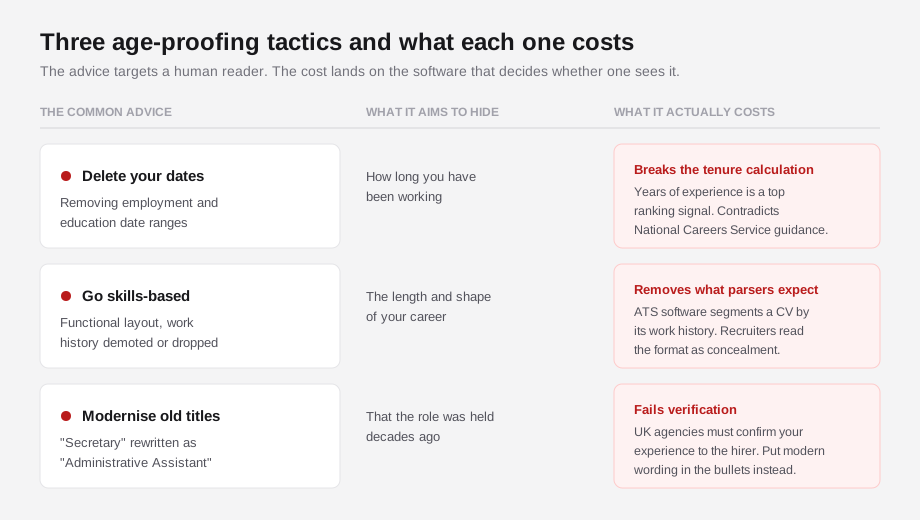
Deleting your employment dates
This is the single most damaging piece of advice in circulation, and it is the most commonly given.
It contradicts UK government careers guidance directly. The National Careers Service specifies what a work history entry must contain: the employer name, the job title, and the dates you worked there. It asks for dates in the education section too - the names of your qualifications, where you studied, and the dates you attended. The official UK guidance treats dates as mandatory CV content, not an optional disclosure.
It also breaks the machinery. An ATS uses your employment dates to calculate total years of experience, and that calculation is one of the most heavily weighted ranking signals in the system. Our breakdown of how an ATS actually parses a CV covers the mechanism: when dates are missing, ambiguous, or inconsistent, the parser cannot work out your tenure and ranks you below candidates whose dates read cleanly. A candidate with 25 years of directly relevant experience and no dates can score below a candidate with four years and a tidy date format.
And it does not work on humans either. A CV with no dates does not read as ageless. It reads as a CV with the dates deliberately taken out, which invites the exact question you were trying to avoid, plus a second one about what else has been left off.
Switching to a skills-based (functional) CV
The functional CV - skills grouped at the top, employers and dates demoted or dropped entirely - is sold as a way to lead with capability rather than chronology. It fails for the same structural reason it fails for career changers, which we covered in the guide to rewriting a CV for a career change: ATS parsers expect a work history section and score the document poorly when it is not there, and recruiters have seen the format often enough to read it as concealment.
The instinct behind it is sound. Leading with relevant capability is genuinely the right move over 50. But the place to do that is a strong profile and a core skills section at the top of a conventional reverse-chronological CV, which costs you nothing structurally.
Rewriting your old job titles
The usual suggestion is to replace a dated title with its modern equivalent - "Secretary" becomes "Administrative Assistant", "Data Entry Clerk" becomes "Data Specialist".
The keyword problem this tries to solve is real. An old title genuinely may not match the vocabulary a recruiter searches on. The fix is in the wrong place, though. Your job title is a verifiable fact about your employment history, and it gets verified: recruitment agencies operating in the UK work under the Conduct of Employment Agencies and Employment Businesses Regulations 2003, which oblige them to confirm a work-seeker's experience and qualifications to the hirer. A title that does not match what a former employer confirms is a problem you do not want, and the line between tailoring and misrepresentation sits exactly here.
Keep the title you actually held. Put the modern vocabulary in the bullets underneath it and in your skills section, where it is accurate, searchable, and carries no verification risk.

What actually works on a CV over 50
You are not trying to look younger. You are trying to make thirty years of history read as a targeted case for one job - which means weighting it, not hiding it.
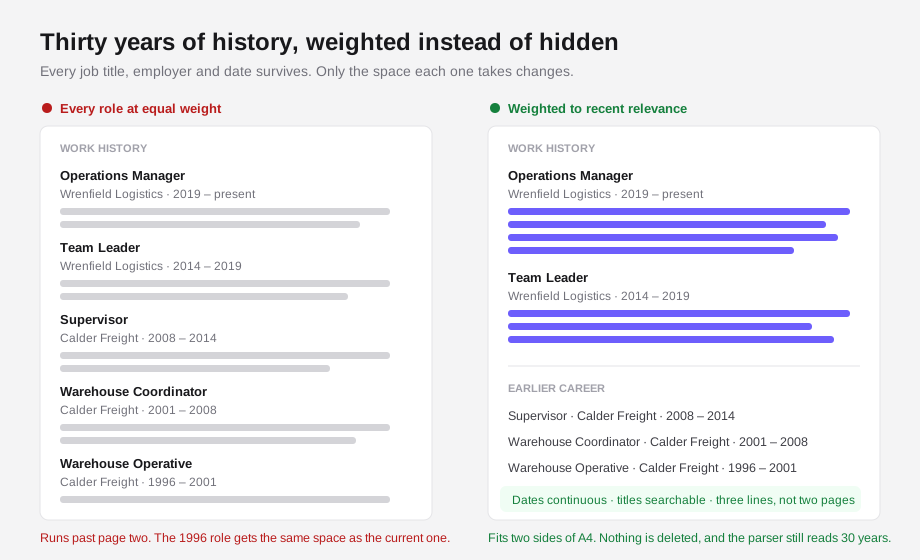
Weight the recent decade, compress the rest
Give full bullet points to roles from roughly the last 10 to 15 years - the ones a recruiter is actually assessing. Then compress everything before that into a short Earlier career block: one line per role carrying the job title, the employer, and the dates.
That block is doing real work. It keeps your dates continuous, so there are no unexplained gaps and the tenure calculation still runs - and if your history does include a genuine break, a dated career-break entry preserves the same continuity. It keeps early employer names and titles present as searchable text. And it does all of that in three or four lines rather than a page and a half, which is usually what gets a long history down to the standard two sides of A4 without deleting anything.
Signal that you are current
Most age bias in screening is a proxy for an assumption about currency - that a longer career means older tools and older methods. That assumption is answerable with evidence, and evidence is more persuasive than absence.
- Name the platforms and tools you use now, with their current names. These are the exact terms recruiters type into database searches, so they earn their place twice.
- Include recent training or certifications with the dates attached. A 2025 date next to a qualification does more for you than removing a 1993 one.
- Quantify recent achievements rather than describing long service. "Thirty years of experience" is a claim about duration; a figure from last year is a claim about capability.
Your skills section is the natural home for most of this, and it sits high on page one where it gets read.
Cut the age markers that do no work
Some details genuinely should come off, not because they reveal your age but because they take up space and tell an employer nothing. Your date of birth, your age, and your marital status are all on the standard UK cut list - our guide to what to remove from your CV covers the full set and why each one goes.
Two specific cases are worth calling out for a CV over 50:
- Qualification dates. This is the one legitimate concession. Age UK's guidance acknowledges that some older people are reluctant to date old school qualifications, and says you do not have to include those dates if you would rather not, so long as you still list the qualifications themselves. Note how narrow that is: it applies to qualifications, not to employment. No credible UK source tells you to remove the dates from your work history.
- "Over 30 years of experience" in your profile. This is a duration claim doing the work a capability claim should do, and it front-loads the one number you were worried about. Replace it with the scope of what you currently handle.
FAQ
Should I remove the dates from my CV if I'm over 50?
No. National Careers Service guidance asks for dates in both your work history and your education, and an ATS uses employment dates to calculate your years of experience - one of the most heavily weighted ranking factors. A CV without dates parses badly and reads to a recruiter as though something is being withheld.
How far back should a CV go if you are over 50?
Give detailed bullet points to roughly the last 10 to 15 years, then list earlier roles as single lines with the title, employer and dates. Everything stays present and searchable, but the space goes to the experience the employer is actually assessing.
Should I take my graduation year off my CV?
You can. Age UK's guidance for older job seekers says you do not have to include dates on qualifications if you prefer not to, provided the qualifications themselves are listed. This is specific to education - it is not a reason to remove your employment dates, which do a different job entirely.
Is age discrimination in UK recruitment actually illegal?
Yes. Age is a protected characteristic under the Equality Act 2010, and gov.uk states that it is against the law to discriminate against anyone because of age. That protection covers the recruitment process, not only people already in a job.
Should I use a skills-based CV to hide my age?
No. Functional CVs that remove or demote dated work history parse poorly, because ATS software expects a work history section to segment and score. Lead with a strong profile and a core skills section instead, then keep the conventional reverse-chronological structure underneath.
Check what the system sees before you cut anything
Before you delete a single date, find out what an ATS currently makes of your CV - how it reads your work history, whether your experience calculates correctly, and which of your terms match the roles you are applying for. Run a free scan of your CV and Shadow CV shows you exactly what the parser extracts and where the gaps are. If the report finds real problems, the £5 rewrite restructures the document so your recent experience leads, your earlier career stays intact and searchable, and nothing that matters gets stripped out to make it look shorter. Once, no subscription.