Key Takeaways
- A military to civilian CV has to swap service vocabulary for the terms civilian recruiters search: job functions, team sizes, budgets and outcomes.
- Lead with the civilian function and keep the rank as context.
- UK Security Vetting tells clearance holders not to disclose their level online, so keep it off job-board and LinkedIn profiles.
Most service leavers write their first military to civilian CV with the same instinct: list the ranks, the postings and the courses, in the order the service recorded them. It reads perfectly to anyone who has served. To a civilian recruiter, and to the applicant tracking system searching on their behalf, much of it is noise. Nobody hiring an operations manager types "SNCO" or "troop" into a search box.
The underlying picture is encouraging. The Ministry of Defence's Career Transition Partnership annual statistics, published 12 February 2026, follow up the 14,588 regular and Gurkha personnel who left the UK armed forces in 2024/25. Of those who used a billable CTP service and reported their outcome, 86% were in work six months after leaving, against a UK population employment rate of 75% over the same period. Service leavers get hired. The CV decides how quickly, and into what.
Why a military CV gets lost in civilian recruitment
Civilian recruitment runs on search. Recruiters filter an ATS or a job-board database for the exact terms in their job advert, and a CV that does not contain those terms does not appear, however strong the career behind it. How to find and use ATS keywords covers the mechanics.
A service CV usually fails that search in three predictable ways:
- Acronyms with no expansion. "JNCO", "OC", "QM", "CO", "MT", "RSM". An ATS has no idea what they stand for, and a recruiter who does not know will not look them up.
- Ranks in place of functions. "Sergeant" tells a civilian reader your seniority but not your job. "Led a team of 30" or "managed a £1.2m equipment account" tells them both.
- Unit and posting names as job titles. A line reading "3 Regt, B Sqn" gives a parser nothing it can match to an advert.
None of this is a problem with the experience. The CTP figures show where leavers actually land: 59% of those in work were in associate professional and technical roles (23%), professional roles (19%) or skilled trades (17%). Those are the vocabularies your CV needs to speak.
How to translate rank, role and jargon on a military to civilian CV
The method is the same one any career changer uses, and our career change CV guide goes deeper on it. For service leavers it comes down to four moves.
- Lead each role with the civilian function. Write the job title as the work it was: "Logistics Team Leader", "Communications Engineer", "Training Manager". Put the rank and unit in a second line or in brackets, so a reference check can still match them to your service record.
- Expand or delete every acronym. If a civilian would need it explained, either explain it once ("Quartermaster (stores and equipment manager)") or replace it with the plain term.
- Quantify scope. Team size, budget, value of equipment, number of people trained, area or sites covered. Numbers translate across sectors without help.
- Borrow the advert's words where they are true. If the advert says "stakeholder management" and you briefed commanders, partner agencies and contractors, use the advert's phrase. This is translation, not exaggeration: every claim still has to be something you actually did.
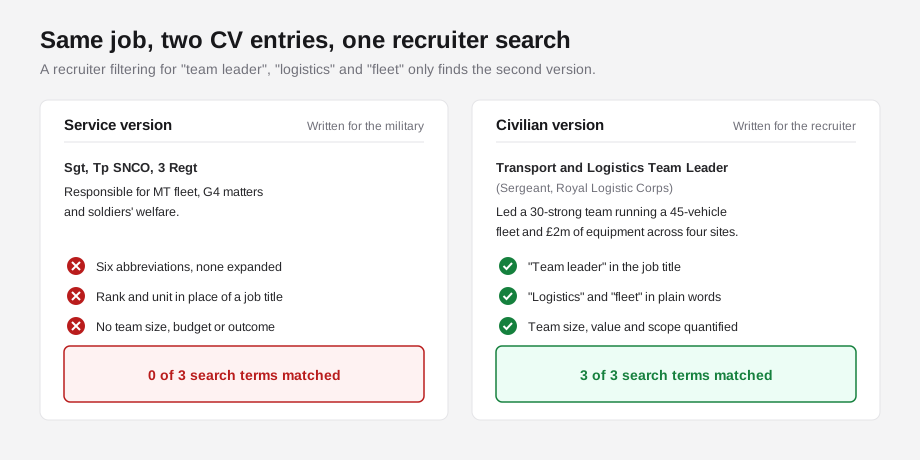
A worked example. A Royal Logistic Corps sergeant's draft read: "Sgt, Tp SNCO, 3 Regt. Responsible for MT fleet, G4 matters and soldiers' welfare." The rewrite read: "Transport and Logistics Team Leader (Sergeant, Royal Logistic Corps). Led a 30-strong team running a fleet of 45 vehicles and £2m of equipment. Planned and delivered fuel, rations and spares to four sites. Line-managed five supervisors and handled welfare and performance reviews." Same job, same truth. The second version contains the words "team leader", "fleet", "logistics" and "line-managed", which a transport or operations recruiter will actually search for. The figures here are illustrative, so use your own.
Should you put security clearance on your CV?
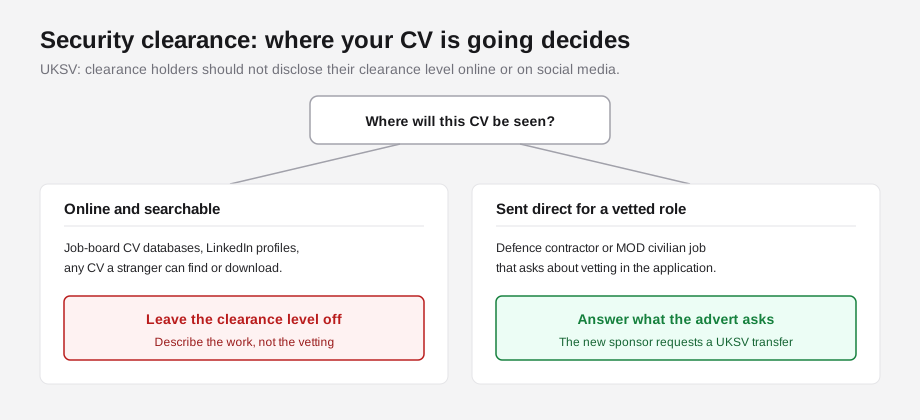
This is where most ex-forces CV advice stops at "list it if you have it". UK Security Vetting (UKSV), the government's main clearance provider, is more specific. Its guidance for existing clearance holders lists what you should not do, and one item is to "disclose your level of security clearance online or on social media profiles".
That matters because much of a modern job search happens online. A CV uploaded to a job-board database is searchable by every recruiter with access, and a LinkedIn profile is public. So the practical rule is:
- CVs uploaded to job boards, CV databases or LinkedIn: leave the clearance level off.
- A CV sent directly to an employer for a role that needs vetting: answer what the advert asks, in the application itself, and be ready to confirm it to their security team.
You lose little by leaving it off. UKSV's guidance for hiring managers says that advertising for staff who already hold a clearance is "contrary to government policy, unnecessary and potentially discriminatory", except for short-term posts that need filling urgently. Clearance also does not travel with you automatically. When you move to a defence contractor or a MOD civilian role, the new employing sponsor asks UKSV to transfer it, at the same or a lower level.

Service leaver CV structure: what goes where
The standard UK CV structure works for service leavers without modification. What changes is the weighting.
- Profile (three or four lines). The civilian role you are targeting, your years of service in plain terms, and two or three strengths in the target sector's language. Not "highly motivated ex-soldier".
- Work history. Reverse chronological. If you held several appointments, list the most recent two or three as separate roles with their own dates, and group older ones in a single short line. Our guide to the work experience section covers dates and layout.
- Qualifications and training. Civilian-recognised qualifications first, with the awarding body named. Military courses go in only if a civilian reader would understand them, described in plain terms.
- Licences and tickets. Driving categories, plant and forklift tickets, first aid. These are search terms in their own right, so name them exactly.
Two pages is enough for almost every service leaver. A 22-year career does not need 22 years of detail: the last ten years carry the weight.
The Civil Service veterans scheme and your CV
The Civil Service runs an opt-in recruitment scheme called Great Place to Work for Veterans. When a veteran opts in and meets the minimum criteria, they progress to the next stage for most vacancies, whether that is an interview or an online test. Applicants are prompted to opt in on Civil Service Jobs by confirming they served. All appointments are still made on merit.
The eligibility conditions, as published on the Home Office's careers site, are:
- at least one year in HM Armed Forces, as a Regular or a Reserve, including time spent training
- being in transition from, or having left, the armed forces
- not already being a civil servant, or employed by a Civil Service Commission accredited public body
There is no maximum time limit since leaving. The catch is the same one that applies to every guaranteed-progression scheme: you only progress if your application shows you meet the minimum criteria. A shortlister cannot credit experience that is buried in acronyms. How Civil Service applications are scored, including the Success Profiles behaviours, is covered in our Civil Service CV guide.
Key point: Every advantage a service leaver has in civilian hiring, from the veterans scheme to a recruiter who rates military experience, depends on the CV being readable by someone who never served.
FAQ
Should I put my military rank on my civilian CV?
Yes, but as context rather than the headline. Lead each role with the civilian function, such as "Operations Team Leader", and put the rank and service in brackets or on the line below. Keeping the rank lets an employer match your CV to your service record during reference checks.
How long should a service leaver's CV be?
Two pages of A4 for almost everyone, however long the career. Give the last ten years most of the space, and compress older appointments into a single line each. Recruiters judge what you can do now, not every posting since basic training.
Can I put SC or DV clearance on my CV?
UK Security Vetting tells clearance holders not to disclose their clearance level online or on social media profiles, so leave it off any CV uploaded to a job board, CV database or LinkedIn. For a role that needs vetting, answer the employer's question directly in the application. Your new employer's sponsor then asks UKSV whether the clearance can be transferred.
What support does the Career Transition Partnership give with CVs?
The CTP is the MOD's resettlement service, run by Reed in Partnership since 1 October 2024. Support is available from two years before you leave until two years after, and the level depends on length of service: the full Core Resettlement Programme is for those with six or more years' service or a medical discharge. It includes workshops, one-to-one guidance and job-finding support.
Do I get a guaranteed interview for Civil Service jobs as a veteran?
Not quite. Under the Great Place to Work for Veterans scheme, eligible veterans who opt in and meet the minimum criteria progress to the next stage for most vacancies, which may be an interview or an online test. You need at least one year's service, Regular or Reserve, and there is no limit on how long ago you left.
Translating a service career is mostly a vocabulary problem, and vocabulary is measurable. Run your CV through Shadow CV's free scan to see which keywords it matches against the civilian role you are targeting, and which ones your service language is hiding. The £5 rewrite translates them for you, once, with no subscription.