Key Takeaways
- You can rewrite your CV to score higher without lying - tailoring rephrases and reprioritises real experience, while lying invents or inflates facts a reference check would expose.
- Fabricating qualifications, job titles, or dates can be fraud under the Fraud Act 2006 and is grounds for instant dismissal even years later.
- Rephrase, quantify, and translate what you actually did - never add what you did not.
Most people asking how to rewrite their CV without lying are not trying to cheat. They have read that you should "tailor your CV" and "use the keywords from the job advert", and somewhere in doing that it started to feel like they were dressing up a version of themselves that does not exist. That anxiety is worth taking seriously, because the line between an optimised CV and a dishonest one is real - and staying the right side of it is both an ethical and a legal matter. The good news is that almost everything that makes a CV score higher is on the honest side of that line.
Tailoring Is Not Lying - Where the Line Actually Sits
A tailored CV and a fabricated one are different documents built from different raw material. Tailoring works from things you actually did and changes how they are described and ordered. Fabrication adds things that did not happen. The test is simple: could you defend this line at interview with a concrete, specific example, and would it survive a reference check? If yes, it is tailoring. If no, it is a lie waiting to be found.
Consider the same candidate, three ways:
- Honest and weak: "Helped out with the team's reporting."
- Honest and strong: "Produced the team's weekly performance report in Excel, tracking five KPIs for a team of 12."
- A lie: "Owned the department's entire analytics function and built its reporting from scratch."
The middle version scores far better than the first - more specific, quantified, keyword-rich - and every word of it is true. The third version is not a stronger CV, it is a liability. A rewrite that works is the second one, every time. The whole craft is moving from the first to the second without ever drifting into the third.
What Actually Counts as Lying on a CV
The grey area feels bigger than it is. In practice, four things cross the line, and none of them are ambiguous once you name them plainly:
- Inventing qualifications you do not hold - claiming a degree, grade, or professional registration you never earned. This is the most serious and the most checked.
- Fabricating job titles or seniority - promoting yourself from "Sales Assistant" to "Sales Manager", or claiming you led a team you were a member of.
- Altering employment dates to hide a gap - stretching a role to paper over a period out of work. A career gap is now common and rarely fatal when explained honestly; the date change is the real risk, not the gap.
- Claiming skills or experience you do not have - listing a language you cannot speak or software you have never opened, in the hope the interview never tests it.
This is not only a reputational risk. Providing false information to obtain employment can be fraud by false representation under the Fraud Act 2006, which carries a maximum of ten years' imprisonment on indictment. Prosecutions of individual job seekers are rare, but the more ordinary consequence is not: a fabrication discovered after you are hired is generally treated as a fundamental breach of trust, and UK employers can - and do - dismiss for it, sometimes years later. The fraud prevention body Cifas found that around one in eleven UK adults (roughly 9%) admitted lying about their degree qualification on a CV within the previous twelve months, in research it published in March 2023. Employers know the numbers too, which is exactly why qualification and reference checks have become routine.

How to Make a Real CV Stronger Without Inventing Anything
Almost all of the score improvement in a good rewrite comes from four moves, and every one of them stays firmly on the honest side of the line.
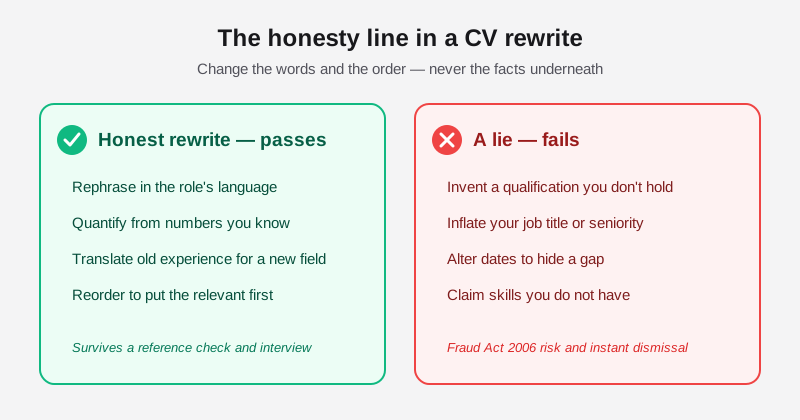
Rephrase what you did in the target role's language. If the advert asks for "stakeholder management" and you "kept clients and suppliers updated", say "managed client and supplier relationships". Same facts, better matched. This is keyword alignment, not invention - the underlying work is identical.
Quantify from numbers you actually know. "Handled a lot of tickets" becomes "resolved around 40 support tickets a week". You are not inventing the figure; you are stating one you already know but left off. A defensible estimate you can explain is honest. A precise-sounding number you made up is not.
Translate old experience for a new field. A career changer re-expressing "ran a busy retail floor" as "managed scheduling, stock budgets, and a team of 14" is describing the same job in words the new field recognises. We cover this fully in the career change CV guide - the rule throughout is that nothing gets added, only re-described.
Reorder to put the relevant first. Moving the most relevant role, skill, or achievement to the top of its section changes nothing about what is true - it just stops the reader missing it in the 7.4 seconds they spend on a first pass.
The Grey Areas Most People Get Wrong
A few specific situations trip people up, so here is the honest reading of each:
- Job titles: use your official title. If it was vague or misleading internally, you may add a clarifying phrase in brackets - "Coordinator (team lead for three staff)" - but do not replace the real title with an inflated one. The same goes for placements: a week watching a solicitor at work goes on a CV as work shadowing, labelled as such, never as a job title you did not hold.
- The "we" problem: describing team achievements as your own. Claim your genuine contribution to a group result, not the whole result. "Contributed to a project that cut costs 15%" is honest; "cut costs 15%" alone, when it was a team of ten, is not.
- Skills you are still learning: do not list them as held. Put them under a clearly labelled "currently developing" line, or leave them off. A skill you cannot demonstrate is a liability the moment it comes up.
- Rounding and estimates: honest if you can explain the basis ("approximately", "over 30"). Dishonest if the number is invented to impress and you could not defend it.
The consistent principle: change the words and the order freely, but never the facts underneath them. Every honest technique survives a follow-up question - and interviewers ask follow-up questions.
This is also the line an agency recruiter is working to. When a recruiter asks you to rewrite your CV, they are almost always asking you to evidence something you have already done but left implicit - because under the Conduct Regulations they can only confirm to the client what your CV actually states.
FAQ
Is it illegal to lie on your CV in the UK? It can be. Deliberately providing false information to obtain a job - inventing a qualification or a job title - can amount to fraud by false representation under the Fraud Act 2006, which carries up to ten years' imprisonment on indictment. Prosecutions of applicants are uncommon, but dismissal for the discovery is not.
Is exaggerating on a CV the same as lying? It depends on whether the underlying fact is true. Stating an achievement more strongly ("managed" rather than "helped with") is fine if you can defend it with an example. Inflating the fact itself - a bigger team, a higher title, a result that was not yours - is a lie, even if it feels like "just exaggerating".
Will employers actually check my CV? Increasingly, yes, though what a UK employment history check can actually see is narrower than most people assume - employers, dates and qualifications rather than your bullet points. Qualification checks, reference checks, and third-party background screening are now routine for UK employers, especially for regulated roles in the NHS, finance, and the Civil Service. Assume anything checkable on your CV will be checked.
Can I be sacked for a lie on a CV I submitted years ago? Yes. A fabrication that induced your hiring can be treated as a fundamental breach of trust regardless of how long ago it was, and can justify dismissal when discovered. Time does not make a false qualification true.
How do I make my CV competitive without exaggerating? Rephrase real work in the target role's language, quantify results you can actually stand behind, and reorder so your most relevant evidence is seen first. Every gain a keyword-matched, well-structured CV delivers is available without inventing a single fact.
Your CV probably scores lower than it should - not because you need to invent anything, but because real, defensible experience is buried in vague wording the ATS cannot read. Scan your CV free and Shadow CV shows you exactly which lines are costing you points and which keywords are missing. The £5 rewrite rephrases and restructures what is genuinely there - never inventing, fabricating, or embellishing - so it scores higher and still reads as honestly yours. Once, no subscription.