Key Takeaways
- You never have to disclose a disability on your CV. Section 60 of the Equality Act 2010 stops most health questions before a job offer.
- The Disability Confident interview offer is claimed on the application form, not the CV.
- It only applies if your CV or form evidences every essential criterion in the advert.
Most advice on whether to disclose a disability on your CV stops at "it's your choice". True, but incomplete. In UK recruitment, disability disclosure happens at set points in the process, each with its own purpose and its own legal rules, and the CV is not one of them. The CV matters in a different way: under the Disability Confident scheme it is often the document that decides whether a disabled applicant's interview offer applies at all.
This affects a lot of applicants. The Department for Work and Pensions' Employment of disabled people 2025 report counted 5.5 million disabled people in work in the UK in Q2 2025. The disability employment rate was 52.8%, against 82.5% for non-disabled people, a gap of 29.7 percentage points.
Do you have to disclose a disability on your CV?
No. Nothing requires a CV to mention a disability or health condition, and the law goes further than that.
Section 60 of the Equality Act 2010 says an employer "must not ask about the health of the applicant" before offering them work, or before putting them in a pool of candidates to be offered work. A breach is enforceable by the Equality and Human Rights Commission. It then allows a small set of questions before an offer, each for a specific purpose:
- Adjustments for the assessment itself - whether you need adjustments to take part in an interview, test or assessment centre.
- Functions intrinsic to the job - whether you can do something essential to the role, judged as if any reasonable adjustments were already in place.
- Diversity monitoring - the equal opportunities form.
- Positive action - measures to encourage disabled applicants, which is how GOV.UK frames the Disability Confident interview offer.
- A genuine occupational requirement - rare roles where having a particular disability is itself a requirement.
None of those purposes is served by your CV. The Act covers England, Scotland and Wales. Northern Ireland has separate disability legislation.
Where disability disclosure actually happens in a UK job application
There are four points where a disability can come up before you start a job. Each is optional, and each is a different question.
- The Disability Confident question. Employers in the scheme are expected to ask every applicant whether they want to apply under it. Usually this is a tick box on the application form.
- A reasonable adjustments request. Space on the form, or in the interview invitation, to say what you need for the selection process: extra time, a step-free room, questions in advance, a BSL interpreter.
- The equal opportunities monitoring form. Collected for monitoring only, which is why section 60 allows it.
- After the offer. Occupational health questionnaires and conversations about workplace adjustments belong here, once you have the job.
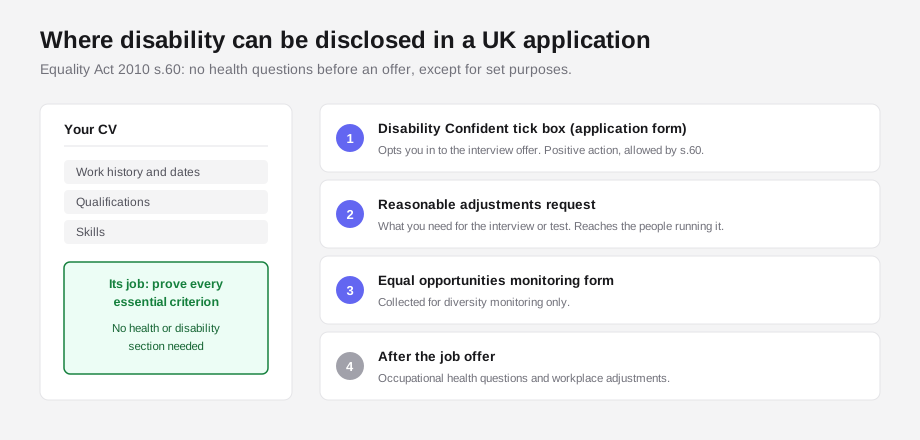
Every legitimate route for disclosure sits outside the CV, with a defined purpose. The same logic is why what to remove from your CV treats disability like the other protected characteristics under the Equality Act: information the employer has to set aside, not weigh.
How the Disability Confident interview offer works
Disability Confident is the government's employer scheme. At every level, from "Committed" upwards, members sign up to one core action that matters here: offer an interview to disabled people who meet the minimum criteria for the job. It used to be called the guaranteed interview scheme, and many job adverts still use that name.
GOV.UK's employer guidance is specific about what that promises.
- It is not automatic. "This does not mean that all disabled people are entitled to an interview. They must meet the minimum criteria for a job as defined by the employer."
- Minimum criteria means the essentials. The guidance defines them as "the minimum qualities, skills, experience and/or qualifications that a candidate needs to demonstrate" to progress to the first stage of selection.
- It can be capped. With a high number of applications, or at seasonal peaks, an employer may interview only the disabled candidates who best meet the minimum criteria, rather than all of them. The guidance says this should be explained in the employer's recruitment policies and adverts.
The Civil Service runs its own version of the scheme, and its careers site sets out both conditions for being considered. You must have a condition with a "substantial and long-term (over 12 months) adverse effect" on normal day-to-day activities, which follows the Equality Act definition of disability. And you must have "demonstrated in your application and testing stages that you meet the minimum job criteria as set out in the advert or person specification". How Civil Service applications are scored is covered in the Civil Service CV and Oleeo guide.
Why your CV decides whether the interview offer applies
This is the part the ranking advice leaves out. GOV.UK's Disability Confident guidance says: "Within the application form or CV (depending on the employers preferred recruitment process) the applicant must be able to demonstrate that they meet the minimum criteria for the job if they are requesting an interview under the Disability Confident scheme."
Ticking the box opts you in. Whether it leads to an interview depends on what your CV or form shows. If an essential criterion is not visibly evidenced, the shortlister has no basis for applying the offer, however well you actually fit the role.
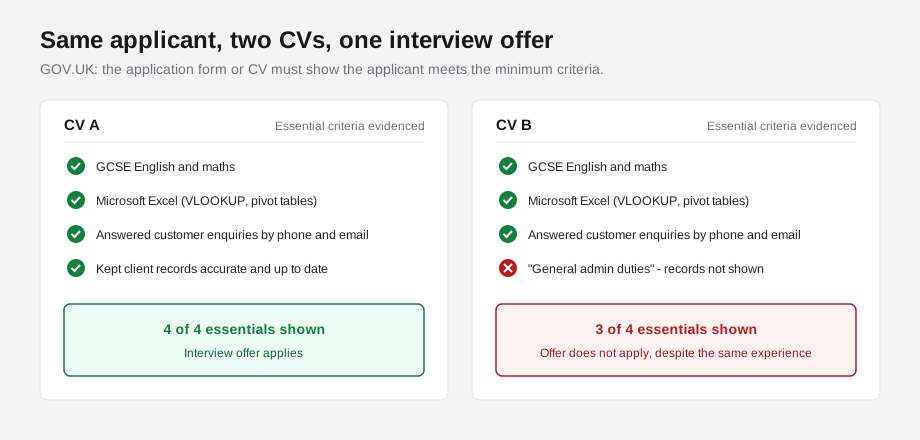
Treat each essential criterion as a line your CV has to answer:
- List every essential criterion from the advert or person specification. Separate them from the desirables. How to read a job description like a recruiter covers how to tell them apart when the advert does not label them.
- Find the CV line that proves each one. A qualification in the education section, a bullet in your work history, a named system in your skills list.
- Use the advert's own wording where it is true. If the essential criterion is "experience of managing a caseload", a bullet reading "managed a caseload of 30 clients" matches it. "Supported clients" leaves the reader to guess. ATS searches and human shortlisters both look for the stated term.
- Fill the gaps. If you meet a criterion but the CV does not show it, add the evidence. If you genuinely do not meet one, the offer will not apply.
A worked example. An administrator advert lists four essentials: GCSE English and maths, Microsoft Excel, handling customer enquiries, and maintaining accurate records. Candidate A's CV has a qualifications line, "Microsoft Excel (VLOOKUP, pivot tables)" in skills, a bullet on answering customer enquiries at [Employer name], and one on keeping [system name] records up to date. All four are met. Candidate B did the same job, but wrote "general admin duties" where the records bullet should be. On paper one essential is missing, so the offer does not apply.
What to put on your CV if you are disabled
For most applicants, nothing about the disability itself. The CV should carry the evidence the scheme depends on, where a parser and a person can both find it.
- Leave the condition off. No health section, no line in the personal statement.
- Keep your work history continuous and factual. If a health condition caused a gap, the dates still need to be clean and parseable. How to explain employment gaps on your CV covers what to write, and "health reasons, now resolved" or "career break" is enough. You do not owe a diagnosis.
- Include disability-related experience when it is relevant to the job. Advocacy work, running a peer support group or training colleagues on accessibility is real experience. List it the same way as any other role or volunteering, with what you did and what came of it.
- Put your adjustment needs in the adjustments request. A request made there reaches the people organising the assessment. The same sentence on a CV may never reach them.
There is one legal reason to disclose early that has nothing to do with the CV. Under Schedule 8 of the Equality Act, an employer is not under a duty to make reasonable adjustments if they do not know, and could not reasonably be expected to know, that you are disabled and likely to be at a disadvantage. If you need an adjustment to get through an assessment fairly, ask for it before the assessment. In England, Scotland and Wales, Access to Work can also help pay for communication support at a job interview, such as a BSL interpreter or lipspeaker, and you apply to it directly rather than through the employer.
Key point: The Disability Confident tick box opts you in to the interview offer. The CV, or the application form, is what makes you eligible for it, by showing every essential criterion in the advert.
FAQ
Do I have to tell an employer I am disabled when applying for a job?
No. Disclosure is optional at every stage, and section 60 of the Equality Act 2010 stops employers asking about your health before an offer except for set purposes such as assessment adjustments, diversity monitoring and positive action schemes. You may choose to disclose to use the Disability Confident scheme or to get adjustments, but nothing requires it.
Should I mention my disability in my cover letter instead of my CV?
You can, but it is rarely the best route. If the employer is in the Disability Confident scheme, the tick box on the form is how you apply under it, and the adjustments request is how you get support at interview. A cover letter mention does neither of those things formally.
Does Disability Confident guarantee me an interview?
No. It guarantees consideration for an interview if your application shows you meet every minimum criterion for the job. When an employer has a very high number of applicants, it may interview only the disabled candidates who best meet those criteria, and GOV.UK expects that to be stated in the advert.
Can an employer reject me for disclosing a disability?
Rejecting you because of a disability is unlawful discrimination under the Equality Act 2010. Section 60 also shifts the burden: if an employer asked an improper health question and you bring a tribunal claim about how they used your answer, that is treated as facts from which the tribunal could find discrimination, and the employer has to explain. Acas and the Equality Advisory and Support Service can advise on individual cases.
Do I count as disabled for the Disability Confident scheme?
Under the Equality Act, you are disabled if you have a physical or mental impairment with a substantial and long-term adverse effect on your ability to carry out normal day-to-day activities. Long-term generally means it has lasted, or is likely to last, at least 12 months. The test is about the effect on daily life, not a diagnosis or a label, so it is worth checking even if you do not think of yourself as disabled.
The Disability Confident offer depends on one thing your CV controls: whether every essential criterion is visibly evidenced, in words a parser and a shortlister can match to the advert. Run your CV through Shadow CV's free scan to see which criteria and keywords it picks up against your target role, and which it misses. The £5 rewrite fills those gaps, once, with no subscription.