Key Takeaways
- A dismissal does not go on your CV: keep the job, its real dates and its achievements, and give no reason for leaving.
- A UK reference can say you were sacked if that is fair and accurate.
- If an application form asks, answer truthfully in one line, then explain at interview.
Being dismissed from a job feels like something you have to confess on every application that follows. It is not. A UK CV has no reason-for-leaving field, and the dismissal does not belong on it in any form. What it does have is a dated job entry, and that entry is the part people get wrong after being sacked: they delete the job, stretch the dates around it or quietly fold it into the role before.
Each of those creates a problem the dismissal itself never would. The places where a dismissal can genuinely come up are narrower and more predictable: the reference, an application form that asks directly, and the interview. This guide takes each in turn, using what GOV.UK and Acas actually say rather than the US advice that dominates this question.
Does being dismissed have to go on your CV?
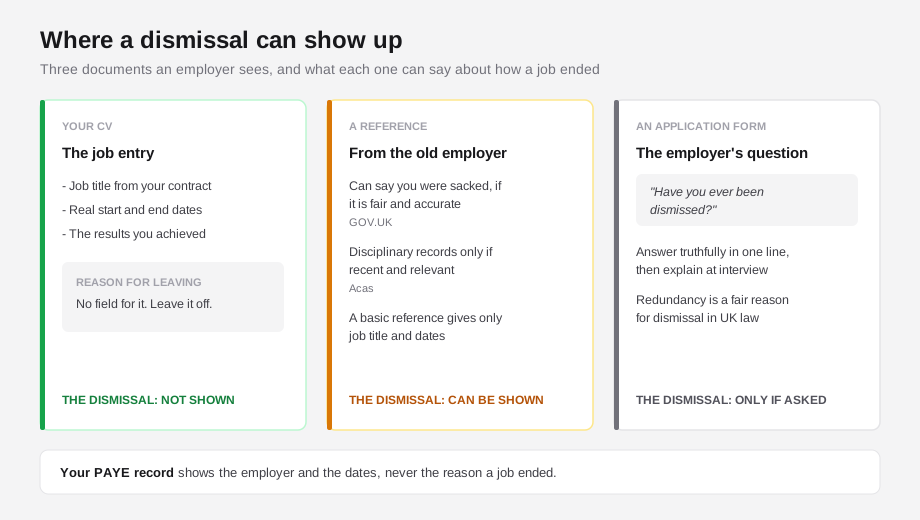
No. A CV lists your jobs, your dates and the evidence of what you did. It does not list why each job ended, and giving a reason on one entry draws the eye to exactly the one you would rather it skipped. This is the same rule as for short jobs on a CV: a bracketed note earns its place only where it removes a doubt, such as a fixed-term contract ending. "Dismissed" removes no doubt. Leave the reason off.
What stays is the entry itself, written exactly as it would be if you had left on good terms:
- The real job title, the one on your contract.
- The real start and end dates, month and year.
- The results you achieved while you were there. The work happened; being dismissed does not cancel it.
Do not delete the job. It sits on your PAYE record with its dates, and our guide to what an employment history check shows explains how a screening company can see that record with your consent. A missing job turns into an unexplained gap, and a gap invites the question you were trying to avoid. Stretching the previous job's end date to cover it is worse, because a changed date is a false statement rather than an omission.
What a reference can say about a dismissal
This is where a dismissal usually surfaces, and the rules are clearer than most people expect. GOV.UK's guidance on references says an employer "does not usually have to give a work reference", but if it does, the reference "must be fair and accurate - and can include details about your performance and if you were sacked".
So a former employer is allowed to say you were dismissed. What it is not allowed to do is say it unfairly. Acas's guidance on what employers can say in a reference lists "the reasons for leaving the job" and "any current, relevant disciplinary records" as things a detailed reference may include, but says disciplinary records or investigations should be left out "unless this is recent and relevant". A reference must not be misleading, and GOV.UK adds that your previous employer "must be able to back up the reference, such as by supplying examples of warning letters".
In practice, many employers give only a basic reference, which Acas describes as "a short summary of employment": job title and dates. A basic reference confirms the entry on your CV and says nothing about how it ended.
Two practical points follow:
- You cannot see the reference before it is sent. GOV.UK is explicit that you can ask your new employer for a copy once you have started there, but "you have no right to ask your previous employer".
- You can choose your referee. If a former manager from an earlier job knows your work better, offer them first. The references guide covers when references are taken up and how to line up the right people, but an employer that wants a reference from your most recent job will still ask for it.

When an application form asks "Have you ever been dismissed?"
A CV is your own document, so you decide what goes on it. An application form is the employer's document, and its questions have to be answered as asked. Some forms ask directly whether you have ever been dismissed, or ask for a reason for leaving against each job.
Answer truthfully. A false answer on a form is a different thing from a reason left off a CV: it is a statement you have made to get the job, and the guide to rewriting a CV without lying explains why that can be fraud by false representation, and grounds for dismissal if it is found out later.
Keep the answer short and factual. GOV.UK's list of fair reasons for dismissal gives you neutral wording for most situations, including not being able to do the job properly, illness, gross misconduct, and a "statutory restriction" such as a driver losing their driving licence. A one-line answer is enough on a form:
- "Dismissed in March 2025 after a probation review. Happy to discuss at interview."
- "Dismissed in 2024 when I lost my driving licence, which the role required. Licence restored January 2026."
One point catches people out. GOV.UK lists redundancy as one of the fair reasons for dismissal. If you were made redundant and a form asks whether you have ever been dismissed, "Yes - redundancy, site closure, 2025" is the safest accurate answer, and nobody reads it as a mark against you. What a redundancy looks like on the CV itself, including which leaving date to use, is covered in our guide to redundancy on a CV.
Know what is on record before you are asked
The worst position at interview is guessing what your old employer will say. You can usually find out first.
- Ask for the written reasons. GOV.UK says that an employee with 2 years' service has "the right to ask for a written statement from your employer giving the reasons why you've been dismissed", and the employer "must supply the statement within 14 days". If you were dismissed while on Statutory Maternity Leave, you get one automatically, whatever your length of service.
- Check what you signed. If you left under a settlement agreement, Acas notes that one can include "an employment reference", and a common reason to use one is to "agree a job reference". If yours has an agreed reference, that wording is what your former employer will send.
- Work in a regulated sector? Expect the dismissal to travel. Where someone is removed from work with children or vulnerable adults because of harm or a risk of harm, GOV.UK's barring referral guidance puts a legal duty on the employer to refer them to the DBS, and that duty still applies if the person "resigned, retired, or left" before being dismissed. Resigning first does not keep it off the record.
How to explain a dismissal at interview
If the dismissal comes up, it will come up as a direct question, and a prepared answer of three or four sentences beats an improvised one every time. Build it in three parts:
- The fact, in one sentence. What happened, in plain words. No blame, no detail about the manager.
- What changed. The skill you built, the condition you dealt with, or the reason the circumstances no longer apply.
- The evidence since. A later job, a course, a reference from that later job. This is the part that ends the conversation.
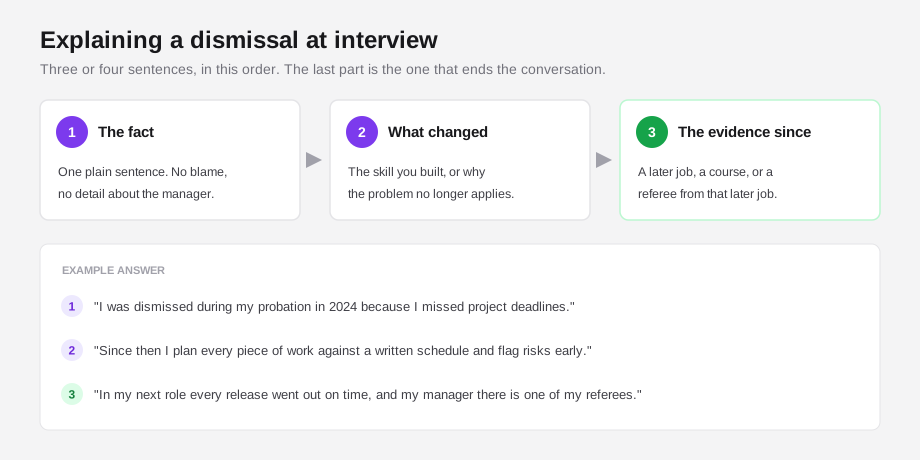
Practise it out loud until it sounds like a fact rather than a confession. Recruiters ask about dismissals to see how you talk about them, and a calm, short answer with evidence attached usually satisfies them.
FAQ
Can a new employer find out I was dismissed?
Yes, through a reference. GOV.UK says a reference can include whether you were sacked, as long as it is fair and accurate. Your PAYE record shows the employer, the dates and your pay, not the reason the job ended, and many employers only give a basic reference with job title and dates.
Do I have to put the reason for leaving on my CV?
No. A CV has no reason-for-leaving field, and adding one to a single entry draws attention to it. Keep the job, its real dates and its results. If an application form asks for a reason, answer that question truthfully on the form.
Is redundancy the same as being dismissed?
In UK employment law, redundancy is one of the fair reasons for dismissal listed on GOV.UK. If a form asks whether you have ever been dismissed and you were made redundant, answering "Yes - redundancy" is accurate and carries no stigma.
Can I leave a job I was sacked from off my CV?
You can, but it usually backfires. The job is on your PAYE record, so leaving it out creates a gap that invites questions, and stretching another job's dates to hide it is a false statement. For a job of a few weeks inside a period your CV already covers, leaving it off is unremarkable.
Can my old employer give me a bad reference?
They can give an accurate one, including a dismissal or recent and relevant disciplinary records. They cannot give a misleading one, and GOV.UK says they must be able to back up what they say. If an inaccurate reference cost you a job offer, you may be able to claim damages.
Once the reason is off your CV, the dated job entry has to do its work cleanly, with the right title, dates and results, and parsed the way a recruiter's system will read it. Run your CV through Shadow CV's free scan to see the work history an ATS actually extracts, entry by entry. If anything is landing wrong, the £5 rewrite rebuilds it - once, and not a subscription.