Key Takeaways
- Leave referees' names and contact details off your CV. References on a CV add nothing at the screening stage, because UK employers take them up at the offer stage.
- "References available on request" is optional - keep it if you have space, cut it if you do not.
- Line up two referees before you apply, and always ask them first.
Whether to put references on a CV is one of the few UK CV questions with a clean answer: no referee names, no phone numbers, no email addresses. Not because a careers adviser said so, but because of when references actually happen. UK employers check them at the end of the hiring process, after they have already decided they want you. A block of referee details on page two is answering a question nobody has asked yet, in space your evidence needed.
That is the short version. The longer version has real nuance - an optional line the government's own guidance is relaxed about, and a handful of sectors where references genuinely are requested early - and getting it right frees six to eight lines on a document where every line has to earn its place.
Why references do not belong on your CV
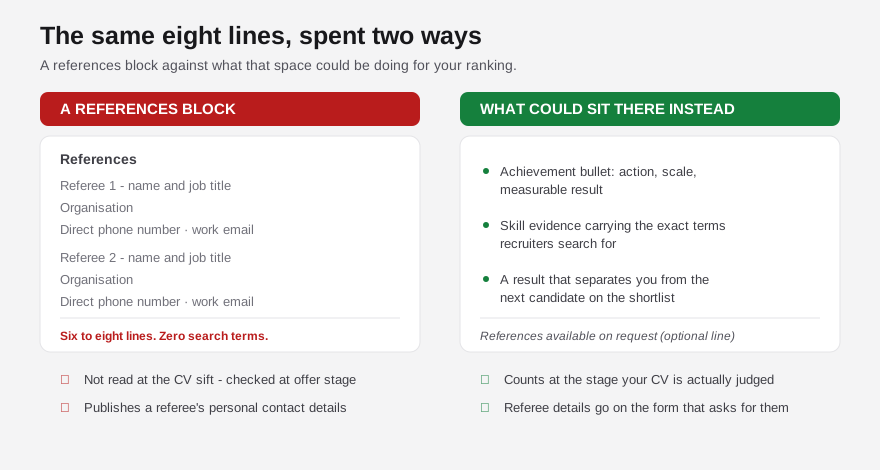
A typical references block lists two referees: name, job title, organisation, phone number, email address. That is six to eight lines of text. Measured against what a CV is screened on, those lines do no work at all.
- No recruiter search finds you through a referee. Database searches and ATS ranking run on job titles, skills, and the vocabulary of the job description. Your former manager's name is not a search term.
- Nobody rings a referee at the sift stage. A recruiter with a few hundred applications is shortlisting, not investigating. References enter the process after the shortlist, usually after the interview.
- It publishes someone else's personal data. Every job board upload and speculative application sends your former manager's direct phone number to strangers. The National Careers Service advises against listing referees' contact details on a CV for exactly this reason.
- It spends your strongest space. Six lines of referee details is roughly the space of three achievement bullets - the material that actually moves you up a shortlist.
The National Careers Service position is worth quoting precisely, because it is softer than most internet advice. Its CV guidance says you "might want to include a section about references if there is someone who has agreed to give you one" - but without contact details, writing that references are available on request instead. The official view, in other words, is that the section is optional and the phone numbers never belong. Referee details also sit on the longer list of things a UK CV is better off without - our full cut list covers the rest.
When UK employers actually take up references
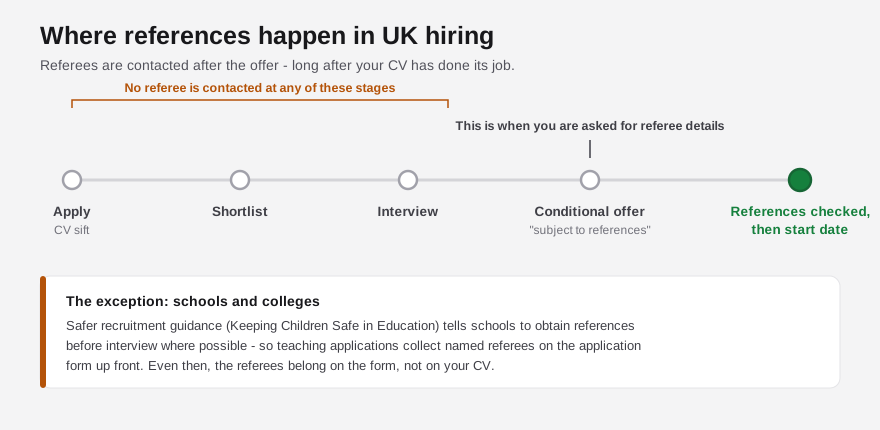
The timing is the whole argument, so it is worth seeing the sequence UK hiring actually follows.
- Application and sift. Your CV is parsed, ranked, and shortlisted. No referee is contacted.
- Interviews. Still no referee. At this stage most employers have not even asked who your referees are.
- Conditional offer. The offer letter arrives "subject to satisfactory references". This is the point at which you are asked for referee details, usually on a form.
- Reference checks. The employer contacts your referees, confirms your dates, title, and suitability, and the offer becomes unconditional.
This is not just custom. ACAS - the public body that advises on UK employment relations - says it is best for employers to ask for a reference at the final stage of the recruitment process, when making a job offer, and to get your permission before approaching your current employer. Requesting references earlier risks telling your current employer you are job-hunting before you have anything to show for it.
What a reference contains is also narrower than most people assume. Under UK government guidance on work references, an employer does not have to give a reference at all unless a contract or a regulated industry requires it - and if they do give one, it must be fair and accurate. Many organisations keep to a brief factual statement: job title, salary, and dates of employment. The glowing character endorsement people imagine their referee writing is often, in practice, three lines from HR - which is why the reference is only one part of what an employer can actually verify about your work history.

"References available on request": keep it or cut it?
The one-line version of a references section divides opinion out of proportion to its importance. The honest answer: it is optional, and nothing turns on it.
The case for keeping it is that the National Careers Service suggests exactly this wording in place of contact details, and a closing line can round off the document. The case for cutting it is that every UK employer already assumes references are available on request - the line states the obvious and gives back nothing.
So make it a space decision. If your CV sits comfortably inside two pages, the line costs you nothing. If you are fighting for room, it is the safest cut on the page. What is never worth keeping is the version with phone numbers attached.
The exceptions: when references are requested early
A few corners of the UK job market genuinely do want references sooner, and knowing which they are stops you misreading a request as a red flag.
- Schools and colleges. Safer recruitment rules run the process differently. The Department for Education's Keeping Children Safe in Education guidance says schools and colleges should obtain references before interview where possible, so concerns can be explored with the referee and raised with the candidate at interview. This is why teaching applications run on application forms that demand named referees up front - the form carries the referees, and your CV still should not.
- Nurseries and early years settings. The Early Years Foundation Stage framework goes further than KCSIE: a registered provider in England must obtain at least one written reference before anyone is recruited, from the current employer or from the last employer where the applicant worked with children. That is why a nursery practitioner CV keeps the job the reference will come from, even when it was not in childcare.
- Regulated financial services. One of the few sectors where government guidance notes an employer must give a reference - regulatory references for senior and certified roles mean references are a formal, structured part of hiring rather than a courtesy call.
- Adult social care. CQC-registered providers in England must obtain evidence of your conduct in previous care roles before employing you, so expect previous care employers to be contacted early - one of several checks that shape a care assistant CV.
- Agency children's social work. Since October 2024, Department for Education statutory guidance says councils should take two detailed practice-based references on a standard form before offering an agency child and family social worker an assignment - a check that shapes how the work history on a social worker CV is written.
- Recruitment agencies. Agencies carry a statutory duty to confirm that candidates are suitable for the roles they put them forward for, which is why a consultant may ask for referee details early - the same duty behind an agency asking you to rewrite your CV.
Notice what the exceptions have in common: the references travel through an application form, a regulatory process, or an agency's own system. None of them needs referee details on the CV itself.
How to line up your referees before you apply
Leaving references off your CV does not mean leaving them to chance. The time to organise referees is before applications go out, not in a scramble after an offer.
- Choose two. The UK convention is your current or most recent employer plus one other professional contact - an earlier manager, a client, or for a first job, a teacher, tutor, or volunteering supervisor.
- Ask before you name them. The National Careers Service frames the section as someone "who has agreed to give you one" - agreement comes first. A referee caught cold gives a flatter reference than one who said yes.
- Brief them per application. A referee who knows the role you are chasing can confirm the right things. Tell them the job title and what the employer cares about.
- Check the details you will eventually submit. A referee who changed jobs, or an old work email that bounces, delays an offer at the worst possible moment.
- Keep the list out of the CV file. Hold referee details in a separate document, ready to paste into the form that asks for them.
FAQ
Can a UK employer give you a bad reference?
They can decline to give one at all - there is no general legal obligation - but any reference they do give must be fair and accurate under UK government guidance. Many employers limit references to job title, salary, and dates for exactly this reason. If a misleading or inaccurate reference costs you a job offer, you may have grounds to challenge it.
Can you see what your referee wrote about you?
Often not. The Information Commissioner's Office confirms that a reference given in confidence is exempt from the usual right of access to your personal data - and the exemption applies whether the reference is held by the employer who wrote it or the one who received it.
Do employers contact your references before the interview?
Outside a few sectors, no. ACAS guidance is that employers should request references at the final stage of recruitment, when making an offer, and get your permission before approaching your current employer. Schools and colleges are the main exception: safer recruitment guidance tells them to obtain references before interview where possible.
How many referees do you need for a UK job application?
Two is the standard expectation: your current or most recent employer, plus one other professional contact. If you are early in your career, a teacher, tutor, or volunteering supervisor is an accepted substitute. Ask each referee before you name them anywhere.
What if you do not want your current employer to know you are looking?
Say so - it is a normal request. Employers are used to holding off on the current-employer reference until you have accepted a conditional offer, and ACAS guidance tells them to seek your permission first. An offer made "subject to references" protects both sides while that reference is taken up.
Find out what that space should be doing instead
A references block is the easy cut. The harder question is whether the space it frees - and the rest of your CV - is carrying the keywords and evidence the shortlist is actually decided on.
Scan your CV free - Shadow CV reads it the way an employer's software does and shows you what parses, what gets ignored, and which keywords from your target role are missing. The £5 rewrite rebuilds the CV around the material that earns interviews - once, with no monthly subscription.