Key Takeaways
- For most UK teaching jobs, ATS scoring doesn't happen on your CV - it's the school's application form, judged against the person specification under KCSIE safer-recruitment rules.
- Your CV still gets parsed for agency registration, independent and international schools, and higher education roles.
- Mirror the person specification's exact wording, and keep formatting single-column with standard headings.
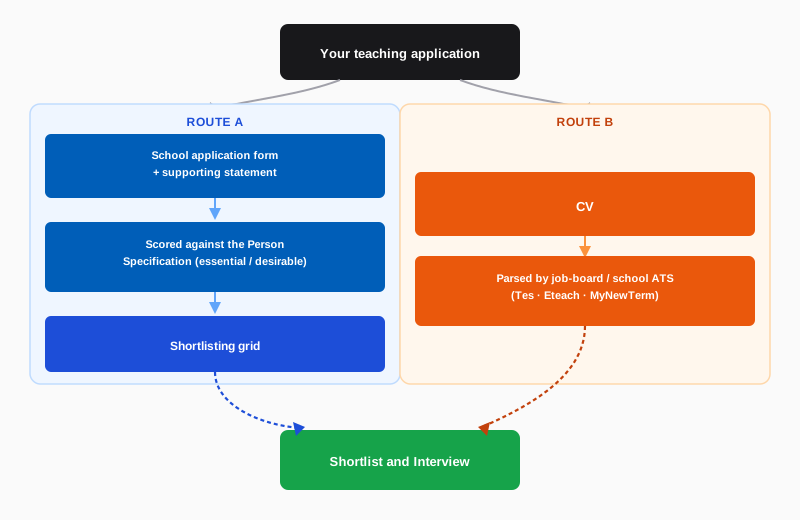
Apply for a classroom post in England and the first thing that happens to your application is rarely what job-seekers expect. For most teaching jobs, the document that gets scored isn't your CV at all - it's the school's own application form, marked against a person specification. That single fact reshapes how you should approach an ATS-friendly teaching CV in the UK, because the machinery that filters teachers works differently from the ATS pipeline used for corporate roles. Here is what actually happens to a teaching application, when your CV genuinely does get parsed, and how to pass whichever filter stands in front of you.
Why most UK teaching jobs score a form, not your CV
Safer-recruitment rules are the reason. Under Keeping Children Safe in Education (KCSIE), schools are expected to insist on their own application form rather than a CV. For any role in "regulated activity" - which covers teaching - a CV on its own is not accepted as a sufficient application, and is only considered alongside a fully completed form. The logic is safeguarding, not bureaucracy: a form forces a complete, gap-free employment history, self-disclosures, and named referees that a CV can quietly omit. Teaching is also the big exception to when references are normally taken up - KCSIE tells schools to obtain them before interview where possible, not after an offer.
So the part of your application that behaves like an ATS-scored document is usually the supporting statement inside that form, judged line by line against the person specification. The form itself captures the vetting detail; the statement is where your evidence either matches the criteria or doesn't. Because that statement carries the weight, it is worth writing properly - our teacher letter of application guide covers how heads read it, how to evidence pupil progress without overclaiming, and what changes between ECT, main-scale and TLR posts.
Key point: For most classroom posts, "passing ATS" really means scoring well against the person specification. Treat that document, not the job advert, as your keyword list.
When your teaching CV actually gets parsed by an ATS
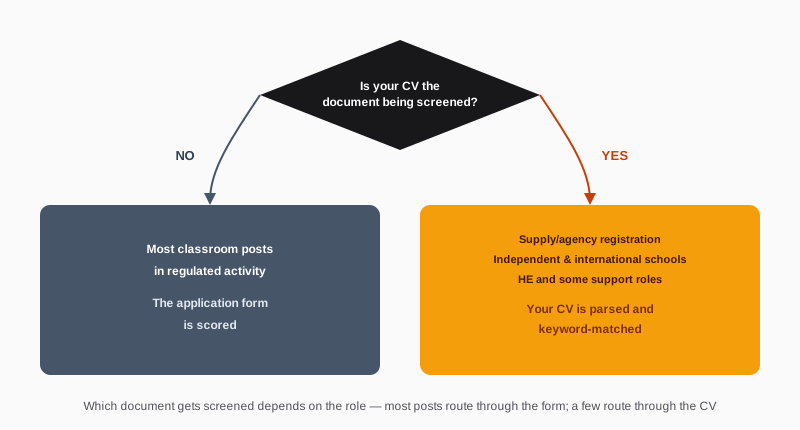
The form-first rule has real exceptions, and in these your CV is the screened document - parsed, keyword-matched, and ranked much like a corporate application:
- Supply and agency registration. Recruitment agencies parse your CV into their own databases and search it by keyword. Formatting and terminology decide whether you surface for a booking.
- Independent and international schools. These are still bound by safeguarding duties (KCSIE plus the Independent School Standards for many), but several invite a CV earlier in the process before a formal form.
- Early years settings. Private day nurseries and nursery groups recruit on a CV, and the claim they check first is the qualification: a nursery practitioner CV is run against the Department for Education's qualifications list before the holder can count in staff:child ratios.
- Higher education and some support roles. University teaching, lecturing, and certain support-staff or MAT central-team posts often run CV-first.
- The attached CV inside a form. Even where a form is mandatory, you frequently attach a CV that is parsed - and the form's free-text boxes face the same literal keyword matching a machine applies elsewhere.
In other words, an ATS-ready teaching CV is never wasted effort. It is sometimes the main event and always the backup.
How school ATS platforms read your teaching application
UK schools rarely use the corporate ATS names. The platforms that route, store, and help shortlist teaching applications are education-specific: Tes Jobs, Eteach, MyNewTerm, and school-and-MAT systems such as CVMinder. Tes alone has more than 550,000 registered UK teachers and education staff, and MyNewTerm reports being the applicant tracking system of choice for over 6,000 schools and 500 multi-academy trusts.
Two behaviours matter for how you write:
- Parsing still applies. These systems extract your details into fields. Contact information buried in a document header or footer can be skipped, exactly as it is by corporate parsers - so keep your name, email, and phone in the body of the document.
- Anonymised shortlisting is common. Many trusts run name-blind shortlisting to reduce bias: platforms strip names, contact details, and sometimes school or university names before a panel scores the application. CVMinder hides protected characteristics from shortlisting staff, and MyNewTerm separates anonymised equal-opportunities data. This mirrors how Oleeo anonymises Civil Service applications, covered in our Civil Service CV guide - the practical lesson is the same: don't lean on prestige signals a machine may remove, and make your evidence stand on its own.
The person specification is your teaching CV's keyword list
Shortlisting in schools is deliberately mechanical. A panel scores each application against the person specification's essential and desirable criteria, usually on a grid, and anyone who misses the essential criteria is filtered out before the fuller read. That is the teaching equivalent of ATS keyword matching, and it works just like the NHS person-specification model in our NHS ATS CV guide.
To align with it:
- Copy the person specification into two lists: essential and desirable criteria.
- For each essential criterion, write one concrete piece of evidence that uses the same terminology the specification uses - "QTS", "safeguarding", the key stage, the subject, "intervention", "assessment for learning", the exam board.
- Lead with essentials; treat desirables as a bonus, not a substitute.
- Mirror the exact wording rather than a synonym. A literal match scores; a paraphrase can miss. The three-source method in our ATS keywords guide works the same way here, with the person specification as your primary source.
How to format a teaching CV so the ATS can read it
When a CV is the screened document, formatting decides whether your content survives extraction:
- Single column, no tables, no text boxes. Multi-column layouts and tables get scrambled or dropped by parsers.
- Standard section headings. Use plain, expected labels - Personal Statement, Qualifications, Teaching Experience, Professional Development, Education.
- Contact details in the body, never in the header or footer.
- State the credentials the criteria ask for: QTS or QTLS status, your Teacher Reference Number, DBS on the update service, safeguarding training, key stages and subjects taught, and exam boards.
- Standard bullets only - round bullets, not arrows or icons. Each bullet should pair a specific task with a measurable outcome, using the formula in our CV bullet points guide.
- Match the file type the portal asks for. If it specifies Word, send a clean .docx; if it accepts either, a properly exported, text-based PDF is fine. Avoid design-tool exports that bury text in images.
If your CV came out of a design tool and breaks several of these at once, rebuilding beats patching. Our free CV builder only produces single-column layouts with standard headings and exports to .docx, which covers every formatting rule above.
Competition makes this discipline worthwhile. NFER's latest data shows primary teacher recruitment hit its training target for the first time in four years, while secondary recruitment sat around 11% below target - meaning primary posts and non-shortage secondary subjects draw large, well-qualified fields where a shortlisting filter bites hard, and only genuine shortage subjects see thinner competition.
Worked example: turning a person-spec criterion into evidence
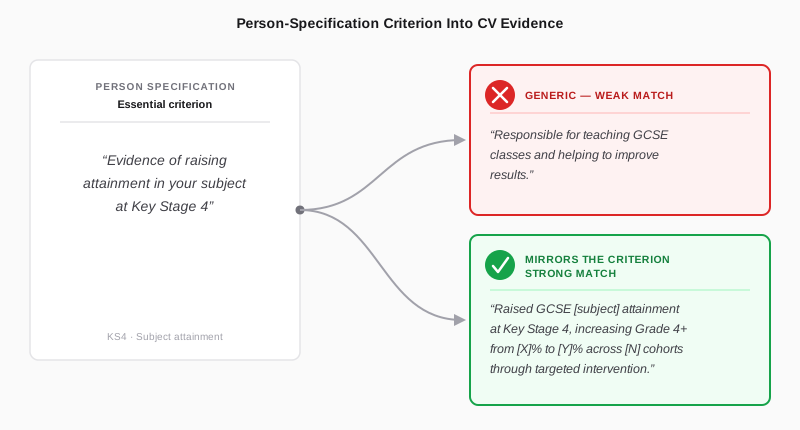
Take an essential criterion many secondary specifications include: "Evidence of raising attainment in your subject at Key Stage 4."
Candidate A writes a generic line:
- "Responsible for teaching GCSE classes and helping to improve results."
It names no key stage in the specification's language, offers no evidence, and gives a scorer nothing to tick. Candidate B mirrors the criterion and attaches a measurable outcome:
- "Raised GCSE [subject] attainment at Key Stage 4, increasing Grade 4+ from [X]% to [Y]% across [N] cohorts through targeted intervention and data-led assessment."
The experience behind both lines can be identical. Only the second one matches the criterion's wording and hands the panel - or the parser - the exact terms it is scoring for. Fill the brackets with your real figures; never invent them.
FAQ
Do schools accept a CV for teaching jobs, or do I need an application form? For most classroom roles in England, you must complete the school's own application form. Under KCSIE safer-recruitment guidance, a CV alone isn't a sufficient application for roles in regulated activity, and is only accepted alongside a full form. Supply agencies, some independent and international schools, and many HE roles are the main exceptions where a CV leads.
Which ATS or job sites do UK schools use? The common platforms are Tes Jobs, Eteach, and MyNewTerm, plus school-and-MAT systems such as CVMinder. They advertise vacancies, collect applications, and help panels shortlist - increasingly with anonymised, name-blind screening.
Does a teaching CV need keywords like a corporate CV? Yes, but the source is the person specification, not a generic keyword list. Mirror its essential criteria in the specification's own terminology, because shortlisting scores your application against those criteria directly.
How long should a teaching CV be? For UK teaching, two pages is the usual expectation - long enough to evidence your experience against the criteria, short enough to stay readable. Prioritise the essential criteria on the first page.
Will an ATS reject my teaching CV if it's a Canva template? It can. Design-led templates often use columns, text boxes, or text baked into images that parsers can't read. A clean, single-column, text-based document is safer for both school ATS platforms and anonymised shortlisting.
Scan your teaching CV free - Shadow CV checks it against the exact language of the role you're targeting, the same way a person specification or an ATS scores it. The £5 rewrite turns it into a clean, single-column, keyword-aligned document that parses correctly and reads well to a shortlisting panel - once, no subscription, no account needed.