Key Takeaways
- Lead your social worker CV with a registration block: Social Work England number, registered-since date, any AMHP or BIA annotation, qualifying degree and a dated ASYE line.
- Employers must check that number against the public register before you start.
- Agency work in children's services needs three years of council experience your work history has to show.
A social worker CV makes one claim the employer is required to check. "Registered social worker" is not a skill. It is an assertion that your name, number and status sit on a public register that Social Work England updates in real time, and the regulator's guidance for employers puts the check first: as an employer of a social worker you "must: check that your employee is registered with us". The guides ranking for "social worker CV" - Indeed UK, PurpleCV and CVMaker, all checked directly - cover the sections and the soft skills. One mentions the protected title. None explain how the check works, what the register shows, or that a second set of rules now decides whether a children's social worker can take agency work at all.
Who Checks a Social Worker CV - and What They Check It Against
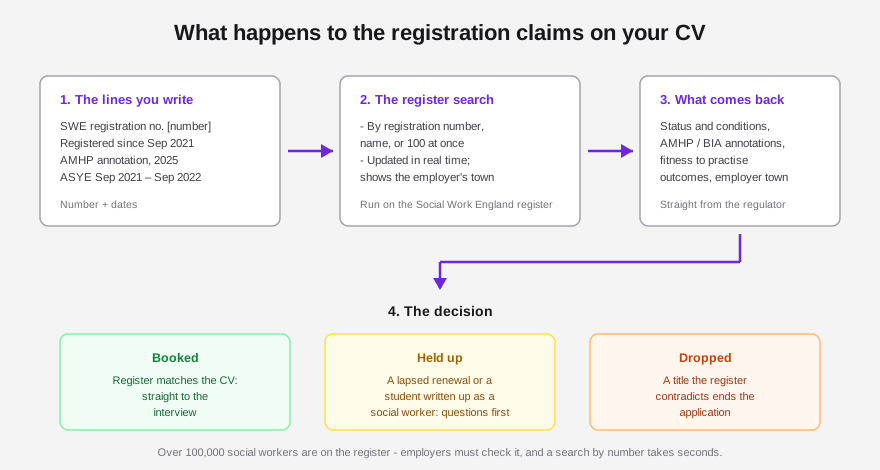
Social Work England's guide to the register is plain about what it is for: "to be able to practise as a social worker in England, individuals must be registered with Social Work England. Once registered, all social workers are listed on our public register." Anyone can search it by name or registration number, and the regulator's own advice is that "the quickest way to find a social worker on the register is to search using their registration number". Employers get a bulk version: up to 100 registration numbers at once, results downloaded as a CSV. That is how a shortlist is checked, and it runs on the number, not the name.
What comes back is more than a yes or no: name, number and registration status, the postal town of your current employer, any conditions, any annotation as an approved mental health professional (AMHP) or best interests assessor (BIA), and the outcome of any fitness to practise case, all "updated in real time".
The law behind the search is regulation 28 of the Social Workers Regulations 2018: "A person may not practise as a social worker in England unless they are a registered social worker", and "A person must not use the title of 'social worker' unless they are a registered social worker." Regulation 31 makes it an offence, with intent to deceive, to use the title, to claim to be registered, or to claim a social work qualification you do not hold. The regulator's misuse-of-title guidance adds: "a qualification alone does not make you a registered social worker".
The register also has a clock on it. Registration is renewed every year between 1 September and 30 November: a form, a fee of £122 for the 2026 to 2027 year under the regulator's fees guidance, and at least two pieces of recorded CPD, one with a peer reflection. Miss it and your status becomes "No longer registered – failure to renew", you cannot practise or use the title, and restoration from 1 December 2026 costs £183 and can take 20 working days or more. That window is open as you read this.
The market behind the check is large and still short-staffed. The Department for Education's children's social work workforce statistics, published 19 March 2026, count 36,200 full-time equivalent child and family social workers at 30 September 2025, up 5.4% on the year, with 6,000 vacancies, a 14% vacancy rate, and 5,400 agency workers. Social Work England's annual report for 2024 to 2025 puts the register "above 100,000 social workers".
The Registration Block Every Social Worker CV Needs
Put the evidence where the first glance lands - a short block under your contact details, before the work history - in the fields the register and the reference form use:
Social Work England registered social worker - registration no. [your number]; registered since September 2021; AMHP annotation, 2025
BA (Hons) Social Work - [university], 2021
ASYE completed - children's services, [council], Sep 2021 – Sep 2022
Registration renewal submitted for 2026 to 2027; CPD with peer reflection recorded
Enhanced DBS with children's barred list check, issued July 2026; registered with the DBS Update Service
The registration line is the search key. Give the number and the bulk checker confirms you in seconds; leave it off and someone has to search a common name across 100,000 entries. The register lists the town of your current employer, so update it when you move: a CV that says Leeds and a register that says Bristol is a mismatch a screener has to resolve first.
The degree line is a legal claim. Regulation 31 covers falsely claiming "to possess a qualification in relation to social work", so name the qualification and the university exactly as the certificate does. The register does not show it, which is why the certificate is asked for at offer.
The ASYE line is where post-qualifying experience starts. Skills for Care defines the Assessed and Supported Year in Employment as "a 12-month, employer led and employment-based programme of support and assessment for newly qualified social workers"; the DfE's child and family version is optional on paper, "but most employers will expect you to take part". Give the employer, service and months, because that year counts towards the agency-rules threshold below.
The renewal line pre-empts the December question. While the register is updated from 1 December, Social Work England warns employers that "some social workers may have a 'registered until' date of 30 November". One line saying the renewal is in answers it.
The DBS line has to be right before day one. Social Work England's employer duties include ensuring "that your employee has had relevant DBS checks". Write the level and barred list, the month, and whether you are on the Update Service; the certificate number stays off, as it does on a care assistant CV.
Not registered yet? Never borrow the protected title. Social Work England's guidance is that a student "should use the terms 'social work student' or 'student in social work'", and a graduate waiting for registration is a graduate: "Social work graduate - BA (Hons) Social Work, 2026; Social Work England registration applied for, July 2026". It is the only line that is true, and every employer knows what it means.

Social Worker CV Keywords: Safeguarding, Section 47, Care Act
Councils and agencies surface CVs by exact-term search, and the terms are the statute's own, so use them as the advert does, following our guide to finding ATS keywords:
- Registration and compliance: Social Work England registered, registration number, AMHP, BIA, ASYE, practice educator, enhanced DBS, CPD and peer reflection
- Children and families, in the Children Act's words: section 47 enquiries, child in need (section 17), child protection conference, child protection plan, looked after children, care proceedings, Public Law Outline, court work, duty and assessment, Working Together to Safeguard Children
- Adults, in the Care Act's words: Care Act 2014 assessments, section 42 safeguarding enquiries, Mental Capacity Act 2005, best interests decisions, Deprivation of Liberty Safeguards, Mental Health Act assessments, hospital discharge, direct payments
- Systems and evidence: case recording, chronologies, court reports, supervision, multi-agency working, Liquidlogic (System C's case management system, widely used by English councils)
The children's list is checkable in a way most CV keywords are not: the DfE's standard reference form for agency children's social workers asks the referee to tick the area of practice - child in need and child protection, looked after children, fostering, adoption - and whether the assignment included court work. Name those areas in the same words and the reference will match the CV.
How to Write the Work History on a Social Worker CV
The structure is the standard one - most recent first, employer, title, month-and-year dates, two to four evidence bullets per job, as in our guide to the work experience section - with two adjustments a set of government rules now forces.
Make the employer type and the service visible on every entry. The DfE's Agency Rules, statutory guidance in force since 31 October 2024, tell councils they "should not engage agency child and family social workers with less than three years post-qualifying experience (PQE) in direct employment of an English local authority practising in a child and family context while registered as a social worker with a UK regulator". The guidance defines what counts: the three years can be built up across several councils, statutory leave and an ASYE year count, "unpaid career breaks should not", and nothing outside direct council employment counts - not agency assignments, and not practice outside England. The rules cover children's services only.
That sum is done from your CV. So every entry says which council, whether you were directly employed or on assignment through a named agency, whether the team was children's or adults', and the months. "Social Worker, 2022 – 2026" gives the reviewer nothing to add up. A dated career break is honest and simply subtracted; our guide to explaining employment gaps has the wording.
Write the bullets the reference form will score. The same rules say a council should "require at least two detailed practice-based references for all agency child and family social workers before offering an assignment", on a standard template. Section 1 is factual: job title, dates, area of practice, court work. Section 2 grades you A to D under knowledge and record keeping, assessment and intervention, working effectively with others, and professionalism, then asks "Would you re-employ this worker in a similar role". The strongest bullets are the ones a referee can tick: the caseload and what was on it, the enquiries you led, the proceedings you gave evidence in, the state of your records at audit. "Safeguarding and multi-agency working" is a heading on that form, not evidence.
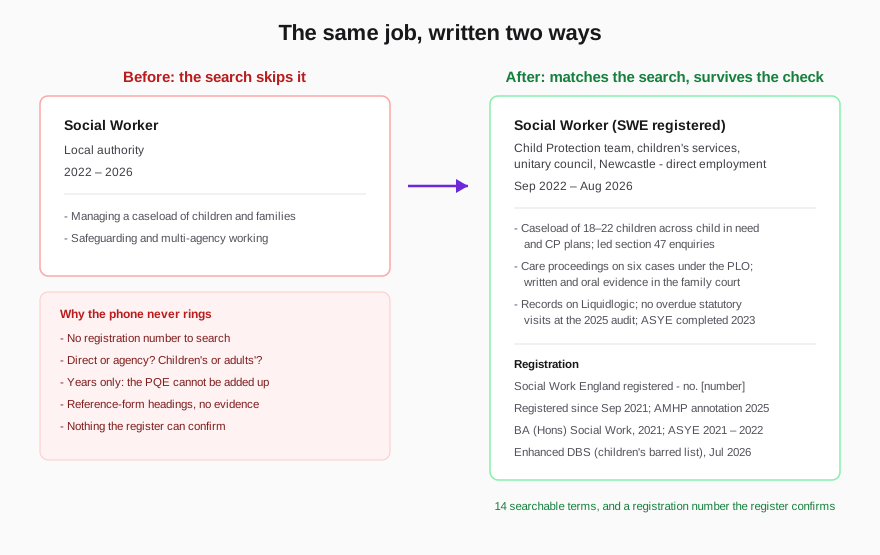
Agency assignments get one dated entry each, naming the council. Assignments do not count towards PQE, so a reviewer needs to separate them from direct employment at a glance: "Agency social worker (via [agency]) - Child Protection team, [council], Feb 2025 – Jul 2025". The same guidance sets a four-week notice period on assignments and a three-month wait after you leave a substantive post in the same region; neither belongs on the CV, but both explain questions an agency will ask first.
Five Social Worker CV Mistakes That Cost You Interviews
- "Social Work England registered" with no number. The bulk checker runs on numbers; a CV that cannot be searched waits behind the ones that can.
- "Social worker" on a student's or graduate's CV. The title is protected under regulation 28, and using it with intent to deceive is an offence under regulation 31. "Social work student" or "social work graduate, registration applied for" gets the interview.
- No employer type or service on the entry. Without "direct employment", "children's services" and months, nobody can add up your PQE, and under the agency rules that sum decides whether you can be engaged.
- Headings instead of evidence. "Safeguarding" is a section of the reference form. The caseload, the section 47 enquiries and the court work are what the referee grades.
- A designed template. Columns, icons and sidebars break the parse an agency database runs before a person looks. One column, standard headings, a plain-text registration block.
FAQ
Should you put your Social Work England registration number on your CV?
Yes. It is the search key: the regulator says searching by number is the quickest way to find you, employers check up to 100 numbers at a time, and the DfE's standard reference form asks for it on its first line. The number is already public on the register, so leaving it off protects nothing.
Can you call yourself a social worker before you are registered?
No. In England only a person on the Social Work England register may use the title, and using it with intent to deceive is a criminal offence. Students write "social work student"; graduates waiting for registration write "social work graduate" with the date they applied.
What are the agency rules for children's social workers?
DfE statutory guidance in force since 31 October 2024 says councils should not engage agency child and family social workers with less than three years of post-qualifying experience in direct council employment in children's services, should take two detailed practice-based references first, and should apply a four-week notice period and a three-month regional cool-off. The rules do not apply to adults' or mental health assignments.
What happens if you miss the registration renewal deadline?
If you have not renewed by 30 November you are removed from the register as "failure to renew", cannot practise or use the title, and must apply to restore, which costs £183 from 1 December 2026 and can take 20 working days or more. Renewal opens on 1 September and needs the form, the fee and two pieces of CPD, one with a peer reflection.
Does Social Work England registration cover Scotland, Wales and Northern Ireland?
No. Each nation keeps its own register: the Scottish Social Services Council, Social Care Wales and the Northern Ireland Social Care Council. Regulation 28 lets a social worker registered with one of those bodies practise in England "on a temporary basis"; a permanent move means registering with that nation's regulator and putting that number on the CV.
A social worker CV has to match an exact-term database search, then survive a real-time register check and a two-reference form. Run yours through Shadow CV's free scan to see what the software actually extracts - whether your registration number, qualification, ASYE dates and DBS line came through, and which of the advert's terms are missing. If the scan finds gaps, the £5 rewrite fixes the structure and works the sector's vocabulary in naturally - once, no subscription.