Key Takeaways
- A care assistant CV is checked against a legal list before anyone judges the writing: a full employment history with every gap explained, DBS status, and conduct in previous care roles.
- Put your DBS level, Update Service status and Care Certificate progress where the screener looks first.
- Use the employer's role name and the advert's exact terms.
Most care assistant CV guides say what every CV guide says: a personal statement about compassion, a skills list, two pages, tailor it. What they miss is that before a care provider in England can employ you, the law requires it to hold specific information about you, and the CV is the first place it looks for most of it. Supply that information cleanly and you are the easy candidate to process. Send a generic CV and the provider chases you for the rest while the next applicant gets started.
What Makes a Care Assistant CV Different From Every Other CV
Care providers registered with the Care Quality Commission (CQC) operate under the Health and Social Care Act 2008 (Regulated Activities) Regulations 2014. Regulation 19, "Fit and proper persons employed", requires the information in Schedule 3 of the regulations to be confirmed before someone is employed. Schedule 3 is short, and two of its items rewrite the usual CV advice.
The first is "a full employment history, together with a satisfactory written explanation of any gaps in employment". Not the last ten years. Not the relevant roles. All of it, with the gaps accounted for in writing. The second is "satisfactory evidence of conduct in previous employment" in health or social care, or work with children or vulnerable adults, and, where you left such a role, verification of why it ended. The rest of the list is identity, a criminal record check, proof of relevant qualifications, and health information relevant to the work.
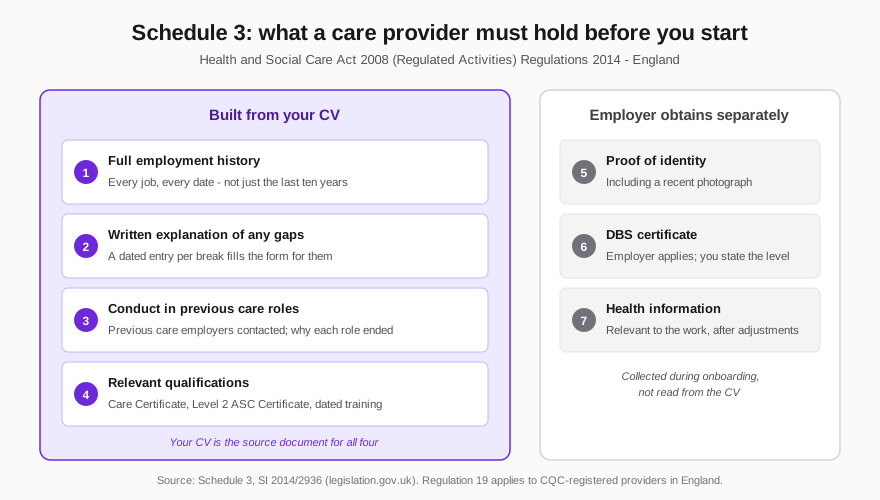
Three things follow for your CV:
- The ten-to-fifteen-year rule does not apply. The general advice on how far back a work experience section should go is to compress older roles. In care, compress all you like, but nothing drops off.
- Gaps are a form field, not a judgement call. The provider must record a written explanation for each one. A dated entry on the CV fills the form for them.
- Your previous care employers will be contacted. Nothing on the CV should contradict what they will say.
This is why so many providers insist on their own application form: it captures Schedule 3 in one place. Your CV is what you copy it from and what the interviewer holds, so the two must agree. Regulation 19 covers England; Scotland, Wales and Northern Ireland have their own care regulators, and the safe assumption everywhere is the same: write the full history. Care is not the only sector that verifies a CV's claims - the card named on a construction CV is scanned against the CSCS database at the site gate, and the SIA licence on a security guard CV is checked against a public register - but here the checklist is statutory. It is the same statutory checklist a dental nurse CV has to satisfy, because dental practices in England are CQC-registered too. A nursery practitioner CV meets the early years version of the same idea: the qualification is checked against a Department for Education list before the practitioner can count in staff:child ratios. And a social worker CV is checked against a public register that employers are required to search before the first day.
The Care Job Market You Are Writing Into
Skills for Care, the workforce body for adult social care in England, publishes the sector's supply and demand figures annually. Its June 2026 report, The size and structure of the adult social care sector and workforce in England, puts the sector at 1.69 million posts for 2025/26: 1.59 million filled and 96,000 vacant on any given day. That is a 6.2% vacancy rate, the lowest since 2015/16 and well down from the 10.4% peak of 2021/22, but still around three times the rate in the wider economy.
The vacancies are not evenly spread. Skills for Care's estimate for domiciliary (home) care was a 9.1% vacancy rate against 3.8% in care homes without nursing and 3.9% in care homes with nursing. If you want to start quickly, home care is where the openings are, and a home care CV should say plainly whether you drive and have access to a car.
The pipeline has changed too. The Health and Care Worker visa route closed to new overseas care worker applicants in July 2025, and Skills for Care estimates around 30,000 international recruits started direct care roles in 2025/26, down from 105,000 two years earlier. Providers that used to recruit abroad are now recruiting at home, under time pressure, and the candidate whose compliance information is already on the page is the one they can move fastest.
Where to Put Your DBS, Care Certificate and Training
The vetting items belong near the top of a care assistant CV, under your contact details and personal statement, in a block a screener can read in seconds. Three things go in it.
Your DBS status, stated precisely
GOV.UK lists four levels of Disclosure and Barring Service check: basic, standard, enhanced (which adds relevant local police information) and enhanced with barred lists (which adds whether you are barred from the role). The government's DBS leaflet for adult social care roles states that anyone providing personal care, which covers washing, dressing, toileting, eating and drinking, can be asked for an enhanced check with an adults' barred list check, whatever the setting.
"DBS checked" tells a screener almost nothing. Write the level, the date and whether it is on the Update Service:
Enhanced DBS (Adults' Barred List) - issued Mar 2025 - registered on the DBS Update Service
The Update Service is the detail that speeds everything up. It costs £16 a year, you must register within 30 days of the certificate being issued, and it lets an employer check online, with your consent, that a certificate from a previous role is still current. GOV.UK is explicit that a DBS certificate has no official expiry date and that an employer can accept one from a previous role if it is the right level and type and nothing has changed. Leave the certificate number off the CV.
Your Care Certificate, with the standard count right
The Care Certificate sets out the knowledge, skills and behaviours expected of people new to care, and is normally completed during induction. Skills for Care's updated 2025 version has 16 standards, one more than most CV templates still describe, after a standard on learning disability and autism awareness was added. Name it with the date and, if you are partway through, how far:
Care Certificate (16 standards) - completed Jun 2024 or Care Certificate - 11 of 16 standards signed off, in progress
If you hold the Level 2 Adult Social Care Certificate, the accredited qualification built on the same standards, list it with the awarding body and year - the four-part format that applies to any certificate or training course on a CV.
Your mandatory training, dated
Moving and handling, safeguarding adults, medication administration, infection prevention and control, basic life support, food hygiene, Mental Capacity Act and Deprivation of Liberty Safeguards, dementia awareness. Each with a month and year. Training expires on the provider's matrix, so an undated line is useless to them, and every phrase above is an exact-match term a recruiter searches for.

How to Write the Work History on a Care Assistant CV
The structure is the standard one: most recent first, job title, employer, location, month and year dates, then two to four lines of evidence. What changes in care is completeness and vocabulary.
Keep the timeline continuous. Month and year on every entry, and a dated entry for any break. "Career break - caring for a family member (Sep 2022 – Mar 2023)" is a complete explanation, and exactly what the Schedule 3 form will ask for. Our guide to explaining employment gaps on a CV covers the wording; the care-specific difference is that leaving the gap silent is not an option.
Name the setting and the people. The advert is for a specific setting and client group. "Residential care home, 32 beds, older adults including dementia care" or "Domiciliary care, 8 to 10 visits per shift, adults with learning disabilities" places you immediately.
Write the tasks in the sector's words. Personal care, moving and handling with hoists, MAR charts, care plans, daily records, end of life care, supporting meals and hydration, safeguarding concerns raised and recorded. These are the terms in the advert and in the recruiter's search.
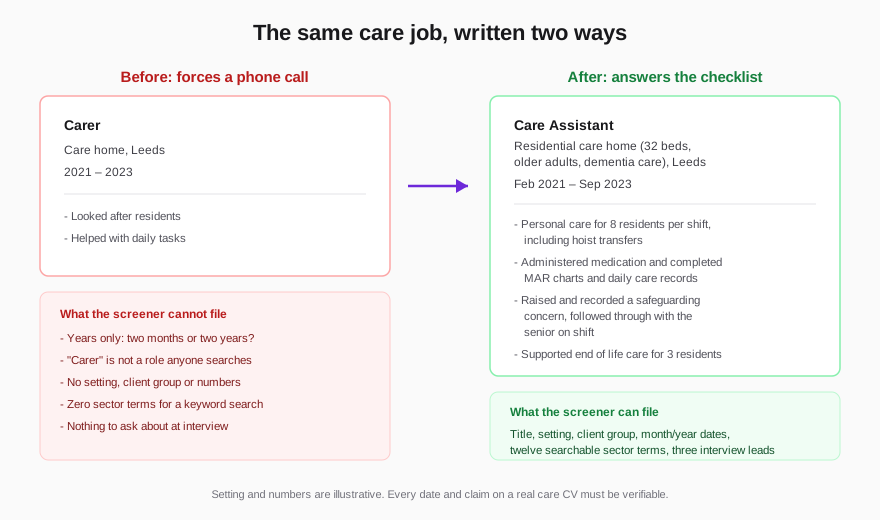
The first version says nothing searchable and forces a call about the dates. The second answers the Schedule 3 questions and gives the interviewer three things to ask about.
Use the employer's role name. The Department of Health and Social Care's care workforce pathway for adult social care, updated in July 2026, names the direct care roles: new to care, care or support worker, enhanced care worker, personal assistant, supervisor or leader, up to registered manager. Adverts increasingly use those names. If the advert says "care and support worker", your title line says "care and support worker", not "carer", which is what you call yourself at home and not what anyone searches for.
Volunteering and unpaid caring count. Both go in the work history with dates: both are experience, and both fill what would otherwise be a gap. If you are writing a CV with no paid experience, a dated volunteering entry in a care setting plus your Care Certificate progress is a credible first care CV.
Mistakes That Slow a Care Application Down
- Years-only dates. "2021 – 2023" could be two months or two years. The provider cannot file it as a full history without ringing you.
- Dropping old jobs to save space. Compress them to one line each; never delete them.
- "DBS checked" with no level, date or Update Service status. The screener has to ask, and a screener with 96,000 vacancies to fill would rather not.
- Undated training. To a training matrix, a certificate without a date is an expired certificate.
- A two-column template. Job boards and provider career sites parse your CV before a person sees it. A sidebar that separates your training block from your dates is a parsing failure waiting to happen.
FAQ
Do you need a DBS check before applying for a care assistant job?
No. Standard and enhanced checks are requested by the employer, not the applicant, so a provider expects to apply for one during onboarding. If you already hold an enhanced certificate with the adults' barred list check, especially one on the Update Service, say so on the CV: it can save the provider the wait for a new one.
Does a care assistant CV need to go back further than ten years?
Yes. Schedule 3 of the 2014 regulations requires a CQC-registered provider in England to hold a full employment history with a written explanation of any gaps before employing you. Older roles can be compressed to a single line of title, employer and dates, but they stay on the CV.
Can you get a care assistant job with no experience?
Yes, and the sector is built for it. "New to care" is a named role on the government's care workforce pathway, the Care Certificate is designed to be completed during induction, and Skills for Care counted 96,000 vacant posts in England in 2025/26. A first care CV leans on dated volunteering or unpaid caring and plain evidence of reliability.
Should you put your DBS certificate number on your CV?
No. State the level, the issue date and whether it is on the Update Service. The provider verifies the certificate itself during onboarding. A certificate number on a document sent to many employers is a privacy risk with no upside.
What is the difference between a care assistant CV and a healthcare assistant CV?
Mostly the employer. Healthcare assistants usually work for the NHS, where applications run through Trac and NHS Jobs and are scored against a person specification, which our NHS CV guide covers. Care assistants mostly work for CQC-registered independent providers and local authorities, where Schedule 3 shapes the process. The vetting block, dated training and full history in this post serve both.
A care assistant CV has to satisfy a legal checklist and persuade a person. Run your CV through Shadow CV's free scan to see what a screener's software actually extracts from it - whether every role and date came through, whether your DBS and training lines survived the parse, and where the advert's terms are missing. If the scan finds problems, the £5 rewrite fixes the structure and works the sector's vocabulary in naturally - once, with no subscription.