Key Takeaways
- The skills to put on a CV are specific, verifiable and technical: tools, systems, qualifications and named methods, written exactly as the advert writes them.
- Ten to twelve is enough. A forty-item list ranks no better and reads worse.
- Soft skills belong in your work history as evidence, not in a list as adjectives.
The National Careers Service publishes the UK government's guidance on how to write a CV. It lists five sections: contact details, introduction, education history, work history and references. There is no skills section on that list.
That is not an oversight, and it is not a reason to delete yours. It tells you something about what the section is actually for. The five sections are what a human reader needs. The skills section survives on modern CVs because of the second reader - the software that parses your CV and the recruiter who searches the database afterwards. Once you know which of those two readers the section is written for, the question of what skills to put on a CV mostly answers itself.
Most advice on this gets it backwards. Search for skills to put on a CV and you will find lists of 50, 100, sometimes 150 suggested skills, sorted into hard and soft, with no guidance on which ones are worth the space on your two pages.
Where the skills section sits on a UK CV
A skills section does one job well: it holds exact terms that a machine can match and a recruiter can search for.
Recruiters do not browse a database. They search it, using the specific terms a vacancy calls for - a qualification, a system, a named method. A CV that contains "SQL" is returned by that search. A CV that describes the same work as "querying our reporting database" is not. The skills section is where you make sure the exact term is present in a form that cannot be missed.
That framing rules a lot of common content out. It is not a personality summary, not a place for adjectives, and not a second personal statement. Anything in it that a recruiter would never type into a search box is taking up space and earning nothing. The same evidence-or-nothing test decides whether hobbies and interests belong on your CV at all.
Key point: If you cannot imagine a recruiter typing it into a search box, it does not belong in your skills list.
What skills UK employers say they cannot find
There is good UK data on which skills employers struggle to recruit, and it is not the data the CV-template sites quote.
The Department for Education's Employer Skills Survey 2024 - a telephone survey of 22,712 employers across the UK, carried out by IFF Research - asked employers with vacancies they could not fill what the applicants were missing. There were 250,500 of these skill-shortage vacancies in the UK in 2024, around 27% of all vacancies.
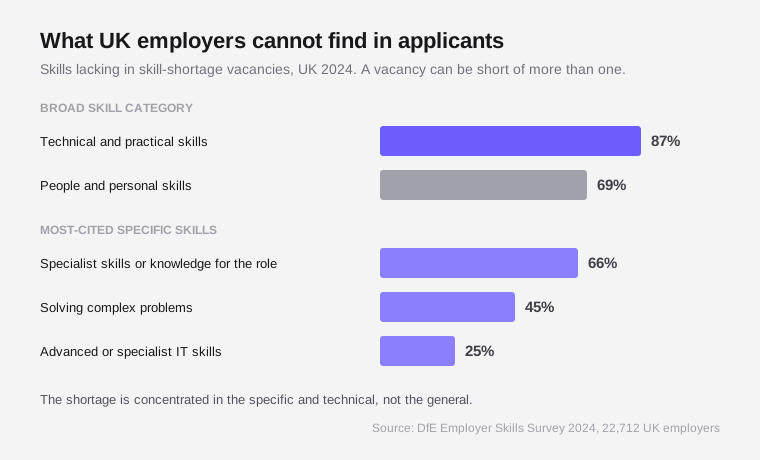
Technical and practical skills were a factor in 87% of those vacancies. People and personal skills were a factor in 69%. Both matter, and the two overlap - a single vacancy can be short of each. But look at what tops the specific list: "specialist skills or knowledge required for the role" was cited for 66% of skill-shortage vacancies, ahead of everything else. Solving complex problems came next at 45%, up sharply from 36% in 2022, followed by advanced or specialist IT skills at 25%.
The pattern is consistent. What employers report they cannot find is specific and role-bound. "Communication" is not what is scarce.
Hard skills belong in a list. Soft skills do not.
The distinction that matters is not hard versus soft. It is verifiable versus asserted.
A hard skill is a noun with a fact behind it. Xero. IOSH Managing Safely. Python. IFRS. SAP. Level 3 Diploma in Adult Care. Each one is either true or not, a recruiter can search for it, and it survives being asked about at interview. Languages pass the same test once they carry a level: "Spanish - B2" is checkable where "Spanish - good" is not, and how to list languages and levels on a CV covers the scale UK employers recognise. The last two of those are qualifications rather than skills, and they earn more in their own block than in this list - where certificates and training courses go on a CV sets out the split. In some trades the fact sits on a register: an electrician's ECS card and JIB grade can be checked online before anyone picks up the phone.
A soft skill in a list is an adjective about yourself. "Excellent communicator" is a claim with nothing attached. Every candidate writes it, so it distinguishes nobody, and no recruiter has ever searched a database for "team player" to build a shortlist. It costs you a line and returns nothing.
This is not an argument that soft skills do not matter - the survey above says plainly that they do, in more than two-thirds of hard-to-fill vacancies. It is an argument about where they go. A soft skill asserted in a list is worthless. The same skill shown in a work-history bullet, with a situation and an outcome attached, is evidence.

How many skills to put on your CV
Ten to twelve, in most cases.
A long list looks like thoroughness and reads as padding. Forty skills tells a recruiter you have not decided which of them matters, and it dilutes the terms that would otherwise stand out. It also strongly suggests some of them are not real, which invites the kind of interview question you do not want.
Choose them like this:
- Take the essential requirements from the advert first. Every named tool, system, qualification or method in the essential criteria goes on the list if you genuinely have it. Our guide to finding the right ATS keywords for a role covers the three sources worth mining for these.
- Match the employer's exact wording. "PRINCE2" not "Prince 2". "A/B testing" not "AB testing". Software matches literally and recruiters search literally.
- Write the full term at least once. "Chartered Institute of Personnel and Development (CIPD)" covers both the search for the acronym and the search for the full name.
- Order them by relevance to this advert, not by how good you are at them. The first four are the ones a skim-reader takes in.
- Cut anything universal. Email, Microsoft Word and "internet research" are assumed. Listing them makes an experienced candidate look junior.
Where soft skills actually earn their place on your CV
Move them into the work history, where they arrive attached to something that happened.
The National Careers Service recommends describing each role in two to three lines using the STAR method - situation, task, action, result. That structure does the work a skills list cannot: it names the skill and proves it in the same sentence.
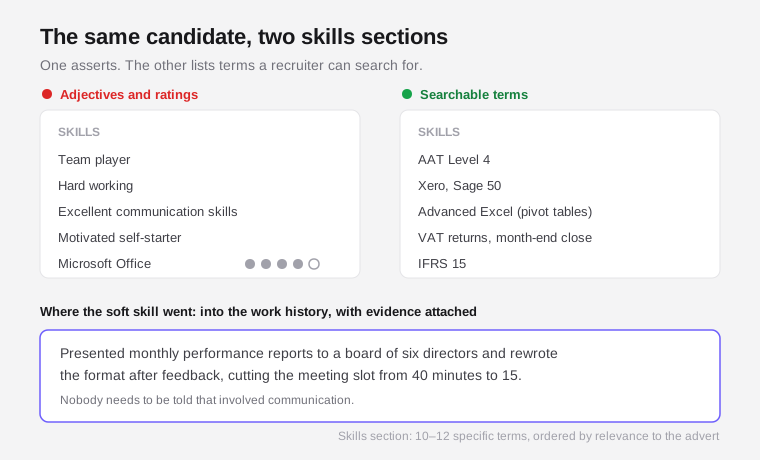
"Excellent communication skills" in a list says nothing. The same claim, relocated: "Presented monthly performance reports to a board of six directors and rewrote the format after feedback, cutting the meeting slot from 40 minutes to 15." Nobody needs to be told that involved communication. Our formula for CV bullet points breaks down how to build these so they hold up to both readers.
Your introduction is the other place a soft skill can live honestly, because there it is framed as a summary of a career rather than a standalone assertion. What that section should actually say is worth getting right - it is four lines, and it sits above everything else on the page.
Skills section mistakes that cost you interviews
- Star ratings and progress bars. A five-dot rating next to "Excel" is an image to a parser, so the skill name often disappears with it. We tested Canva CV templates through ATS simulation and graphical skill ratings were among the clearest failure points. They also invite the obvious question: who decided that was four dots and not three?
- Skills that appear nowhere else. If "project management" is in your list but no role in your work history mentions managing a project, the claim is unsupported. A recruiter reading properly will notice, and it is the first thing an interviewer probes.
- Acronyms with no expansion. "AAT" and "Association of Accounting Technicians" are different search terms. Use both once.
- Skills copied from a job you did not get. Tailoring is fine; inventing is not. Nothing on the list should be something you would rather not be asked about.
- A section that never changes. The list is the fastest part of a CV to tailor, and the part most people leave untouched from application to application.
FAQ
How many skills should I put on my CV?
Ten to twelve is the working range for most UK CVs. That is enough to cover the essential criteria of a specific advert without diluting them. If you are listing more than fifteen, some of them are either universal, unsupported by your work history, or irrelevant to the role you are applying for.
Should I put soft skills on my CV?
Yes, but not as a list of adjectives. Employers genuinely do struggle to find people and personal skills - the DfE's Employer Skills Survey 2024 found them a factor in 69% of skill-shortage vacancies. The place to demonstrate them is in your work-history bullet points, where the skill comes attached to a situation and a result rather than standing alone as a claim.
Does a CV need a skills section at all?
The National Careers Service's five recommended CV sections do not include one, so a CV without it is not wrong. In practice it is worth keeping, because it is the most reliable place to put exact terms that a parser and a recruiter database search will pick up. Keep it short and specific and it costs you very little space.
What skills are UK employers actually short of?
Specific, role-bound technical ones. In the Employer Skills Survey 2024, "specialist skills or knowledge required for the role" was cited in 66% of skill-shortage vacancies - well ahead of any single people or personal skill. Solving complex problems was cited in 45%, and advanced or specialist IT skills in 25%.
Where should the skills section go on the page?
Below your introduction and above or below your work history, depending on how much experience you have. Early in your career, put it high - it is carrying more of the evidence. With ten years of relevant roles behind you, the work history is the stronger material and the skills list works fine further down as a summary of terms.
A skills list is the easiest part of a CV to write and the easiest to get wrong, because nothing about it looks broken. Shadow CV scans your CV the way an employer's software does and shows you which of the role's terms are actually present, which are missing, and which are buried where nothing will find them. The £5 rewrite puts them where they count - once, with no monthly subscription.
Check what your CV is missing - free scan, no account needed.