Key Takeaways
- Certificates and training courses go in their own short block, not buried in your education section, and near the top only when the advert makes one essential.
- Write each line as qualification title, level, awarding organisation, year.
- A named level and awarding body is what makes a certificate checkable, and what makes it match the advert.
Ofqual, the qualifications regulator for England, recorded 5.2 million certificates issued for vocational and other qualifications in the 12 months to March 2026. Most of the advice on where certificates and training courses go on a CV stops at "make a separate section". That is the easy half. What decides whether the certificate does any work for you is how the line is written, because a UK recruiter can check the claim against a free public register before they finish page one.
Where certificates and training courses go on a UK CV
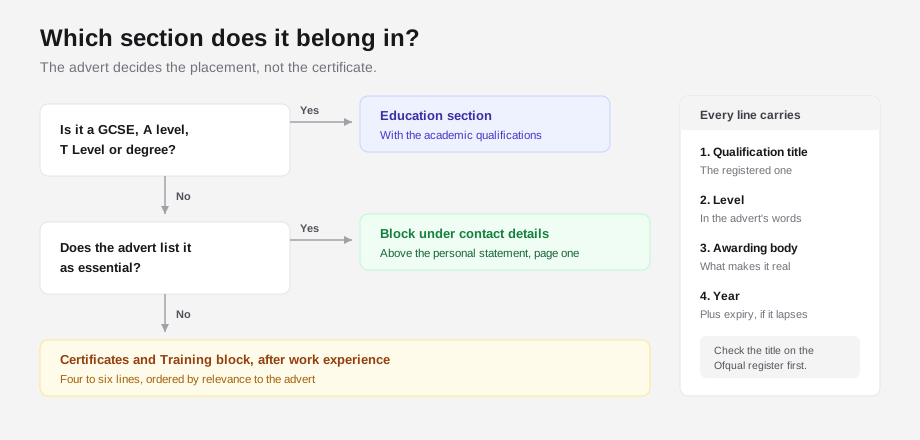
The section is decided by the advert, not by taste.
- The advert lists it as essential. Put it in a short block directly under your contact details, before the personal statement. A screener working through a pile is looking for that one term and should not have to reach page two for it. This is the same logic that puts a CSCS card near the top of a construction CV.
- The advert lists it as desirable, or does not mention it. A block headed Certificates and Training after your work experience, before or beside education.
- It is a full academic qualification. GCSEs, A levels, T Levels and degrees belong in the education section, with the rules set out in the education section guide. A Level 3 diploma is a qualification too, but it reads better with the vocational block, next to the training it sits alongside.
One block, four to six lines, is the working shape. Beyond that the entries that matter get diluted by the ones that do not apply. Order by relevance to the advert, not by date: the certificate the job asks for goes first even if you earned it in 2019, and the interesting one you earned last month goes below it if nobody asked.
Regulated qualification, or certificate of attendance?
This is the distinction almost no CV guide makes, and it is the one a recruiter in a regulated sector applies without telling you.
A regulated qualification has been through an awarding organisation that a qualifications regulator recognises. It has a fixed title, a level, a number, and an entry on a public register. A certificate of attendance from a one-day course has none of that. Both are worth having. Only one is checkable, and writing the second as though it were the first is the kind of thing that gets noticed at reference stage rather than at CV stage.
Anyone can look it up. The Register of Regulated Qualifications, shared by Ofqual and CCEA Regulation, lets you "find out if a qualification is regulated (officially recognised)", "see detailed information about a qualification", and "compare similar qualifications". A companion GOV.UK service does the same for the provider. Neither needs an account.
The framework is not the same across the UK, which matters if you trained in one nation and are applying in another:
- England and Northern Ireland. Ofqual and CCEA Regulation, on the shared Register of Regulated Qualifications.
- Scotland. The Scottish Credit and Qualifications Framework, which runs to 12 levels and measures size in credit points, where one point is 10 notional hours of learning. It has its own register.
- Wales. Qualifications Wales runs the QiW database, covering qualifications approved or designated for teaching in Wales for learners under 19, outside higher education.
Look your own qualification up once. You will get its exact registered title, which is rarely the phrase printed on the certificate in your drawer, and that title is what you should be writing.
How to write a certificate line that survives a check
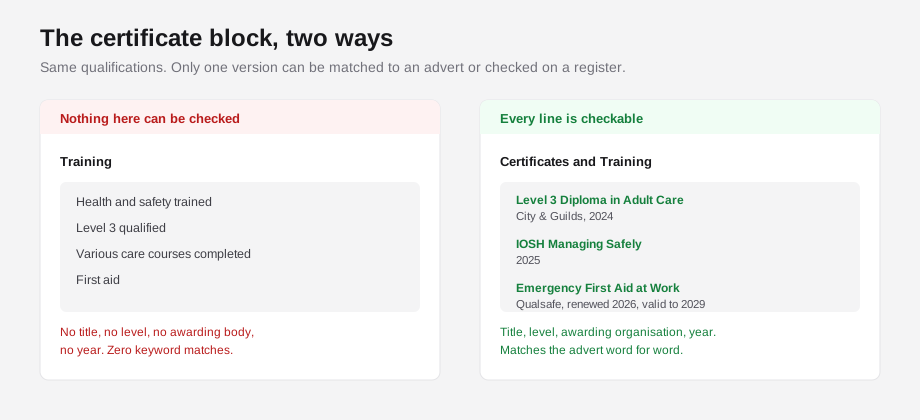
Four elements, in one line, in this order: qualification title, level, awarding organisation, year.
Level 3 Diploma in Adult Care - City & Guilds - 2024
IOSH Managing Safely - 2025
AAT Level 4 Diploma in Professional Accounting - 2023
Compare that with what most CVs carry: "Health and safety trained". "Level 3 qualified". "Various care courses completed".
None of those can be verified, matched or ranked. "Level 3 qualified" is the common one, and it fails for a specific reason: level alone says nothing about subject. A Level 3 Diploma in Adult Care and a Level 3 Diploma in Motor Vehicle Maintenance are the same level and the same size of achievement, and only one of them answers the advert.
Three details worth adding where they apply:
- An expiry or renewal date, for anything that lapses. First Aid at Work certificates, forklift tickets and site cards all have a life, and a recruiter who has been caught out before will assume the worst if the year on its own is four years old.
- "In progress", with the honest date. "Level 5 Diploma in Leadership and Management, City & Guilds - in progress, completing June 2027" is a legitimate and useful line. Writing it as completed is not.
- The awarding organisation, always. It is the field a screener searches when they want to know whether the thing exists.

The level is what the advert is actually asking for
When a UK job advert says "Level 3 qualification in childcare or equivalent", it is using the national qualification levels, and those levels are published on GOV.UK with worked examples at each step.
- Level 1 covers GCSE grades 3, 2 and 1, level 1 awards, certificates and diplomas, level 1 NVQs and level 1 functional skills.
- Level 2 covers GCSE grades 9 to 4, an intermediate apprenticeship, level 2 awards, certificates and diplomas, and level 2 NVQs.
- Level 3 covers A levels, T Levels, an advanced apprenticeship, access to higher education diplomas, and level 3 awards, certificates, diplomas and NVQs.
- Levels 4 to 8 run from higher national certificates through degrees to a doctorate.
Two consequences for the CV. If the advert names a level and you hold it, write the level explicitly, in the same words the advert used: a screener matching "Level 3" against "NVQ3" is making an inference, and inferences get skipped when there are enough applicants not to bother. And if you hold something at the right level under a different name, say so in the same line rather than hoping. "SVQ Level 3 Social Services and Healthcare (SCQF Level 7)" answers the question that "SVQ 3" leaves open for an English employer.
Key point: An advert that asks for a level is describing a filter, not a preference. Matching its exact words costs you nothing and removes the one judgement call a screener is least likely to make in your favour.
How ATS software reads your certificates
Recruitment software matches strings. It does not reason that a Level 3 Diploma in Adult Care satisfies a requirement for "Level 3 in care". The certificate block is one of the easiest places on a CV to win keyword matches, because the terms are fixed and identical to the advert's.
Three formatting rules keep the block readable to a parser:
- A plain heading. "Certificates and Training" or "Professional Development". Not "Continuous Learning Journey", which no parser has a category for.
- One certificate per line, no tables or columns. A two-column certificate block merges left to right in most parsers and produces lines like "Level 3 Diploma City & Guilds IOSH Managing Safely 2024 2025".
- The full name once, the acronym once. "Institution of Occupational Safety and Health (IOSH)" in the first mention covers both search terms. The method behind that, and how to pull the right terms out of an advert in the first place, is in the guide to ATS keywords.
Certificates are not skills, and they do not replace a skills section. A certificate proves a course was passed on a date. The skills section says what you can do now, and a recruiter reads the two together.
What to leave off
- Certificate numbers and learner reference numbers. Nobody needs them at CV stage, and the CV is a file you upload to job boards.
- Internal company training with a company-specific name. "Completed Beacon Level 2" means nothing outside the employer that ran it. Describe what it covered, or drop it.
- Courses implied by a later qualification. If you hold a Level 3, the Level 2 in the same subject takes a line without adding a fact.
- Anything expired, unless you say so. An out-of-date first aid certificate written as current is a correction waiting to happen at induction.
- Six short online courses listed one per line. One summarising line reads better than six that each look like a qualification and are not.
FAQ
Should certificates go in the education section or their own section on a CV?
Their own short block, in almost every case. The education section is where a UK reader expects GCSEs, A levels and degrees, and mixing a first aid certificate in with a degree makes both harder to scan. Put the block after work experience by default, and above the personal statement when the advert names the certificate as essential.
How do I check whether my qualification is officially recognised?
Search the Register of Regulated Qualifications, run jointly by Ofqual and CCEA Regulation. It is free, needs no account, and returns the registered title, level and awarding organisation. A separate GOV.UK service checks whether the organisation that awarded it is recognised in England or Northern Ireland. Scotland has its own SCQF register, and Wales has QiW.
Do I put training courses on my CV if they are not qualifications?
Yes, if they are relevant to the advert and written honestly. A one-day course is not a qualification, so give it the course name, the provider and the year, and do not attach a level to it. Two courses that match the job description are worth more than eight that show you attend things.
What does "Level 3 or equivalent" mean in a UK job advert?
It refers to the national qualification levels published on GOV.UK. Level 3 includes A levels, T Levels, an advanced apprenticeship and level 3 awards, certificates, diplomas and NVQs. "Or equivalent" means the employer will accept another qualification at the same level, which is why writing your level explicitly is worth the four extra characters.
Should I list a qualification I have not finished?
Yes, provided it is labelled as in progress with a realistic completion date. Part-way through a relevant Level 5 often counts for more than a completed course in something unrelated. The only version that causes damage is the one written to look finished.
A certificate block is quick to fix and easy to get wrong, and it is one of the few parts of a CV where the exact words decide whether a match lands. Run your CV through Shadow CV's free scan to see what the software extracts from your qualifications, and which advert terms it found. The £5 rewrite fixes what the scan finds, once, with no subscription.