Key Takeaways
- A construction CV makes claims a site verifies: name your CSCS card type and expiry, date every ticket, and mirror the advert's exact terms.
- Agencies find candidates by searching ticket names, so "digger driver" matches nothing.
- Industry Accreditation cards expired on 31 December 2024 - never list one.
Most construction CV guides tell you to mention your CSCS card. None of them tell you what happens next: the card you name is checked against the CSCS database at induction, the tickets you list are the exact search terms an agency recruiter types into their database, and the card system itself changed hard in 2024 and 2025 in ways that made thousands of CVs quietly wrong. A construction CV is not just read. It is verified. This guide covers how to write one whose claims survive the checking.
Who Actually Reads a Construction CV
The demand side is documented. CITB's Construction Workforce Outlook 2026-2030, published in June 2026, puts the UK construction workforce at 2,606,380 people in 2025 and forecasts that the industry needs an average of 41,200 extra workers a year between 2026 and 2030 - around 206,000 in total - to meet demand and replace people leaving.
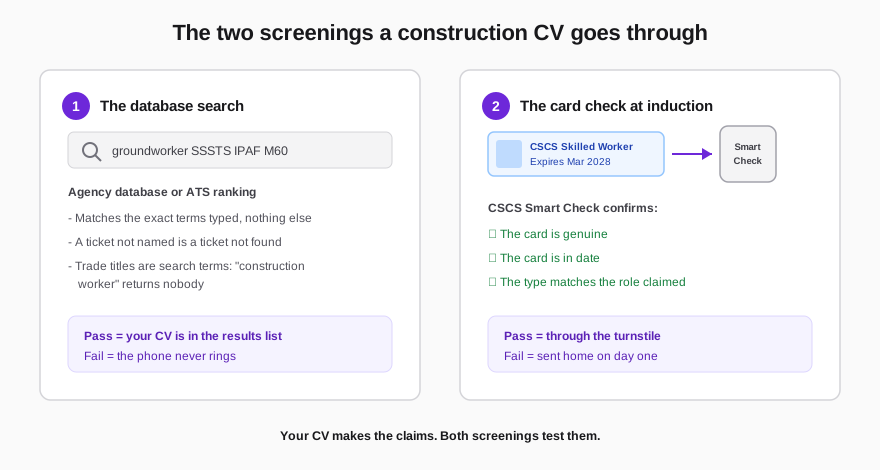
The supply side is what shapes your CV. A large share of site labour is placed through recruitment agencies, and an agency does not read CVs one by one when a contractor rings up needing four groundworkers for Monday. The consultant searches the agency database for the role name, the tickets and the postcode, and rings whoever the search returns. A CV that never mentions the searchable terms is never returned, which means the phone never rings. That is the same database mechanics covered in our guide to how to find and use ATS keywords, applied to an industry that runs on them more than most.
Direct applications to the big contractors and house builders go through standard applicant tracking systems, which parse your CV into fields before anyone reads it. Either route, the machine pass comes first.
Get the CSCS Card Details Right on Your Construction CV
The Construction Skills Certification Scheme is the card system most UK sites run on. CSCS's own position is that "holding a CSCS card is not a legislative requirement and it is entirely up to the principal contractor or client whether workers are required to hold a valid card before they are allowed on site". In practice most principal contractors and major house builders do require one, which is why the card belongs near the top of your CV, not buried in a qualifications list on page two.
CSCS runs more than a dozen card types, colour-coded by role: the green Labourer card, blue Skilled Worker, gold for advanced craft and supervisory roles, black for managers, and red variants for people in training or between qualifications. The card is not a generic pass. It certifies you for the occupation on its face, so the type you hold needs to match the role you are applying for. Electricians and other electrotechnical trades carry the ECS card instead - the CSCS Alliance partner scheme, scanned at the same gate - and our electrician CV guide covers how that check works. Plumbing and heating engineers hold their CSCS card through JIB-PMES, and gas work sits on a legal register of its own - the Gas Safe check our plumber CV guide is built around.
Write the card as one precise line in a block under your contact details:
CSCS Blue Skilled Worker card - NVQ Level 2 Formwork - expires Mar 2028
Type, the qualification behind it, expiry. Leave the registration number off; the site takes it from the card itself at induction. And the expiry date is not decoration. Employers verify cards with CSCS Smart Check, which CSCS describes as confirming a card is "genuine, in date" - it runs as a mobile app, a website and an API wired into contractors' own site-access systems. A card claim on a CV is tested in seconds, which is why two recent changes to the scheme matter more than any writing advice.
Industry Accreditation cards are dead. Industry Accreditation, known as grandfather rights, let experienced workers hold cards on an employer's recommendation instead of a qualification. CSCS closed the route to new applicants in 2010, stopped issuing the cards in June 2024, and every card issued under it expired on 31 December 2024. If your CV still lists one, you are advertising an invalid card to a screener with a scanner. The replacement routes run through recognised qualifications, and the CV should name the qualification, not the old card.
The green Labourer card got stricter. A first-issue Labourer card requires the Level 1 (Scotland Level 4) Award in Health and Safety in a Construction Environment or an approved equivalent, plus a pass in the CITB Health, Safety and Environment test from the last two years - and since 1 February 2025 the first card is valid for two years only, renewable for five once you confirm you are working in a labouring role. "CSCS card holder" with no date on a CV now begs the question of which regime the card was issued under.
Construction is not the only sector where a CV is checked rather than simply read - a care assistant CV faces a statutory vetting list of its own, the forklift training on a warehouse CV can be verified with the accrediting body that issued it, the protected title on a dental nurse CV is confirmed against the GDC register, and the SIA licence on a security guard CV sits on a public register anyone can search - but it is the sector where the check is a barcode scan at a turnstile.

The Tickets Are the Keywords on a Construction CV
After the card, adverts for site roles list tickets: SMSTS or SSSTS for site management and supervision, CPCS or NPORS categories for plant, IPAF for powered access, PASMA for towers, asbestos awareness, manual handling, working at height, first aid at work. These are not background reading. They are the exact strings a recruiter searches and an ATS matches, and each one belongs on your CV as its own dated line:
- CITB SSSTS - completed Feb 2025
- IPAF 3a/3b - expires Sep 2027
- Asbestos Awareness (Category A) - renewed Jan 2026
Two rules make the list work. First, mirror the advert exactly. Plant tickets carry category codes, and if the advert names a category, your CV repeats the code: "digger driver" matches nothing in a database search for the code. Second, date everything. Site compliance runs on training matrices, and to a matrix an undated certificate is an expired certificate.
Tipper, HIAB and low-loader roles add a driving licence to the ticket list - category C or C+E with Driver CPC - and those claims are checked against DVLA records the same way the card is scanned at the gate. Our guide to writing an HGV driver CV covers how to write that block so it survives the check.
The same logic applies to your job titles. "Groundworker", "shuttering joiner", "banksman", "traffic marshal" are search terms; "construction worker" and "general operative doing a bit of everything" are not. Use the title the industry uses, and where the advert's title differs from what your last site called you, our guide to tailoring the work experience section covers how to reconcile the two honestly.
How to Write the Work History on a Construction CV
The structure is the standard one - most recent first, employer, title, month and year dates, then evidence - with two construction-specific adjustments.
Group agency work, name the sites. If you worked eight jobs through one agency in a year, list the agency once as the employer with a continuous date range, then the contractors and projects under it. Eight two-line entries reads like churn; one agency entry with named sites reads like steady work, and it parses cleanly.
Make the bullets about the job, not the weather. Name the work type, the scale and the safety behaviours a site manager actually cares about:
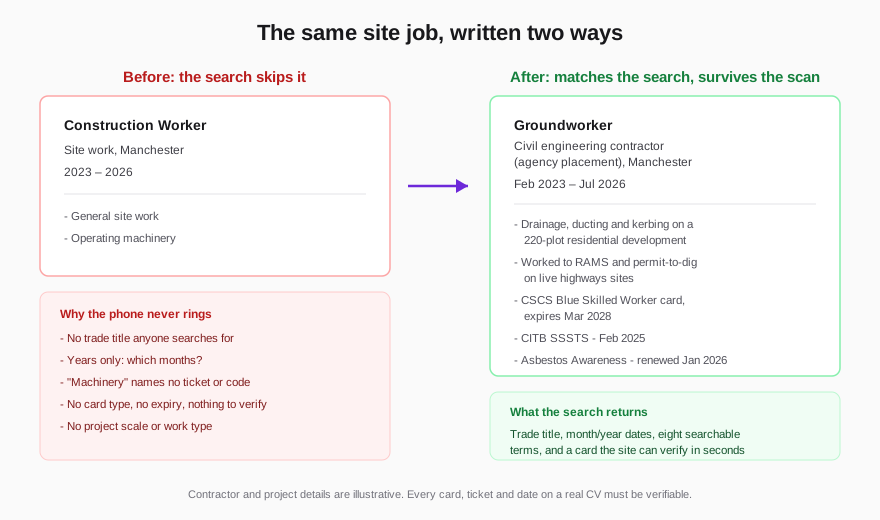
The weak version fails both screenings at once: nothing for the database search to match, and a card claim too vague to verify. The strong version puts eight searchable terms and two checkable credentials on one screen.
If you are starting out with no site history at all, the entry route is the green card plus whatever dated evidence of reliability you have - the approach in our guide to writing a CV with no experience, with the card block doing the heavy lifting.
Five Construction CV Mistakes That Cost Site Work
- "CSCS card holder" with no type or expiry. The screener cannot tell whether you are a labourer or a supervisor, or whether the card outlived 2024.
- Listing an Industry Accreditation card. Expired 31 December 2024, and Smart Check knows.
- Undated tickets. Every certificate line needs a month and year, or an expiry.
- Translating codes into nicknames. If the advert names a plant category, mirror the code. Nicknames do not match searches.
- A designed template. Two columns and icons break the parse that both agencies and ATS platforms run first. One column, standard headings, no graphics.
FAQ
Do you need a CSCS card to get a construction job?
Not by law. CSCS states that holding a card "is not a legislative requirement" and that the decision sits with the principal contractor or client. In practice most major contractors and house builders require a valid card for site access, so for most site roles the working answer is yes - and the CV should say which card.
How much does a CSCS card cost?
The CSCS application fee is £36, with Apprentice cards issued free. The CITB Health, Safety and Environment test is booked separately and costs £23.50 per attempt since April 2026. Budget for the qualification behind the card on top: for a first Labourer card that is the Level 1 Award in Health and Safety in a Construction Environment.
Can you put an expired CSCS card on your CV?
No. Smart Check confirms whether a card is genuine and in date, so an expired card reads as a failed check you invited. If a renewal is underway, say so honestly: name the qualification you hold, the test date you have booked, and leave the card line out until the card exists.
Do labourers need a qualification for a green card now?
Yes. A first-issue Labourer card requires the Level 1 (Scotland Level 4) Award in Health and Safety in a Construction Environment or an approved equivalent, plus a CITB Health, Safety and Environment test pass from the last two years. Since 1 February 2025 the first card lasts two years, renewable for five once you confirm you are working in a labouring role.
How far back should a construction CV go?
Ten to fifteen years in full, older work compressed to a line each. Unlike regulated care recruitment, construction has no statutory full-history requirement, so the standard compression advice applies. Keep every date in month-and-year format: agencies verify with previous employers, and vague dates slow the phone call that gets you the start.
A construction CV has to match a database search and survive a card scan. Run yours through Shadow CV's free scan to see what the software actually extracts - whether your card line, tickets and titles came through, and which of the advert's terms are missing. If the scan finds gaps, the £5 rewrite fixes the structure and works the site vocabulary in naturally - once, no subscription.