Key Takeaways
- List your SIA licence sector and expiry near the top of your security guard CV - employers can verify it on GOV.UK's public register in seconds.
- A door supervisor licence also covers security guard work; say so.
- BS 7858 vetting re-walks your last five years, so date everything and account for gaps.
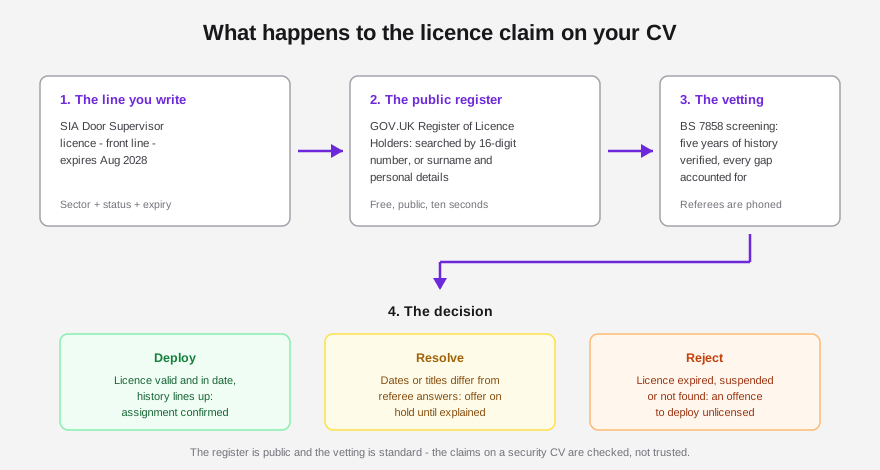
A security guard CV is unusual: its most important claim is publicly checkable by anyone, before you get a phone call. Every SIA licence sits on the Security Industry Authority's Register of Licence Holders, and GOV.UK's check service needs only "their 16-digit SIA licence number" or "their surname and other personal details" to return the licence status. The CV guides ranking for this search tell you to list your SIA licence and stop there. None of them cover the register, the vetting standard behind security employment, or what your licence actually permits. Those three things decide whether your CV gets you deployed.
Who Actually Reads a Security Guard CV
The audience is bigger than most people guess. The Security Industry Authority's own licence-holder data for August 2026 counts 450,364 people holding an active licence - 510,839 active licences between them, because one person can hold several sectors. Door supervision is by far the largest sector at 359,611 active licences, followed by public space surveillance (CCTV) at 67,481 and security guarding at 57,791.
Most of that workforce is deployed through security contractors and agencies, and contractor recruitment is a database exercise. When a client needs four officers for a corporate reception and two for weekend retail cover, the resourcing team searches its candidate database by licence sector, postcode and availability, and calls whoever the search returns - the same triage arithmetic covered in our guide to whether recruiters read every CV. Larger contractors and in-house employers run applicant tracking systems that parse the CV into fields first. Either way, a machine pass over your exact words comes before any human judgement.
The SIA Licence Is a Checkable Claim, Not a CV Line
Working a licensable security role without a licence is a criminal offence under section 3 of the Private Security Industry Act 2001, and the SIA prosecutes: its news pages on GOV.UK list convictions of individual door supervisors and guards, including for working on expired, suspended or revoked licences. That is why no security employer takes "SIA badge holder" on trust. The register exists precisely so they do not have to.
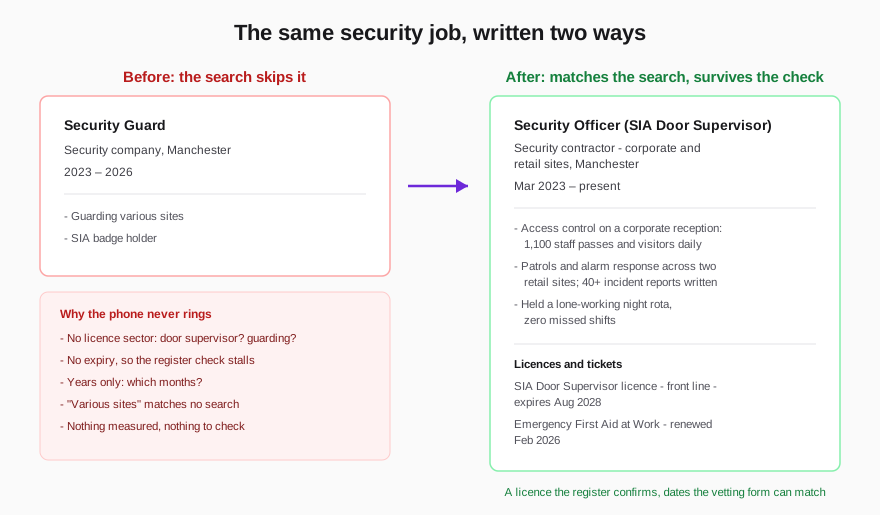
So write the licence the way the register reports it - sector, front line status, expiry:
SIA Door Supervisor licence - front line - expires Aug 2028
A vague line like "SIA licensed" fails twice. It names no sector, so a database search for "door supervisor" may not match it, and it gives the checker nothing to verify. The licence number itself is your choice: it is printed on a badge you wear in public on every shift, so it is hardly a secret, and including it turns verification into a ten-second search. Leave it off and a screener can still find you by surname and date of birth - it just takes them longer.
An expired licence is worse than no licence line at all, because the register will say so. A licence costs £204 and lasts three years; if yours is in renewal, write exactly that, with the sector and the date you applied.
One Licence Covers More Than the Job Title Says
The licence sectors nest, and the SIA's own events guidance spells it out: "If you hold a door supervisor licence, you are also covered for: security guarding, using CCTV to identify a trespasser or protect property." A close protection licence covers door supervision and security guarding on top. Public space surveillance CCTV work still needs its own licence in every case.
This is why door supervision outnumbers security guarding six to one in the licence data - the door supervisor qualification takes in the guarding syllabus, so most people who train at all train for the broader ticket. For your CV it means two things. Name the licence you actually hold, not the job you happen to be doing: "SIA Door Supervisor licence" on a CV applying for a corporate guarding role is a stronger claim than "security guard", because it covers the role and more. And if you hold more than one sector, list each with its own expiry - they are separate entries on the register.

BS 7858: The Five-Year Screening Your CV Has to Match
Reputable security employers screen new starters to BS 7858, the British Standard for security screening - it is the standard SIA approved contractors are expected to work to. The standard defines a security screening period of at least five years before the job starts, or back to your sixteenth birthday if that is more recent, and requires your education, employment, self-employment, unemployment and gaps in employment throughout that period to be accounted for. Screening forms built on it go as far as asking, for any period of unemployment, for the Jobcentre office you reported to or someone who can confirm where you were. Your SIA licence number and expiry are themselves fields on the form, alongside right-to-work evidence and financial checks.
Your CV and that screening form must tell the same story. A CV with years-only dates, a missing six months, or a job title the referee will not recognise does not just read badly - it creates a discrepancy the vetting officer has to resolve before you can be deployed, and unresolved discrepancies end offers. So: month and year on every entry, every employer named, and gaps stated plainly with what you were doing, using the approach in our guide to explaining employment gaps. In security, a dated, complete history is not just good practice. It is the shape the paperwork behind the job already demands.
Licences and Tickets Are the Keywords on a Security Guard CV
After the licence block, the vocabulary of the adverts is the vocabulary of the database searches. Use the exact terms:
- Licences: door supervision, security guarding, CCTV (public space surveillance), close protection - each with expiry
- First aid: Emergency First Aid at Work with its renewal date. Since 1 April 2021 you cannot even sit door supervisor or security guard licence-linked training without a first aid qualification valid for at least another 12 months, so a current EFAW certificate is part of the trade's standard kit - show it
- Duties as the adverts write them: access control, patrols, alarm response, incident reports, conflict management, CCTV monitoring, searches, evacuation procedures
- Site types: corporate reception, retail, construction site, warehouse and distribution, licensed premises, events
Mirror the advert exactly. If it says "SIA door supervisor", a CV that only says "security officer" is relying on the searcher to guess.
How to Write the Work History on a Security Guard CV
The structure is the standard one - most recent first, employer, title, month and year dates - with two security-specific adjustments.
The contractor is the employer; name the assignments. Three years with one contractor across four client sites is one entry: the contractor as employer, a continuous date range, then the sites and the work at each. Do not fragment it into an entry per site - that reads as churn and parses as churn. The mechanics are in our guide to the work experience section.
Put checkable specifics in the bullets. Security work generates records: incident reports written, patrols per shift, staff and visitor volumes through your access point, sites held, radio and CCTV systems used. Only claim what an assignment supervisor would recognise - in a sector whose vetting standard phones your referees, honest specifics beat adjectives everywhere.
If you are writing a first security CV around a freshly issued licence, lead with the licence block and the training dates, then build the evidence section from any work at all using the approach in our guide to writing a CV with no experience - reliability, lone working and customer-facing pressure all translate.
Five Security Guard CV Mistakes That Cost Deployments
- "SIA licensed" with no sector or expiry. The search cannot match it and the checker cannot verify it.
- An expired licence listed as current. The register reports status in seconds, and working on an expired licence is a prosecutable offence - this mistake ends interviews.
- Years-only dates. BS 7858 screening works in months. A CV that will not line up with the screening form creates discrepancies you will have to explain later.
- Unexplained gaps. The vetting standard requires every gap accounted for; a CV that hides one just delays the question until it carries more weight.
- A designed template. Columns, badge graphics and icons break the parse that agency databases and ATS platforms run first. One column, standard headings.
FAQ
Should you put your SIA licence number on your CV?
It is optional but common, and it makes verification effortless - the GOV.UK register returns a licence's status from the 16-digit number in seconds. The number is printed on the badge you display on shift, so it is not sensitive in the way a National Insurance number is. If you prefer to leave it off, employers can still search the register by surname and personal details, and you will supply the number on the BS 7858 screening form anyway.
Can you work in security without an SIA licence?
Not in a licensable role: section 3 of the Private Security Industry Act 2001 makes it a criminal offence, and the SIA publishes its prosecutions. The licence requirement attaches mainly to contract work - guarding supplied to a client by a security company. Directly employed in-house security guards are generally outside it, but door supervision at licensed premises needs a licence whoever employs you.
What does BS 7858 vetting actually check?
Identity, right to work, your SIA licence, financial history, and a verified employment record covering a screening period the standard sets at not less than five years - or back to age 16 if that is more recent. Every gap in that period has to be accounted for and confirmable. It is the reason security job offers can take weeks to complete: referees and dates are actually checked.
Do you need first aid before SIA door supervisor training?
Yes. Since 1 April 2021, you must hold a valid first aid qualification - Emergency First Aid at Work or an accepted equivalent - before taking door supervisor or security guard licence-linked training, and it must remain valid for at least 12 months from the start of the course. The same applies to the top-up training required at renewal.
What is the difference between a door supervisor and a security guard licence?
Both are front line SIA licences, but they are not symmetrical: the SIA's guidance states a door supervisor licence also covers security guarding, plus using CCTV to identify a trespasser or protect property, while a security guarding licence does not permit door supervision at licensed premises. Dedicated public space surveillance CCTV work needs the separate CCTV licence in either case.
A security guard CV has to match a database search, survive a public register check and line up with five years of vetting. Run yours through Shadow CV's free scan to see what the software actually extracts - whether your licence sector, expiry dates and site vocabulary came through, and which of the advert's terms are missing. If the scan finds gaps, the £5 rewrite fixes the structure and works the security vocabulary in naturally - once, no subscription.