Key Takeaways
- No. Most recruiters skim a subset of applications and search the rest by keyword, so a CV can go unopened entirely.
- UK research puts application review at around 3.6 hours for a whole vacancy - a minute or two per CV at best.
- Being readable and keyword-matched is what gets you into the pile that is actually read.
Recruiters do not read every CV they receive, and the ones they do read, they read fast. That is not laziness - it is arithmetic. A single UK vacancy now attracts application volumes that make full, careful review of every submission impossible for one person inside a working week, so the process gets triaged instead. Understanding how that triage works tells you far more about why you were rejected than any advice about font choices.
Totaljobs research published in August 2025, based on a survey of 748 UK HR leaders, found that recruiters spend an average of 3.6 hours per vacancy reviewing and screening applications - part of 17.7 hours of manual admin per vacancy overall. That is the total budget. Everything below follows from dividing it by the number of people who applied.
Do recruiters read every CV they receive?
Practically speaking, no. Three things happen to the applications that arrive for a typical UK vacancy, and only one of them involves someone reading your CV properly.
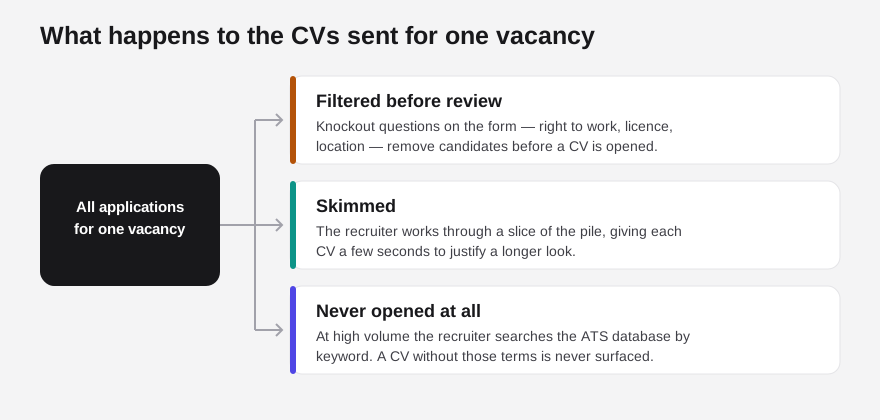
- A portion is filtered before review. Knockout questions on the application form - right to work, required licence, minimum qualification, location - remove candidates without a human opening the CV. These are answered on the form rather than read off the page, which is why right to work belongs on a CV in one line at most.
- A portion is skimmed. The recruiter works through the pile, or a ranked slice of it, giving each CV a few seconds to justify a longer look.
- A portion is never opened at all. When volume is high, recruiters stop working through applications sequentially and start searching the Applicant Tracking System database for the terms that matter. A CV that does not contain those terms sits in the system, unread and unrejected.
That third outcome is the one job seekers rarely account for. There is no rejection decision to appeal because no decision was made. ATS software is standard at large employers, and once the pile is big enough, the search box is a more rational tool than the scroll bar.
The arithmetic of CV screening
The numbers explain the behaviour better than any recruiter ever will.
The Institute of Student Employers' 2025 Student Recruitment Survey found employers received an average of 140 applications per graduate vacancy - the highest in the three decades ISE has collected the data, dating back to 1991. Tribepad, a Sheffield-based recruitment platform, reported 48.7 applications per job in November 2024, up 286% year on year, with 4.5 million applications processed on its platform between September and November.
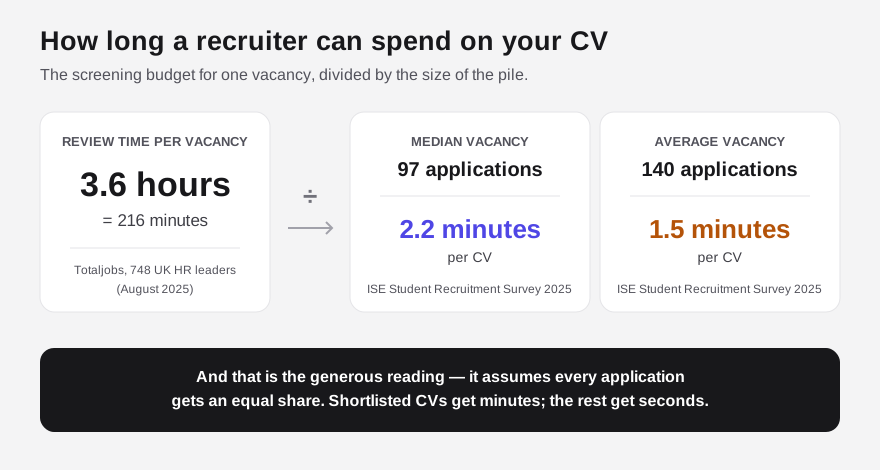
Take the Totaljobs figure of 3.6 hours of application review per vacancy - 216 minutes. Spread across 140 applications, that is about 90 seconds each. Even a pile of 100 leaves only about two minutes each. And that is the generous reading, because it assumes every application receives an equal share of the time. In reality the shortlist gets minutes and the rest get seconds, if anything.
Two minutes is enough to form a judgement. It is not enough to hunt for evidence you buried on page two, decode a two-column layout, or work out that "stakeholder engagement" was what the advert meant by "client relationship management".
What happens to a CV nobody reads
A CV can fail without ever being rejected. It arrives, parses badly or lacks the vocabulary the recruiter searches for, and simply never appears in the results that matter.
This is why the silence after applying is so often total. Our guide on how to know if your CV passed ATS screening breaks down what the different response patterns actually signal - an instant rejection usually means a knockout question, a personalised rejection usually means a human read it, and a long silence frequently means nobody ever surfaced it.
The practical consequence is that two candidates with identical experience can get opposite outcomes. One writes "project management" because that is the phrase in the advert. The other writes "programme delivery" because that is what their last employer called it. The second CV is not worse. It is invisible to the search that was run.
How recruiters read the CVs they do open
The best-known figure here comes from a US study, and it is worth being precise about that. Ladders, an American careers site, ran an eye-tracking study in 2018 and found recruiters spent an average of 7.4 seconds on the initial screen of a CV, up from six seconds in an earlier 2012 round. It used a small group of professional recruiters, and it was not UK data. Treat it as an indication of behaviour rather than a UK benchmark.
What the eye-tracking did show, and what UK recruiters describe informally too, is the shape of that first pass. Attention concentrates on:
- Your name and current job title
- Your current employer and the dates attached to it
- The previous role and its dates
- Education, briefly
- Whatever sits in the top third of page one
Nothing in that list rewards a decorative layout. It rewards a CV where the title line, the most recent role, and the strongest evidence are all visible without scrolling or interpretation. The two-page UK standard exists for the same reason - length is not penalised by the software, but it dilutes the part a human actually looks at.
How to get your CV into the read pile
You cannot make a recruiter read every CV. You can make yours one of the ones that gets surfaced, opened, and given more than a glance.
- Match the vocabulary of the advert. Use the employer's own terms for the skills you genuinely have. This is what determines whether you appear in a database search at all - our guide to finding and using ATS keywords covers the method.
- Put the decisive evidence in the top third. A clear title line, a short profile that names your specialism, and your current role with its strongest results. Assume the reader stops after that and write accordingly.
- Keep the format machine-readable. Single column, standard headings, no tables, no text boxes, no contact details stranded in the document header.
- Lead bullets with outcomes, not duties. "Managed a budget" tells a skimming reader nothing. "Managed a £2.4m budget, coming in 6% under forecast" survives a two-minute review. The bullet point formula covers how to build these.
- Answer the knockout questions honestly and completely. Blank or ambiguous answers on right to work, licences, or location filter you out before your CV is ever a factor.
None of this is about gaming anyone. It is about making a document that survives the conditions it will actually be read in - quickly, on a screen, alongside a hundred others.
FAQ
Do recruiters read every CV they receive?
No. For most vacancies the volume makes it impossible. Applications are triaged: some are removed by knockout questions on the form, some are skimmed briefly, and some are never opened because the recruiter searched the ATS database by keyword instead of working through the pile in order.
How long does a recruiter spend on a CV?
UK research from Totaljobs puts total application review at around 3.6 hours per vacancy, which works out at roughly one to two minutes per application if the time were shared evenly. It is not shared evenly - shortlisted CVs get several minutes and the rest get seconds. The widely quoted 7.4-second figure comes from a small US eye-tracking study and describes the very first glance, not a full review.
Does a human ever see my CV, or just the software?
A human sees the CVs that reach the shortlist. The ATS itself does not usually reject on CV content - its main effect is deciding which CVs a recruiter sees when they search or sort. So the software determines visibility, and the human determines the outcome. Where no human was meaningfully involved, the ICO's 2026 findings mean the rejection carries rights you can use.
Why do I get rejected within minutes of applying?
That speed almost always means an automated knockout question, not a judgement on your CV. Right to work, a required qualification, a licence, or a location filter can trigger an immediate rejection before anyone reads a word. It is not a verdict on your experience.
Does a longer CV get read more thoroughly?
No - usually the opposite. Extra pages do not buy extra attention; they spread a fixed amount of attention more thinly and push your strongest evidence further from the top. Two sides of A4, with the decisive material in the first third, is the format that survives a fast review.
Find out how your CV looks to the system doing the sorting
If recruiters only read a fraction of what they receive, the question that matters is whether yours is in that fraction. That depends on things you cannot see from your own screen: whether the file parses cleanly, whether your headings are recognised, and whether the terms a recruiter would search for actually appear in your text.
Scan your CV free - Shadow CV reads it the way an ATS does and shows you exactly where it loses points, from parsing failures to missing keywords. The £5 rewrite fixes the formatting and works the right terms in naturally, so your CV surfaces in the search and holds up in the two minutes a recruiter gives it - once, with no monthly subscription.