Key Takeaways
- For most UK jobs, a CV should be no more than two sides of A4 - the National Careers Service guidance, and what recruiters actually read.
- One page suits school leavers, graduates, and high-volume retail or hospitality roles; academic and some senior CVs can run longer.
- ATS software does not reject long CVs - but humans stop reading them.
How long should a CV be? For most UK job seekers the answer is two pages - and it has been for years. The National Careers Service, the government's careers advice body, puts it plainly: your finished CV should be no more than two sides of A4 unless it is an academic CV. But the two-page rule is a ceiling, not a target, and there are genuine cases where one page does the job better or three pages is justified. This guide covers the standard, the exceptions, and how to cut an overgrown CV without cutting the keywords that get you found.
How long should a CV be in the UK? The short answer
Two sides of A4, maximum. That is the guidance published by the National Careers Service, and it is the working assumption of nearly every UK recruiter, from agency consultants to in-house talent teams.
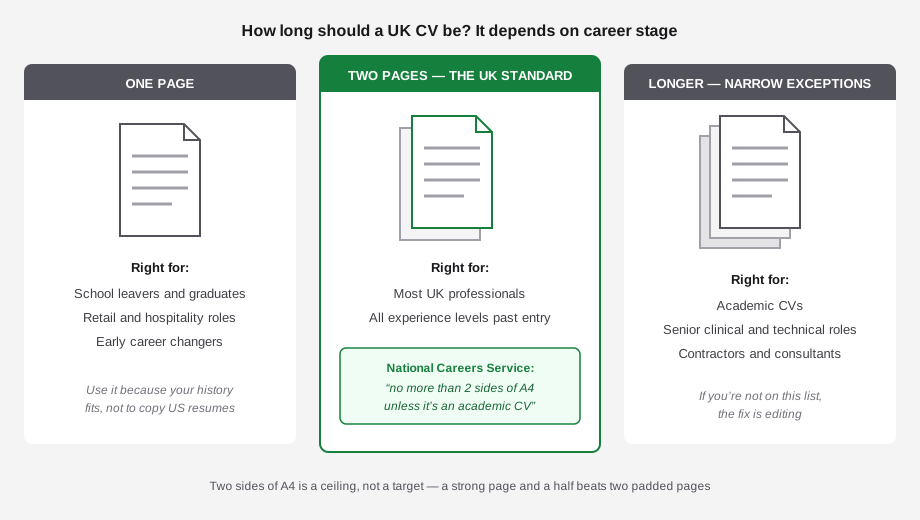
Two pages persists because it matches how recruitment actually works. A typical UK vacancy attracts an average of 118 applications. Nobody reads 118 four-page CVs. A recruiter skims, shortlists, and moves on - and a CV that respects their time reads as a candidate who understands the job of a CV: to earn an interview, not to document a career exhaustively.
Note what the rule is not. It is not a legal requirement, an ATS setting, or a formatting trick. A brilliant two-and-a-bit-page CV will not be binned at the page break. But every line past page two is a line almost nobody will read, so it had better not contain anything you need a recruiter to see.
What recruiters do in the first few seconds
Eye-tracking research by the US job site Ladders found in 2018 that recruiters spend an average of 7.4 seconds on their initial review of a CV - up from about six seconds when the same study ran in 2012, but still a skim, not a read.
That study is American, and no equivalent UK eye-tracking data exists at the same scale - but the mechanics of skimming a document are not different in Britain, and the study's findings about what gets looked at are the useful part. In those first seconds, recruiters looked at:
- Your name and current job title
- Your current company and the one before it
- The dates against each role - checking for progression and gaps
- Education, in a quick flick to the bottom
Everything on that list lives on page one. The CVs that held attention had simple layouts, clear section headings, bold job titles, and bulleted achievements. The ones that lost it were cluttered, dense, multi-column, and long-sentenced - which is also, not coincidentally, exactly what makes a CV parse badly in an ATS.
The practical rule that follows: page one carries the application. Your title, your current and most recent roles, and your strongest evidence belong there. Page two is for supporting history. Anything on page three is invisible.
Does CV length matter to ATS software?
Less than you might think - and not in the way the myths suggest. No mainstream ATS platform is set up to reject a CV for having too many pages. The system parses your document into a database whether it is one page or five. If you have read our guide on whether you really need an ATS-friendly CV, you already know the real failure mode is invisibility in recruiter searches, not robot rejection - and length plays into that in two quieter ways:
- Keyword dilution. Systems that rank candidates score your CV against the role's search terms. A four-page CV stuffed with two decades of detail buries the matching, relevant material inside a mass of text that matches nothing. Tight CVs concentrate their ATS keywords where they count.
- Truncation risk on very long documents. Some platforms import a limited amount of experience data into their structured fields. On a very long CV, content near the end can be cut off before it is fully processed - Oleeo, the Civil Service platform, imports experience this way.
So the honest answer: the two-page rule exists for humans, and the ATS gives you no reason to break it. Length is one of the rare CV questions where the machine and the recruiter want the same thing.

When a one-page CV is the right length
Two pages is the maximum, not the requirement. One page is often the stronger choice if you are:
- A school leaver or graduate. One degree, some part-time work, and a project or two do not need two pages - padding them to fill the space reads as exactly that. Length is not the only thing that shifts with career stage: what an entry-level CV has to prove differs from a senior one in evidence, though not in format. And if there is genuinely nothing to fill a page with yet, the answer is a one-page school leaver CV built from education and volunteering, not padding.
- Applying for retail, hospitality, or other high-volume roles. Screening here is fast and often mobile-first; a single tight page of availability, experience, and certifications wins.
- Early in a career change, where only your recent, relevant experience needs detail.
One warning: do not buy the American "one-page resume" rule wholesale. In the US, one page is a strong convention for professionals well into their careers. In the UK it is not - a mid-career candidate who compresses ten years onto one page usually strips out the evidence and keywords a recruiter needs. Use one page because your history fits on it, not because a US template told you to.
When your CV can be longer than two pages
The exceptions are real but narrow:
- Academic CVs. The National Careers Service guidance makes this exception explicitly. Publications, grants, conference papers, and teaching history make academic CVs structurally longer - no admissions panel expects two pages.
- Senior clinical and technical roles. Some senior NHS posts, for instance, carry enough qualifications, registrations, and audit history that three pages is accepted where there is substantial experience to evidence.
- Contractor and consultant CVs with many short engagements, where clients expect a fuller project history.
If you are not in one of those groups and your CV is over two pages, the problem is almost always editing, not experience.
How to cut your CV down to two pages
Cutting a CV is not shrinking the font. It is removing what no recruiter reads and compressing what they skim:
- Delete the dead lines first. Your full postal address, date of birth, and a "Curriculum Vitae" heading - all standard deletions, together worth several lines. "References available on request" is optional rather than wrong, but it is doing no work if space is tight - whether references belong on a CV at all has a shorter answer than most people expect.
- Cap your personal profile at three lines. Long opening statements are the most-skipped section on any CV. Title, specialism, one or two concrete claims - the four-line structure for a CV personal statement fits in the space without losing anything.
- Compress roles older than ten years. Job title, employer, dates, one line - or a single "Earlier career" block. The Ladders research is blunt about where recruiter attention goes: your current and previous roles, not your third job from 2009. This is also the whole of the fix for a thirty-year history, and it is why the usual advice for a CV over 50 gets it wrong: compressing old roles keeps every date and employer name on the page, whereas deleting them costs you the experience calculation.
- Cut bullets that state duties instead of results. Every bullet should carry an action, a task, and a measurable outcome - the formula from our CV bullet points guide. Duty-only bullets are the padding that pushes CVs to page three.
- Never cut the keywords. Trim adjectives, filler, and repetition - but the terms from the job description are what recruiters search the ATS for. If a cut removes a skill named in the advert, put it back somewhere tighter.
What not to do: 9pt font, invisible margins, single line spacing everywhere - the official floor for CV text is 11 point. A two-page CV achieved by making the text unreadable fails the 7.4-second skim just as badly as a four-pager - white space is part of what holds a recruiter's eye.
FAQ
Is a three-page CV too long in the UK?
For most roles, yes. Two sides of A4 is the National Careers Service guidance and the general recruiter expectation. The accepted exceptions are academic CVs, some senior clinical and technical roles, and contractor CVs with long project histories. Outside those, a third page usually signals under-editing rather than extra experience.
Should a CV be one page like an American resume?
Not by default. The one-page rule is a US resume convention; the UK standard is up to two pages. One page is right for school leavers, graduates, and high-volume entry-level roles - but mid-career UK candidates who force everything onto one page usually cut the evidence and keywords that get them shortlisted.
Will an ATS reject my CV for being too long?
No mainstream ATS rejects a CV on page count. The genuine risks are subtler: long CVs dilute the keyword matches that ranking systems score, and some platforms truncate very long documents during import, losing content near the end. Recruiters, meanwhile, simply stop reading. Two pages avoids all three problems.
How far back should a UK CV go?
Give full detail for roughly the last ten years, then compress. Older roles can be reduced to a title, employer, and dates, or grouped into a single "Earlier career" line. Recruiters judge you on recent, relevant experience - eye-tracking research shows their attention goes to your current and previous roles first.
Does a two-page CV need to fill both pages?
No. A page and a half of strong, relevant content beats two full pages padded with duties and filler. Do not stretch formatting to fill the space - but if page two holds only two or three lines, tighten the CV until it fits comfortably on one page or edit so page two earns its place.
A CV can be exactly two pages and still never surface - if those pages parse into jumbled text or miss the keywords recruiters search for. Scan your CV free and Shadow CV shows you what an ATS actually extracts from it, what is missing for your target role, and what is costing you points. The £5 rewrite fixes the lot - formatted cleanly, keyword-complete, still two pages - once, with no subscription.