Key Takeaways
- Name the trucks on your warehouse operative CV: counterbalance, reach, PPT - the exact terms recruiters search.
- There is no forklift licence. List a dated certificate of basic training with the accrediting body instead, because employers can verify it.
- Group agency work under one entry, and back bullets with honest numbers.
Most warehouse operative CV guides tell you to put your forklift licence near the top. The Health and Safety Executive's guidance on rider-operated lift trucks says, in so many words, "there is no such thing as a lift-truck 'licence'". What exists is a certificate of basic training - and the same guidance tells employers to "insist on evidence" when an operator claims to be trained. A warehouse CV is not just read. Its claims are searched for, parsed and checked. This guide covers how to write one that matches the search and survives the check.
Who Actually Reads a Warehouse Operative CV
The sector is far bigger than the official numbers suggest. Analysis carried out for the UK Warehousing Association by the logistics consultancy Aricia, published in June 2026, put the warehousing workforce at around 760,000 people - more than 70% above the Office for National Statistics industry figure of roughly 440,000 - because so many warehouse roles sit inside retail, manufacturing and other sectors. Even on the lower official figure, warehousing jobs have grown 40% since 2011, against 14% across the economy.
Big numbers mean high-volume screening. A large share of warehouse work is placed through agencies, and when a distribution centre needs ten pickers and two counterbalance drivers for Sunday nights, the consultant does not read CVs one by one. They search the agency database for the truck type, the role and the postcode, and ring whoever the search returns - the same triage arithmetic covered in our guide to whether recruiters read every CV. Direct applications to retailers' distribution arms and third-party logistics firms go through standard applicant tracking systems that parse the CV into fields first. Either route, the machine pass decides who gets the call.
The volume peaks in autumn. Amazon announced more than 15,000 UK seasonal roles for the 2025 festive season across its fulfilment, sortation and delivery network, at £14.30 to £15.30 an hour, and Royal Mail and the supermarkets' distribution operations run seasonal recruitment on a similar clock. Those campaigns open in early autumn, which makes late summer the right time to get the CV straight. The transport operations behind the same sheds hire on the same clock, so if you hold an HGV licence as well as truck tickets, our guide to writing an HGV driver CV covers the licence block that side of the operation checks first.
The Forklift Licence That Does Not Exist
The HSE's Approved Code of Practice on rider-operated lift trucks, L117, is the document UK forklift training runs on, and it is blunt on the point almost every job advert gets wrong: there is no licence. Training ends in a certificate of basic training, there is no legal requirement for that certificate to exist, no expiry date on it, and no DVLA-style register behind it - the HSE states there is "no central organisation which holds copies of training certificates".
On refresher training, L117 is equally specific: "there is no specific time period after which you need to provide refresher training or formal assessment", though it suggests employers may set an automatic retest "after a set period (for example 3-5 years)". That 3-5 year convention is why adverts ask for a "current" or "in-date" forklift licence. Legally there is no such clock; commercially, most employers run one.
For your CV, that means a vague line like "forklift licence holder" gets the concept wrong and gives the screener nothing to check. Write the certificate as it was issued, in a block near the top:
Counterbalance forklift - certificate of basic training (RTITB accredited) - tested Mar 2024
Reach truck - conversion training completed Nov 2024
Truck type, the accrediting body, month and year. If your training is older than five years and you have operated since, say so in the work history - recency of operation is the thing the 3-5 year convention is trying to establish.
How Employers Check Forklift Claims on a Warehouse CV
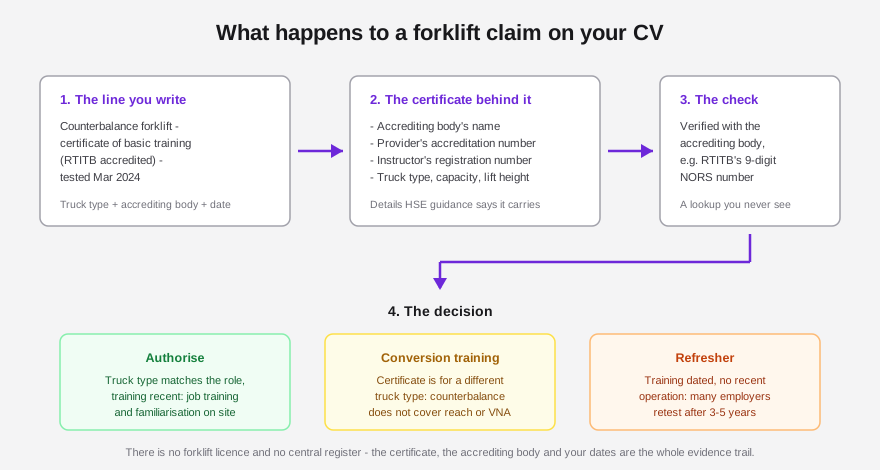
L117 tells employers what to do with your claims: "where operators claim to be trained and experienced, you should insist on evidence". The evidence trail is more organised than the no-central-register position suggests, because accreditation fills the gap. The Accrediting Bodies Association for Workplace Transport - whose members are RTITB, ITSSAR, AITT, NPORS and Lantra Awards - states that the majority of all lift-truck training in the UK is conducted through a training provider accredited by one of its members.
That accreditation is checkable. A certificate from an accredited provider carries the provider's accreditation number, the accrediting body's name and the instructor's registration number. RTITB goes further: every RTITB-trained operator gets a nine-digit National Operator Registration Scheme (NORS) number, and RTITB will verify it for an employer, confirm the training behind it and advise whether conversion training is needed. Conversion matters because a certificate is truck-specific - L117 treats a counterbalance operator moving to a reach truck or a very narrow aisle man-up truck as needing additional training, which is exactly what a screener is working out when they read your certificate line.
Warehousing is the third sector we have covered where the CV's claims are machine-checked rather than taken on trust - a construction CV faces a card scan at the turnstile, and a care CV a statutory vetting list. The warehouse version is quieter: a phone call or database lookup you never see, made before you are offered the shift.
Truck Types and Systems Are the Keywords on a Warehouse CV
After the certificate block, the vocabulary of the adverts is the vocabulary of the searches. These are the exact strings recruiters type and ATS platforms match, so use them as written, not as nicknames:
- Truck types: counterbalance, reach truck, PPT (powered pallet truck), LLOP (low-level order picker), VNA (very narrow aisle), MHE
- Process terms: goods-in, picking, packing, despatch, RF scanning, stock replenishment, cycle counts
- Systems: the warehouse management system by name if the advert names one, plus voice picking or handheld scanners where you used them
- Compliance: manual handling, health and safety induction, safe systems of work
Mirror the advert exactly. If it says "reach truck driver", a CV that only says "forklift" is relying on the searcher to guess. If it says "FLT", carry the abbreviation and the full phrase both - one for the database search, one for the human skim.
How to Write the Work History on a Warehouse CV
The structure is the standard one - most recent first, employer, title, month and year dates - with two warehouse-specific adjustments.
Group agency work, name the sites. Six months of shifts through one agency across three distribution centres is one entry: the agency as employer, a continuous date range, the sites and the work under it. Twelve fragmentary entries read as churn and parse as churn. The mechanics are in our guide to the work experience section.
Put honest numbers in the bullets. Warehouses measure everything, which means you can too: picks per hour against target, accuracy rates, order volumes, shift patterns held. Only claim numbers a referee at that site would recognise.
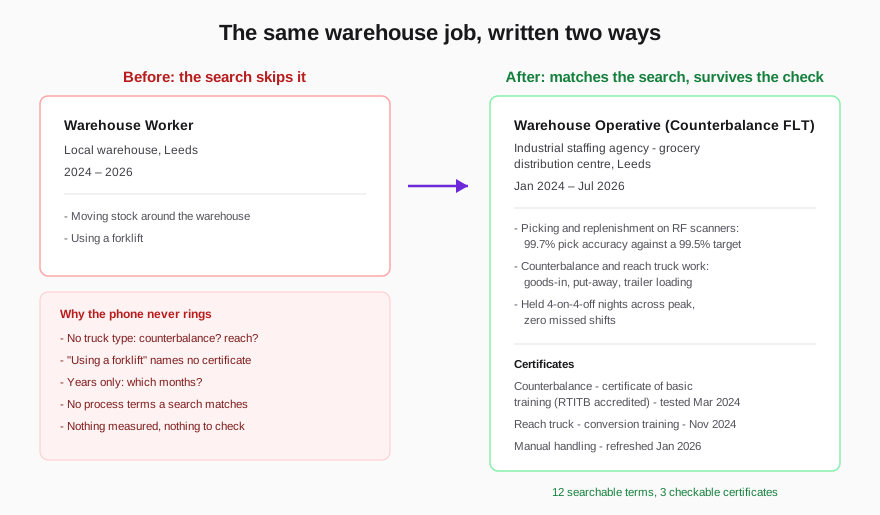
The weak version fails both screenings at once: nothing for the database search to match, and a forklift claim too vague to verify. The strong version puts a dozen searchable terms and a checkable certificate on one screen.
If you are applying for a first warehouse job - seasonal campaigns hire plenty of first-timers - you do not need a forklift certificate to start, and most sites train in-house. Lead with reliability evidence instead, using the approach in our guide to writing a CV with no experience.
Five Warehouse CV Mistakes That Cost Shifts
- "Forklift licence holder" with no truck type or date. The screener cannot tell counterbalance from reach, or 2024 training from 2014.
- No accrediting body on the certificate line. RTITB, ITSSAR, AITT, NPORS or Lantra Awards is the difference between a checkable claim and a bare assertion.
- Generic bullets. "Moving stock" and "general duties" match no search. Goods-in, replenishment, despatch and RF scanning do.
- Numbers you cannot evidence. Pick rates are verified with a phone call to the agency or site. Round honestly, or leave the number out.
- A designed template. Columns, icons and graphics break the parse that both agency databases and ATS platforms run first. One column, standard headings.
FAQ
Do you need a forklift licence to work in a warehouse?
No, because no such licence exists - the HSE's L117 guidance says so directly. What employers want is evidence of training: a certificate of basic training for the truck type, issued through an accredited provider. Plenty of warehouse roles need no truck experience at all, and many sites train new starters in-house.
Does forklift training expire?
Not legally. L117 sets no time limit on a certificate of basic training and no fixed refresher interval. But it does suggest employers may run an automatic retest after a set period, for example 3-5 years, and most treat training older than that without recent operation as due a refresher. Date the certificate on your CV and show recent operation in the work history.
Do warehouse employers use an ATS?
The big operators and third-party logistics firms screen high volumes through applicant tracking systems, and agency consultants find candidates by keyword search in their own databases. Both are machine passes over the same text, which is why exact truck types, process terms and systems belong on the CV as the adverts write them.
Should you put pick rates on a warehouse CV?
Yes, if they are true and a referee would back them. Picks per hour against target, accuracy percentages and order volumes are the rare CV numbers an employer can actually check, which makes honest ones more persuasive than adjectives - and inflated ones easy to catch.
How do you list agency warehouse work?
The agency is the employer: one entry, one continuous date range, then the sites and the work underneath. Name the distribution centres or clients where you can, and the truck types used at each. One steady agency entry with named sites reads as reliability; a dozen two-week entries read as risk.
A warehouse CV has to match a database search and survive a certificate check. Run yours through Shadow CV's free scan to see what the software actually extracts - whether your truck types, certificate line and dates came through, and which of the advert's terms are missing. If the scan finds gaps, the £5 rewrite fixes the structure and works the warehouse vocabulary in naturally - once, no subscription.