Key Takeaways
- Lead your HGV driver CV with a licence block: exact categories (C+E, C, C1), Driver CPC expiry and whether it is National or International, and your tachograph card.
- Employers verify all of it - a DVLA check code returns your categories and penalty points in seconds.
- Use month-and-year dates, named contracts and exact vehicle types.
An HGV driver CV is one of the few where the employer can verify the central claims against government records before anyone phones you. Your licence categories and penalty points come back on a DVLA check code. Your Driver CPC training hours and card date sit on a DVSA record you can let an employer log into. And the driver qualification card behind both must be in the cab on every shift. The CV guides ranking for this search cover profiles, skills lists and bullet formulas, and none of them mention any of it. Those checks decide whether your CV turns into work, so write the CV around them.
Who Reads an HGV Driver CV Before You Get a Shift
Demand is not the problem. The Road Haulage Association's February 2025 report Lorry drivers - the vital link notes that 81% of all freight in this country is transported by road and calls for 40,000 new drivers a year over the next five years - 200,000 in total - to keep the supply chain moving. The workforce it needs to replace is ageing: Logistics UK's 2026 Employment and Skills Report puts 61.6% of HGV drivers at 45 or over.
So transport offices and driving agencies are actively hunting, and their recruitment is database-first, the same shape as the warehouse operative hiring that shares its distribution centres. When a client needs four Class 1 drivers for night trunking, a resourcer searches the candidate database by licence category, postcode and shift availability, and rings whoever the search returns. Your CV is the record that search runs over. If it says "HGV licence" instead of "C+E", the search for C+E may never find you - and the checks that follow are built to catch anything the CV rounded up.
The Licence Block Every HGV Driver CV Needs
List your entitlements the way DVLA records them, near the top of the CV, with the informal name the adverts use alongside:
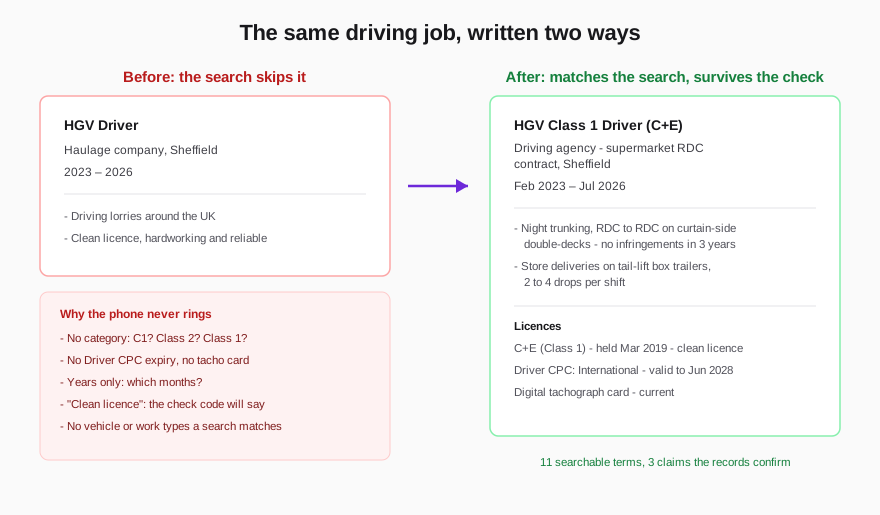
Licences: C+E (Class 1) - held since Mar 2019 - clean licence
Driver CPC: International - valid to Jun 2028
Digital tachograph card: current
The categories are precise legal entitlements, defined on GOV.UK: C1 covers vehicles between 3,500kg and 7,500kg, category C ("Class 2", rigids) covers vehicles over 3,500kg with a trailer up to 750kg, and C+E ("Class 1", artics) covers category C vehicles with a trailer over 750kg. Adverts and database searches use both vocabularies - "Class 1", "C+E", sometimes "LGV 1" - so give the DVLA category with the advert's name in brackets and you match either search.
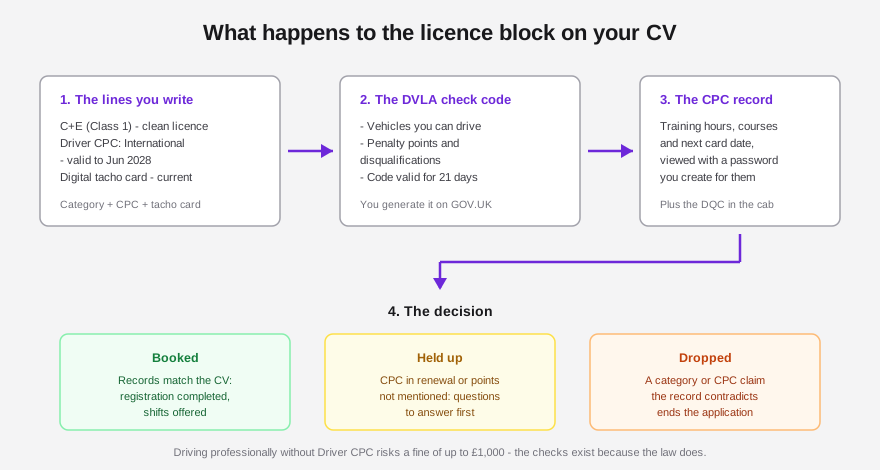
Every claim in that block is checkable. Agencies ask new drivers for a licence check code, generated free through GOV.UK's View and Share Your Driving Licence service, and the code lets them see the vehicles you can drive and any penalty points or disqualifications. A code stays valid for 21 days, so expect to generate a fresh one at registration. This is why "clean licence" is a line to write only when it is true: the record that contradicts it is on the screener's desk before you are.
You will also need your digital tachograph card in any vehicle with a digital or smart tachograph - in practice, the fleet. DVLA issues it (£32 for a first card), and a transport office wants to know it is current before booking you, not on Monday morning.
National or International Driver CPC: Say Which You Hold
To drive a lorry professionally you must hold Driver CPC, kept current with 35 hours of periodic training every 5 years - GOV.UK puts the fine for driving professionally without it at up to £1,000, with a separate £50 fixed penalty for driving without your card on you. Since 3 December 2024 there have been two kinds. International Driver CPC is the old regime under a new name and covers professional driving in the UK and EU. National Driver CPC is UK-only and more flexible: courses can be as short as 3 hours 30 minutes and can be taken online, with up to 12 of the 35 hours as e-learning. The trap is that mixing in even one National course produces a National card - and a National card does not permit EU work.
A CV line that just says "Driver CPC" hides the difference, so say which card you hold, with the expiry - for agencies whose clients run European work, that one word decides whether they can book you. The claim is verifiable either way: GOV.UK's Check Your Driver CPC Periodic Training Hours service shows your recorded hours, courses and next card date, and lets you create a temporary password so an employer can view the record directly.

HGV Driver CV Keywords: Vehicle Types, Tickets and Work Types
After the licence block, the vocabulary of the adverts is the vocabulary of the database searches. Use the exact terms for what you have actually driven and done:
- Work types: trunking, multi-drop, store deliveries, RDC work, container work, general haulage, nights out (tramping)
- Vehicle and trailer types: curtainsider, box trailer, tail lift, refrigerated (fridge), flatbed, walking floor, double-deck, drawbar
- Tickets beyond the licence: ADR (with the classes you hold), HIAB or lorry loader, Moffett (truck-mounted forklift), each with its expiry date
- The records your work generates: tacho infringements, telematics or fuel-economy scores, delivery success rates
That last group is worth taking seriously. Driving is a measured job - every shift produces tachograph data, and most fleets run telematics - so a bullet like "no tachograph infringements in three years" is a claim your next transport manager knows the previous one could see. Concrete, checkable numbers beat "hardworking and reliable" everywhere.
How to Write the Work History on an HGV Driver CV
The structure is the standard one - most recent first, employer, title, month and year dates, covered in our guide to the work experience section - with two driving-specific adjustments.
The agency is the employer; name the contracts. Two years through one driving agency across three client contracts is one entry: the agency as employer, a continuous date range, then the contracts and the work on each. Splitting it into an entry per client reads as churn and parses as churn.
Put the vehicle and the work in the bullets, not the profile. "Class 1 nights, supermarket RDC to store on curtain-side double-decks, 2 to 4 drops per shift" gives a resourcer the category, the shift pattern, the trailer type and the work type in one line - four searchable terms and nothing to chase.
If your Driver CPC has lapsed, handle it the way you would any other employment gap: dates intact, explanation ready. You are not alone - plenty of lorry licence holders do not hold a current Driver CPC - and since 1 February 2025 there has been a specific way back. If your CPC expired more than 60 days but less than two years ago, a seven-hour Return to Driving course lets you start driving professionally in the UK again as soon as the training is recorded, with 28 further hours to complete within 12 months. A CV line that says "Driver CPC: Return to Driving completed May 2026, 21 of 28 further hours logged" turns an awkward question into evidence you manage your own compliance.
Five HGV Driver CV Mistakes That Cost You Shifts
- "HGV licence" with no category. C1, C and C+E are different jobs. A search for Class 1 drivers cannot match it, and the resourcer moves to the CV that says C+E.
- "Clean licence" that is not. The check code reports your points in seconds. Minor points rarely end a booking; being caught rounding up does.
- No Driver CPC expiry - or no National/International. An expired CPC means you cannot legally be given driving work, so a missing date is a question every screener must ask. Since the December 2024 changes, which card you hold matters too.
- Fragmented agency work. Six one-line entries for six clients through one agency parses as six short jobs. One employer, one date range, named contracts.
- A designed template. Columns, graphics and icon fonts break the parse that agency databases and ATS platforms run before any human reads a word. One column, standard headings.
FAQ
Should you put your driving licence number on your HGV CV?
There is no need. What agencies actually ask for is a licence check code, which you generate through GOV.UK's View and Share Your Driving Licence service when they need it. Do not print a code on the CV itself - each code expires after 21 days, so it would be dead by the time most readers try it. "Licence check code available on request" signals you know the process.
What is the difference between Class 1 and Class 2?
They are informal names for DVLA categories. Class 1 is C+E: category C vehicles with a trailer over 750kg, which covers articulated lorries. Class 2 is category C: rigid vehicles over 3,500kg with a trailer up to 750kg. C1 sits below both, covering 3,500kg to 7,500kg vehicles. Adverts use both vocabularies, so your CV should too - "C+E (Class 1)" matches either search.
Do you need to put Driver CPC on your CV?
Yes, with the expiry date and, since December 2024, whether it is National or International. You cannot legally drive a lorry professionally without valid Driver CPC - GOV.UK puts the fine at up to £1,000 - so a CV without a CPC line forces the screener to ask the most basic question in the trade. Employers can verify your hours and card date on the DVSA record if you create a temporary password for them.
Can you drive an HGV if your Driver CPC has expired?
You keep your licence, but you cannot drive professionally until you are back in qualification. If your CPC expired more than 60 days but less than two years ago, the Return to Driving route introduced on 1 February 2025 applies: a seven-hour course puts you back on the road in the UK once it is recorded, with 28 further hours of training to complete within 12 months. Otherwise it is the full 35 hours.
Do you have to mention penalty points on your CV?
No - a CV is not a declaration form, and nobody expects a points tally on it. The rule is narrower: never write "clean licence" unless it is true, because the check code you will be asked for shows your points and any disqualifications. If you have points, leave the claim off and answer honestly at registration.
An HGV driver CV has to match a database search and then line up with the DVLA and DVSA records behind it. Run yours through Shadow CV's free scan to see what the software actually extracts - whether your categories, CPC expiry and vehicle types came through, and which of the advert's terms are missing. If the scan finds gaps, the £5 rewrite fixes the structure and works the driving vocabulary in naturally - once, no subscription.