Key Takeaways
- If your plumber CV claims gas work, lead with a registration block: Gas Safe licence number, ACS categories and their expiry dates.
- Gas work is the legally gated claim - the register behind it was checked 30.6 million times last year, and anyone can search it.
- Water-only plumbers lead with qualifications and named systems, and never borrow gas wording.
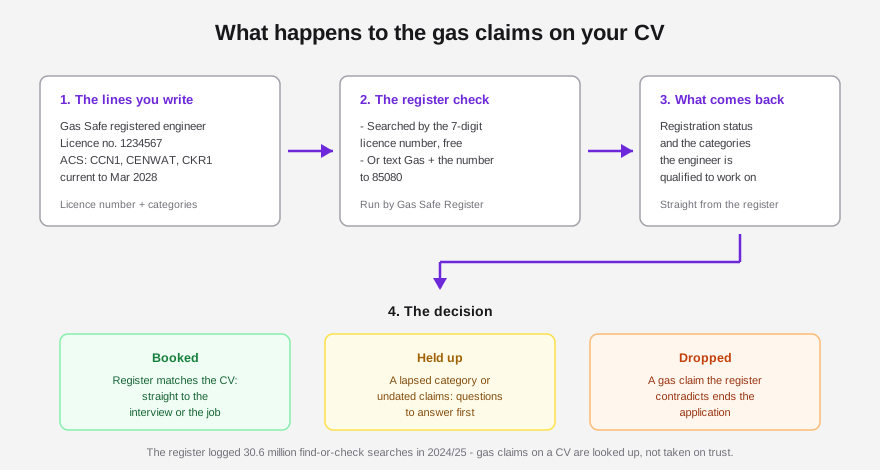
A plumber CV carries two kinds of claim, and only one of them is checkable in seconds. Anyone can write "bathroom installations" or "leak detection" and wait for the interview to prove it. Write "boiler installation and servicing" and you have made a different kind of claim: gas work is illegal without registration, and the register that confirms it is public. Gas Safe Register's own At a Glance report for 2024/25 counts 30,651,739 find-or-check-an-engineer searches on its website in one year. The guides ranking for "plumber CV" cover profiles, templates and skills lists, and not one of the top results mentions the register, the licence number, or the categories printed on the back of the ID card. Those are the first things a hiring manager verifies, so build the CV around them.
Who Checks a Plumber CV - and What They Check It Against
The legal line is sharp. GOV.UK's guidance on registering to carry out gas work states it plainly: "You must be on the Gas Safe Register to carry out gas work legally." Behind that sits regulation 3 of the Gas Safety (Installation and Use) Regulations 1998 - "no person shall carry out any work in relation to a gas fitting or gas storage vessel unless he is competent to do so", with registration through the HSE-approved scheme as the mechanism. Plumbing itself has no licence. Cold water, hot water, drainage, bathrooms: no register, no legal gate. The moment the work touches gas, the gate appears.
That gate is why the register is the busiest verification tool in any trade this site has covered. As of 31 March 2025 the register held 150,847 engineers across 75,920 registered businesses, per the same At a Glance report - and employers, agencies, landlords and homeowners together ran those 30.6 million checks against it. The HSE's consumer guidance explains how simple a check is: an engineer's unique seven-digit licence number, texted with the word "Gas" to 85080, returns a registration status. The same year, the register logged 1,203 reports of unregistered fitters and made 522 site visits investigating unregistered gas work. A gas claim on a plumber CV is not read on trust. It is looked up, the way a practice manager looks up the registration number on a dental nurse CV before picking up the phone.
The Registration Block Every Plumber CV Needs
If you are registered, put the evidence where the first glance lands - a short block under your contact details, before the work history:
Gas Safe registered engineer - licence no. 1234567
ACS: CCN1 (core), CENWAT, CKR1, HTR1 - all current to Mar 2028
Level 3 NVQ Diploma in Plumbing and Domestic Heating - unvented hot water (G3)
Each line maps to something the reader can verify. The licence number is the search key for the register. The ACS categories are the same ones printed on the back of your Gas Safe ID card with their expiry dates - CCN1 is the core domestic gas safety assessment, and the appliance categories (central heating boilers and water heaters, cookers, fires) sit on top of it. ACS assessments run on a five-year cycle, so the expiry date is part of the claim: "CCN1, current to March 2028" and an undated "gas qualified" are read very differently by someone who knows the cycle - and everyone hiring plumbers knows the cycle.
Not registered because your work is water only? Then say that cleanly and lead with what is yours: the Level 3 qualification, the systems you install, and your card. The Level 3 apprenticeship standard for a plumbing and domestic heating technician - fitting and servicing domestic water, heating and drainage systems, in Skills England's wording - also satisfies the requirements for a CSCS card through JIB-PMES, the plumbing industry's card scheme, which is the card that gets you through a site gate the same way the construction trades' CSCS cards do. What you must never do is borrow gas vocabulary for padding. "Boiler experience" on an unregistered plumber's CV invites exactly one question, and there is no good answer to it.

Plumber CV Keywords: Categories, Tickets and Systems
Agency databases and ATS software surface plumber CVs by exact-term search, so use the vocabulary of the adverts - the same working-from-the-advert method as our guide to finding ATS keywords:
- Registration and categories: Gas Safe registered, licence number, CCN1, CENWAT, CKR1, HTR1, LPG where you hold it - each with its expiry
- Qualifications and tickets: Level 2/3 NVQ Diploma in Plumbing and Domestic Heating, unvented hot water (G3), water regulations (WRAS/Water Supply Regulations), IPAF, asbestos awareness, first aid
- Work types: boiler installation, servicing and breakdown, full bathroom refits, first and second fix, planned and reactive maintenance, landlord gas safety records (CP12), power flushing, leak detection
- Systems and settings: combi and system boilers, unvented cylinders, underfloor heating, air source heat pumps, social housing contracts, occupied properties, new build, commercial fit-out
Two of these deserve a note. Named boiler brands are search terms in their own right - "Worcester Bosch and Vaillant installation and warranty work" matches the searches heating firms actually run, where "all major boiler brands" matches none of them. And low-carbon terms are appearing in adverts that never used them: if you have installed or commissioned air source heat pumps or cylinders for them, say so with dates, because that search currently returns far fewer CVs than it will in five years.
How to Write the Work History on a Plumber CV
The structure is the standard one - most recent first, employer, title, month-and-year dates, two to four evidence bullets per job, as covered in our guide to the work experience section - with the trade's two adjustments.
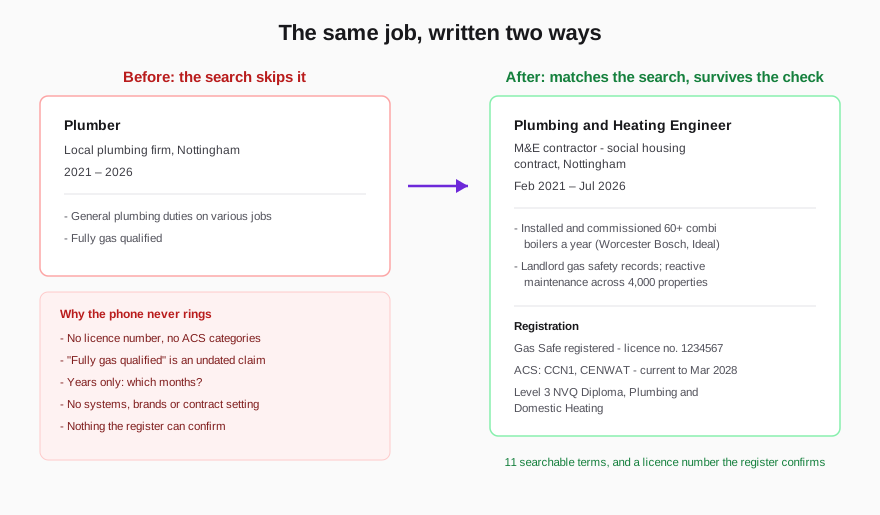
Name the contract, not just the firm. Plumbing and heating work runs through contractors and agencies, and three years with one firm across a dozen sites is one entry: the firm as employer, one date range, then the contracts. "Reactive maintenance across 4,000 social housing properties for a Midlands housing association" tells a resourcer the setting, the scale and the work type in one line.
Make the bullets carry the checkable specifics. "Installed and commissioned 60+ combi boilers a year, issued landlord gas safety records, breakdown diagnostics on Worcester Bosch and Ideal ranges" gives the reader work volume, a legal document they recognise, and two searchable brands. "Responsible for all aspects of plumbing" gives them nothing to match.
If your ACS certificates lapsed while you were out of the trade, treat the time like any other employment gap: dates intact, explanation ready, reassessment booked. "ACS reassessment booked October 2026" reads as an engineer who manages their own compliance; a silently expired CCN1 reads as a problem the employer would be taking on.
Five Plumber CV Mistakes That Cost You Work
- Gas wording with nothing to check. "Fully gas qualified" with no licence number and no categories forces the reader to either chase it or bin it, and at shortlisting stage chasing loses.
- Claiming the firm's registration as yours. Gas Safe registration sits with a business; you hold your own licence number and ID card through it. "Gas Safe registered (licence no. 1234567)" is your claim. "Worked for a Gas Safe registered company" is theirs - fine to say, never to dress up.
- Undated ACS categories. The five-year cycle means every category claim has an expiry attached. Leaving the dates off does not hide a lapse; it advertises one.
- Fragmented contract work. Eight one-line entries for eight sites through one contractor parses as eight short jobs. One employer, one date range, named contracts underneath.
- A designed template. Columns, icons and graphics break the parse that agency databases and ATS platforms run before a human sees the CV. One column, standard headings, and the registration block in plain text - never inside a text box or graphic.
FAQ
Should you put your Gas Safe licence number on your CV?
Yes. The register is searched by the seven-digit licence number, so printing it in your registration block hands the employer the exact key they need - and the number is already public-facing on the ID card you show at every job. Making the check effortless is the point: an easy check that comes back clean is the strongest line on the CV.
Do you need to be Gas Safe registered to work as a plumber?
Only if you work on gas. GOV.UK is explicit that you must be on the Gas Safe Register to carry out gas work legally, under the Gas Safety (Installation and Use) Regulations 1998 - but water, drainage and bathroom work has no licence requirement at all. A water-only plumber CV is fine; a water-only CV that hints at boiler work is not.
What is the difference between a plumber and a gas engineer?
The boundary is the gas connection. A plumber works on water and drainage systems; a gas engineer holds current ACS assessments and works through a Gas Safe registered business on boilers, cookers, fires and gas pipework. Many people hold both sets of qualifications - the CV should show which side each claim sits on, because only one side is on a public register.
What happens if your ACS certificates have expired?
You can no longer legally carry out gas work, and your registration lapses until you pass reassessment - the assessments run on a five-year cycle. On the CV, keep the categories listed with their expiry dates and add the reassessment booking if you have one. Hiding the lapse behind an undated claim is the version that costs interviews.
Is WaterSafe the same as Gas Safe?
No. WaterSafe describes itself as a free online directory and national accreditation body for qualified plumbers and water supply pipe installers, run with scheme operators including APHC, CIPHE, SNIPEF and WIAPS - membership is voluntary and signals water regulations competence. Gas Safe Register is the legal requirement for gas work. On a CV, WaterSafe approval is a plus line; Gas Safe registration is the load-bearing one.
A plumber CV has to match an exact-term database search and then line up with a public register. Run yours through Shadow CV's free scan to see what the software actually extracts - whether your licence number, ACS categories and tickets came through, and which of the advert's terms are missing. If the scan finds gaps, the £5 rewrite fixes the structure and works the trade vocabulary in naturally - once, no subscription.