Key Takeaways
- Each entry in the CV education section needs the qualification name, the institution and the dates - National Careers Service guidance never asks for grades.
- State GCSE grades as awarded: the DfE confirms letters remain valid and grade 4 sits at the old C.
- Education leads a school leaver's CV and drops below work history after about two years.
In May 2019 the Department for Education published a factsheet telling employers to update their recruitment practices for "CVs with numbers as well as letters". Seven years on, the education section of a UK CV is written in two grading currencies at once, and most advice about the section still stops at "school, qualifications, dates". That leaves out the decisions that change outcomes: which grades to state and in what form, how much detail your career stage justifies, and what the screening software extracts before a human sees it.
What the Education Section of a UK CV Must Include
The National Careers Service, the government's careers advice service, recommends five core CV sections: contact details, an introduction, education history, work history and references. For education history, its guidance asks for the names of your qualifications, the name of the school, college or university where you studied, and the dates you attended.
Notice what is missing from that list: grades. They are a choice, and the rest of this guide works through when they earn their place. The other three elements are not optional. A qualification without a name cannot be matched to a requirement, an entry without an institution cannot be verified, and missing dates leave a hole in the timeline that both recruiters and parsing software notice - the same reason employment gaps need dated entries in your work history rather than silence.
A clean entry looks like this:
BSc (Hons) Business Management, 2:1 - University of Leeds, 2019 – 2022
List entries in reverse chronological order, highest and most recent first. Use the qualification's standard name, not a house abbreviation: "BSc (Hons) Business Management" can be matched against an advert asking for a business degree, while "BBM, Leeds" can not.
Where Education Goes on Your CV at Each Career Stage
The section's position and length should change over your career, and this is the part most CVs get wrong in one of two directions: a school leaver burying their strongest evidence at the bottom, or a manager with fifteen years of experience still opening with their A-level results.
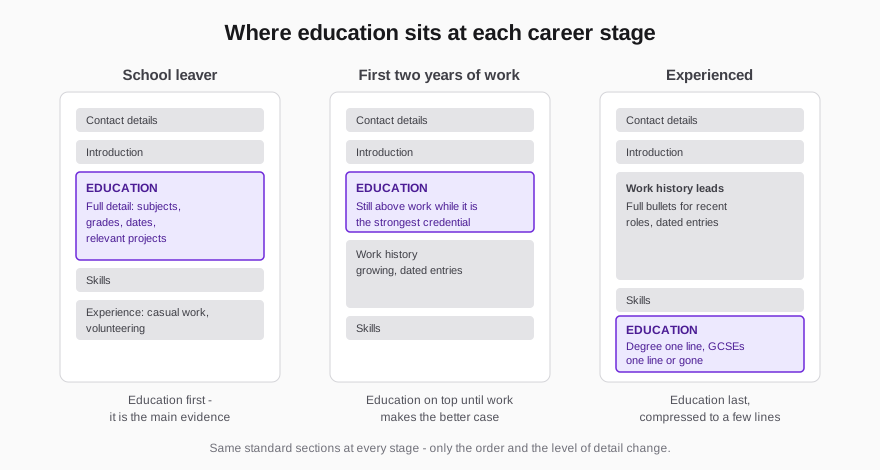
- Still studying or recently finished. Education goes directly after your introduction, before any work history, with full detail: subjects, grades, relevant projects. On a first CV it is the main evidence you have - our guide to writing a CV with no experience builds the whole page around it.
- Roughly the first two years of relevant work. Education stays above work history while it remains your strongest single credential. The switch point is when your work evidence makes the better case, which for most people is around two years in - the same threshold covered in our comparison of entry-level and senior CVs.
- Beyond that. Education moves to the bottom and compresses. The degree keeps its one line. GCSEs become a single summary line or come off entirely, module lists go, and A-level detail shrinks to a compressed form such as "3 A-levels (BBC)". Nobody hiring a senior analyst is reading Year 11 results.
How to List GCSEs: Number Grades, Letter Grades and the DfE's Anchor Points
GCSEs in England moved to a 9 to 1 grading scale, starting with English and maths in 2017, with the last letter-graded exams sat in 2020. Most GCSEs taken in Wales and Northern Ireland still use letters. The result is that UK applicant pools now hold both currencies, which is why the Department for Education's factsheet for employers exists - and it settles the conversion question with three anchor points: the bottom of grade 7 aligns with the bottom of an A, the bottom of grade 4 with the bottom of a C, and the bottom of grade 1 with the bottom of a G. The DfE recognises grade 4 and above as a "standard pass", and a grade 5 and above in English or maths as a "strong pass". The same factsheet states that letter grades remain valid for employment - your 2009 results have not expired.
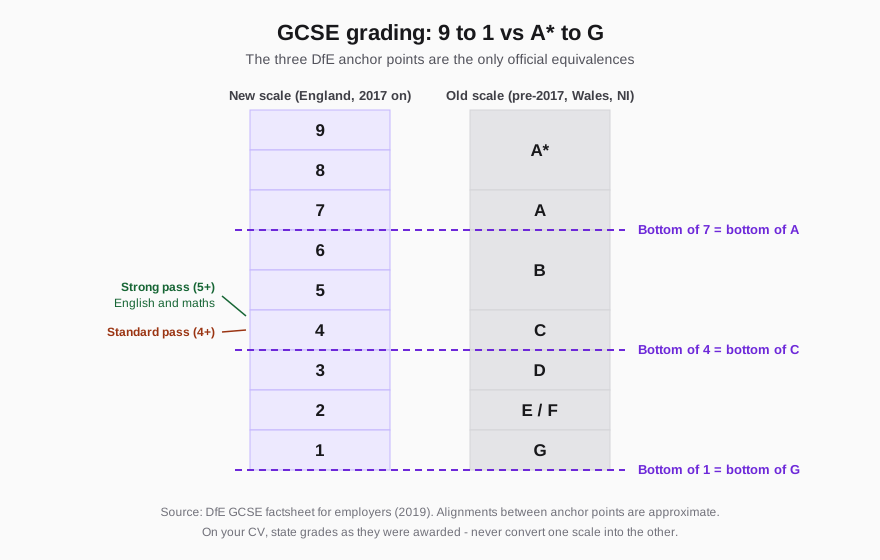
Three rules follow for the CV:
- State grades as they were awarded. Never convert numbers to letters or letters to numbers - the scales are officially not equivalent, and a converted grade is a misstated one.
- Summarise rather than tabulate. One line does the work: "10 GCSEs at grades 9-5, including English and Maths (grade 6)" or "9 GCSEs at grades A*-C, including English and Maths". Name English and maths specifically, because they are the two an advert is most likely to require.
- Mirror the advert's threshold where it is true of you. If the advert asks for "GCSE English and Maths at grade 4/C or above", a summary line that states exactly that clears the requirement in the advert's own words.
A-Levels, T Levels and the Qualification Levels Adverts Ask For
Plenty of UK adverts skip qualification names entirely and ask for "a Level 3 qualification" - phrasing that comes from the government's qualification-levels framework and stops many applicants cold. The mapping is short: GCSEs at grades 9 to 4, or A* to C, sit at Level 2. A levels, T Levels and advanced apprenticeships sit at Level 3. A degree with honours is Level 6, and a master's is Level 7.
This matters beyond the advert text, because qualification requirements are one of the things application forms turn into knockout questions - "Do you hold a Level 3 qualification or above?" is answered before any human reads your CV, and answering it wrongly in either direction costs you. Know the level of what you hold, answer truthfully, and make sure the qualification that clears the bar is named on the CV itself. Where a vocational diploma or NVQ is what clears it, the line belongs in a separate certificates and training block rather than in among the GCSEs.
For the entries: list A-levels individually with grades while they are recent evidence, and compress them once a degree or solid work history sits above them. Treat T Levels, BTEC Nationals and advanced apprenticeships exactly the same way - qualification name, institution, dates, grade if it helps.
Degree Classification: Should a 2:2 Go on Your CV?
The fear around classification runs ahead of the evidence. The Institute of Student Employers' 2025 recruitment survey - 155 employers handling over 1.8 million applications - found 47% of employers specify a 2:1, and 23% set no minimum entry requirement at all. A 2:2 rules out fewer doors than most holders assume.
You have two honest options. State the classification, which reads as confidence and saves the recruiter a question. Or omit it, which is legal and common - the entry simply reads "BA (Hons) History - University of Manchester, 2016 – 2019" - but an experienced recruiter tends to read a missing classification as a 2:2 anyway. What you cannot do is round up. A 2019 Prospects survey found 49% of large businesses and 48% of SMEs had encountered a candidate lying about their degree, including inflating the grade - and Prospects runs Hedd, the UK's degree verification service, which confirms classification and attendance dates directly with the university. Where the line sits between presenting a qualification well and misrepresenting it is covered in our guide to rewriting your CV without lying.
If you left a course unfinished, say what is true: "Completed two years of BSc Economics - University of Nottingham, 2020 – 2022". It preserves the timeline, claims no award, and handles the interview question before it is asked.
How ATS Software Reads Your Education Section
Parsing software does not read your education section as prose. It segments the CV into standard sections, then extracts structured fields from each entry: institution, qualification name, dates, sometimes the grade - the same pipeline that processes the rest of your CV. That mechanism produces four practical rules:
- Keep the heading standard. "Education" parses reliably. "Academic Journey" is a segmentation gamble that gains you nothing.
- Keep the section out of sidebars, tables and graphics. A degree trapped in a two-column sidebar can vanish from the parsed record entirely, which reads to a recruiter search as having no degree at all.
- Write qualification names the way an advert would. Searches and matching run on exact terms: "BSc (Hons) Computer Science" matches a search for a computer science degree, an unexplained abbreviation does not.
- Date every entry. Parsers build a timeline from dates; a dateless qualification either drops out or lands in the wrong place in it.
Reassuringly, mainstream screening software rarely scores your grades. Grades are read by humans, at the shortlist stage. The machine's interest in your education is whether the qualification exists, what it is called, and when it happened - so the formatting rules above matter more to the software than whether you got a 6 or a 7 in geography.
FAQ
Do you put GCSEs on your CV if you have a degree?
A single summary line is enough, and dropping them entirely is fine once you have higher qualifications and experience - employers assume GCSEs sit underneath an A-level or a degree. The exception is when an advert names GCSE English or maths as a requirement: then keep the line in, stating the grade threshold in the advert's own terms.
Should I write my GCSE grades as numbers or letters?
Whichever you were actually awarded. The DfE's guidance for employers is explicit that the two scales are not directly equivalent and that letter grades remain valid, so converting your real grades into the other currency misstates them. If an advert asks for "grade 4/C or above", mirror that combined phrasing in your summary line.
Do employers actually check qualifications and grades?
Increasingly, yes. UK employers can verify a degree's classification and dates through Hedd, the official degree verification service, recruitment agencies have a legal duty to confirm a candidate's qualifications where required for the role, and offer-stage checks routinely ask for certificates. Treat every line of the education section as checkable, because it is.
What if I did not finish my degree?
List it honestly as partial study: the course, the institution, the dates, and wording such as "completed two years". Never name an award you were not given. An unexplained three-year hole costs you more than an unfinished course does, and an untrue degree claim is fraud rather than embellishment.
Can I leave the dates off my education section?
Leave employment dates on, always - but qualification dates are the one place a concession exists. If you are worried your graduation year invites age discrimination, dropping the year from a decades-old qualification is widely accepted. Keep dates on anything recent, because a dateless entry parses badly and reads as evasive.
Your education section is short, but its failure modes - a degree trapped in a sidebar, converted grades, missing dates - are exactly what an automated screening pass punishes. Run your CV through Shadow CV's free scan to see how the software actually parses your qualifications and which of the advert's requirements your wording fails to match. If the scan finds problems, the £5 rewrite fixes the structure and the wording in one pass - once, with no subscription.