Key Takeaways
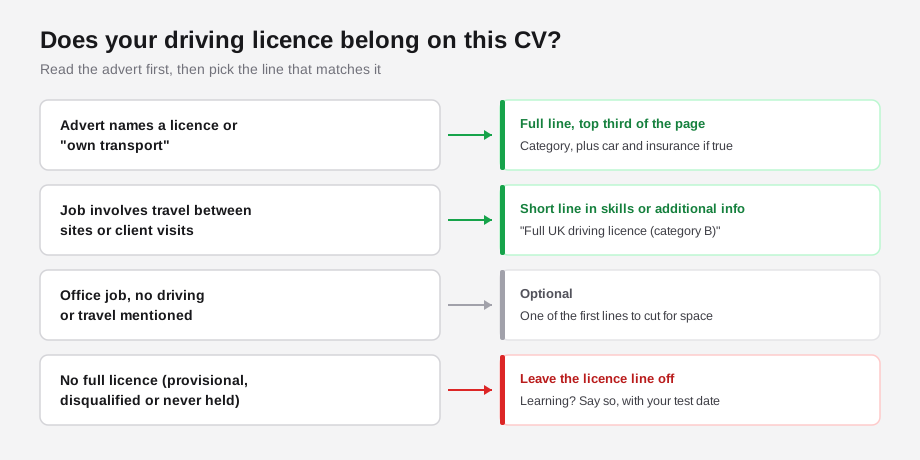
- Put a driving licence on your CV when the advert mentions driving, travel between sites or "own transport", as one plain line: "Full UK driving licence (category B)".
- Write "clean" only if you have no penalty points; employers can check.
- Add "own car with business insurance" only when both are true.
A driving licence on a CV is one line, and for many jobs it is the line that decides whether a recruiter keeps reading. Home care, field sales, surveying, engineering, estate agency, social work and delivery adverts routinely list "full UK driving licence" as essential, and recruiters search their CV databases for exactly that phrase.
It is also less common than people assume. The Department for Transport's National Travel Survey puts full car licence holding at 74% of adults aged 17 and over in England in 2025 - but only 32% of 17 to 20-year-olds and 61% of people in their twenties. For younger applicants in particular, a licence is a real differentiator, and leaving it off a CV for a job that needs one throws that away.
When a driving licence belongs on your CV
The rule is simple: include it when the job involves driving, and treat it as optional otherwise.
Include it when the advert:
- Names it as a requirement - "full UK driving licence essential" or "must be a driver".
- Mentions travel - visits to clients, multiple sites, a regional patch or "travel across the North West".
- Asks for "own transport" - which, in practice, usually means a car.
- Involves a company vehicle - a van, a pool car or a minibus.
For an office job with no travel, a licence adds nothing to the employer's decision. A single line in an additional information section does no harm, but if your CV is tight on space, it is one of the first things to cut, as our guide on what to remove from your CV explains.
Read the advert's wording carefully, because "essential" and "desirable" mean different things. If it says desirable, applying without a licence is reasonable - our guide to reading a job description like a recruiter explains why self-rejecting against desirable criteria is a mistake.
How to write a driving licence on your CV
Use the advert's own words. "Full UK driving licence" is the phrase almost every UK advert uses, so it is the phrase a recruiter types into a database search. Add your category so there is no doubt about what you can drive:
Full UK driving licence (category B), own car with business insurance
A few details make the line accurate rather than vague:
- Category. Category B is a standard car licence. GOV.UK's licence categories page sets it at vehicles with up to 8 passenger seats and a maximum authorised mass of 3,500kg - which covers most small and medium vans. If you passed before 1 January 1997, your licence usually carries extra trailer and minibus entitlements; check your photocard and name them if the job involves either.
- Automatic only. If your licence carries code 78, which GOV.UK defines as "restricted to vehicles with automatic transmission", say so where the job involves a pool car or van. An employer finding out on day one is worse than knowing from the CV.
- "Clean". Only if you have no penalty points. More on that below.
- Own car. Only if you have regular use of one.
Where the licence line goes
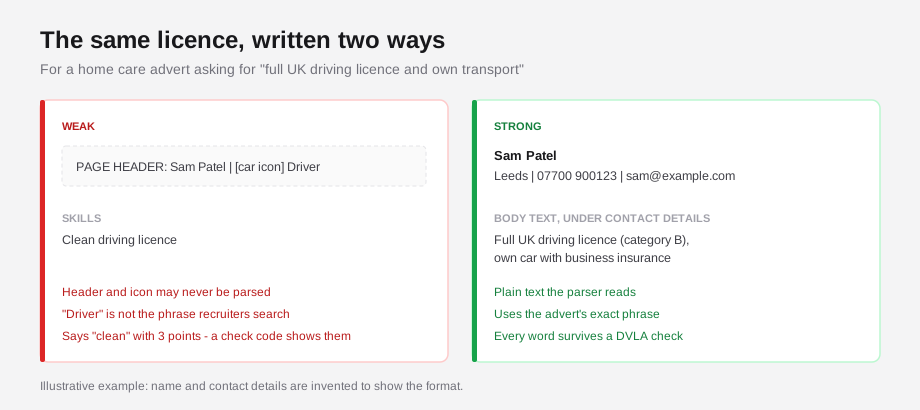
Put it somewhere the parser reads as body text: a line under your contact details, in the skills section, or in a short additional information section at the end. When the advert names a licence as essential, the top third of the page is best, so a human skimming the CV sees it in the first few seconds.
Do not put it in the document's header or footer, inside a text box, or as an icon of a car. Greenhouse, one of the major ATS vendors, lists headers, footers and text boxes among the causes of a failed CV parse, so a licence placed there may never reach the recruiter's search.

"Clean licence": points, endorsements and the check code
"Clean" has a specific meaning to a UK employer: no penalty points or endorsements. Write it only if that is true, because the claim is easy to check.
GOV.UK's View your driving licence service lets you see "vehicles you can drive" and "check your penalty points or disqualifications", and create a check code to share your record. The code is valid for 21 days. Employers that put staff behind the wheel ask for one, or use a licence-checking service, before you drive for them.
What that means for your CV:
- Points do not have to go on a CV. A CV is not a declaration form. If you have three points for speeding, write "Full UK driving licence" and leave "clean" off.
- Answer honestly when asked. Application forms for driving roles often ask about points and convictions directly. Answer the question as asked.
- Points expire from your record. GOV.UK says endorsements stay on your driving record for 4 or 11 years, depending on the offence. Once they have gone, "clean" becomes accurate again.
- New drivers have less room. Under the new drivers rule, your licence is revoked if you get 6 or more points within 2 years of passing your test - something to bear in mind before taking a driving job straight after your test.
Professional driving roles are a different level of scrutiny. If you are applying with category C or C+E, our guide to writing an HGV driver CV covers the licence block, the Driver CPC record and the checks agencies run.
Own car and business insurance
"Own transport" in an advert usually means you will use your own car for work and claim mileage. That brings an obligation many applicants do not notice until their first week.
The Health and Safety Executive's guidance for employers on work vehicles says that privately owned vehicles used for work must be safe, and that "workers must do checks on their vehicles, have them serviced and have insurance and a valid MOT". HSE's employer guidance also states that the law "applies to both company and grey fleet vehicles", grey fleet being a car owned by the worker and driven for business.
In practice, most personal car insurance covers social, domestic and pleasure use, with business use as an extra you add with your insurer. Employers that rely on staff cars usually ask to see the policy. So:
- Write "own car with business insurance" only when the policy already covers business use.
- Write "own car" if you have one and are willing to add business cover before starting.
- Write neither if you do not have regular use of a car. Borrowing a relative's car now and then is not "own transport" an employer can rely on.
Provisional, foreign and lost licences
Provisional licence. A provisional licence is not a driving licence for the purposes of an advert that asks for one, and listing it as "driving licence" will be found out quickly. If you are learning and the job needs a driver, one honest line works: "Learning to drive - practical test booked for March 2027". Leave it off for jobs that do not involve driving.
Licence from another country. Whether you can drive in Great Britain on a non-GB licence, and for how long, depends on the issuing country and how long you have lived here. Use GOV.UK's non-GB licence checker before you claim anything, then write the licence as it is: "Full Polish driving licence (category B), valid for driving in GB". Do not write "full UK driving licence" until you have exchanged it.
Lost or suspended licence. If you are disqualified, leave the licence off entirely until you get it back. A CV that claims a licence you cannot currently use is a false statement, not a presentation choice.
If you cannot drive because of a disability
A licence requirement is not automatically lawful. Under the Equality Act 2010, an employer applying a blanket "must drive" rule has to be able to justify it, and the bar is higher when the role's driving could be done another way.
That was the finding in Drummond v HMRC, decided by an employment tribunal in Edinburgh in July 2022. The claimant had surrendered his licence on medical grounds. When he told HMRC's online application form he did not hold "a full valid UK driving licence, the application process was brought to an end". The tribunal upheld his complaints of disability discrimination, including failure to make reasonable adjustments, and said HMRC's aim "could have been achieved by stating that a driving licence was a desirable criteria, rather than treating it as an essential criteria."
If this applies to you, the CV is not the place to deal with it. Leave the licence line off and raise the requirement with the employer directly as a reasonable adjustment, before or alongside applying. Our guide on disclosing a disability on your CV covers when and how to raise it.
FAQ
Should I put my driving licence on my CV?
Yes, when the job involves driving, travel between sites or "own transport". Write it as one line, such as "Full UK driving licence (category B)". For office jobs with no travel it is optional and is one of the first lines to cut when space is tight.
What does a clean driving licence mean on a CV?
A licence with no penalty points or endorsements on it. Only write "clean" if that is currently true: an employer can see your points through a DVLA check code. If you have points, write "full UK driving licence" without the word "clean".
Do I need to put my driving licence number on my CV?
No. Your licence number is personal data that belongs in onboarding paperwork, not on a document you send to strangers. Employers who need to check your record ask for a check code from GOV.UK's View your driving licence service, which is valid for 21 days.
Can I put a provisional licence on my CV?
Not as a driving licence. If the job needs a driver and you are learning, write that honestly, with your test date if one is booked. Otherwise, leave it off.
Can an employer reject me for not having a driving licence?
Yes, if driving is a genuine requirement of the job. But the requirement has to be justified, and in Drummond v HMRC a tribunal found that rejecting a disabled applicant for not holding a licence was disability discrimination where the licence could have been treated as desirable rather than essential.
Getting the licence line right is the easy part; the harder part is whether the rest of your CV matches the advert as closely. Run your CV through Shadow CV's free scan to see which of the advert's requirements your CV actually shows a recruiter, licence included. If the scan finds gaps, the £5 rewrite closes them - once, and not a subscription.