Key Takeaways
- Regular, relevant volunteering goes in your work history, written exactly like a job, with a title, organisation, dates and results.
- Label it as voluntary, because volunteers have no employment contract.
- Several unrelated roles can share a short Volunteering section.
- One-off events and causes with no link to the job can be cut.
Most CVs put volunteering in the wrong place. It ends up at the bottom of page two, squeezed between "reading" and "travel" in the interests section, written as a single line: "Volunteer at local food bank." The same person may have run the food bank's rota for three years, trained new volunteers and handled the stock system. None of that reaches the reader, because the CV filed it as a hobby.
The official guidance points the other way. The National Careers Service, the government's careers service for England, says your work history should "include details of any work placements, volunteering and paid jobs you've had". Volunteering on a CV is work experience. The useful questions are which volunteering earns a full entry, how to label it, and what an employer can check afterwards.
Does volunteering count as work experience on a CV?
Yes, when it involved real responsibility over a real period. A recruiter screening for "stock control" or "safeguarding" is looking for evidence of the skill, and the evidence counts whether or not you were paid for it. A treasurer who reconciled a charity's accounts for two years has done bookkeeping.
There is one honest limit. GOV.UK is clear that "you do not have a contract of employment as a volunteer, so you do not have the same rights as an employee or worker." That is why the entry must say it was voluntary. The work counts; the status is different, and the CV should not blur the two.
It is also more common than people assume. According to the government's Community Life Survey 2024/25, 28% of adults in England took part in formal volunteering at least once in the previous 12 months, and 17% did so at least monthly. Younger people often volunteer with a CV in mind: NCVO's Time Well Spent 2023 survey found that a quarter (25%) of 18 to 24 year olds volunteer partly because they think it will help their career or lead to a qualification.
Where volunteering goes on a CV
The right section depends on two things: how relevant the role is to the job you want, and how much of it there was.
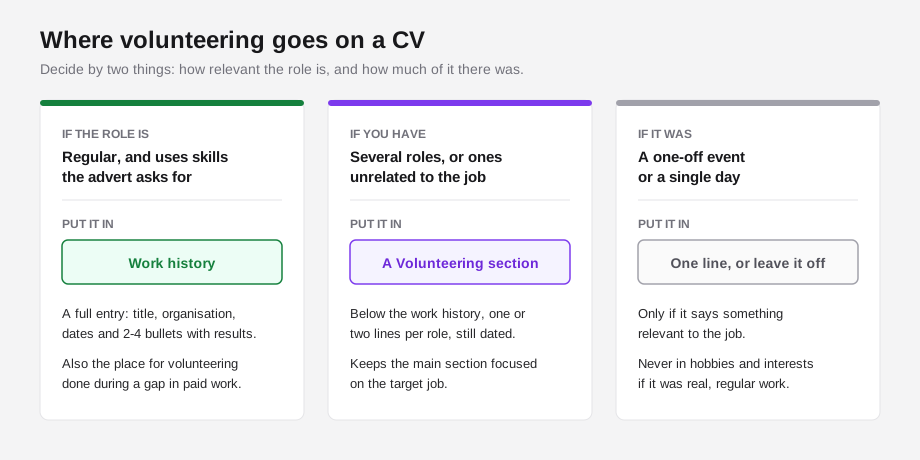
- In your work history, as a full entry, when the volunteering is regular and uses skills the advert asks for. This is the case the National Careers Service guidance describes. Write it with the same structure as a paid job, covered in our guide to the work experience section of your CV.
- In a separate "Volunteering" section, when you have two or more roles, or when the role is worth mentioning but unrelated to the job. A named section below your work history keeps the main section focused and still gives a parser a clean heading to read.
- In one line, or nowhere, for one-off events. A single fun run or a weekend litter pick does not need an entry. If it says something relevant, a line in the Volunteering section is enough.
If volunteering covered a period when you were out of paid work, put it in the work history in date order. A dated volunteering entry is the most natural way to account for that time, and it reads far better than an unexplained hole. Our guide to explaining employment gaps on your CV covers the rest of that situation.
How to write a volunteering entry on a CV
Treat it as a job entry, with one addition: the word "voluntary".
- Title. Use the role's real name: "Volunteer Shop Supervisor", "Treasurer (voluntary)", "Youth Football Coach (volunteer)". If the organisation gave you no title, describe the role plainly rather than inventing a grand one.
- Organisation and location. "British Heart Foundation, Leeds". The charity's name is often a search term in its own right for jobs in the voluntary sector.
- Dates. Month and year, start and end, the same as any other entry. Undated volunteering looks like filler.
- Two to four bullets with results. What you did, how much, and what changed. Use the vocabulary of the job you are applying for wherever it is true.
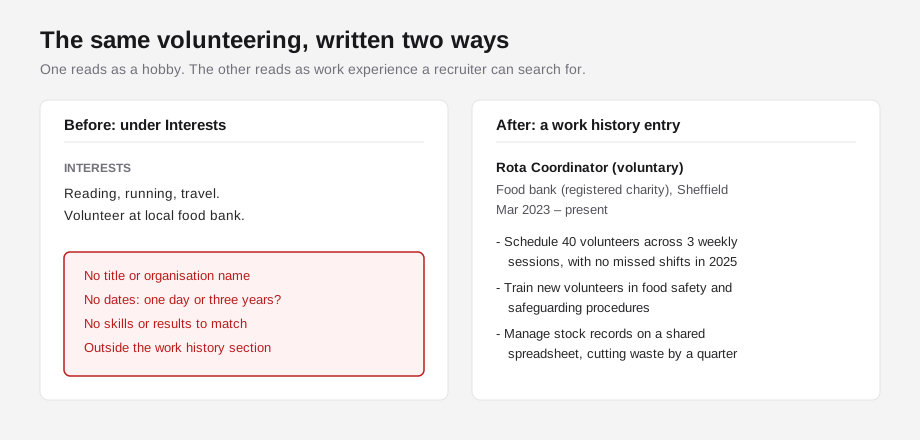
Put "voluntary" or "volunteer" in the title line, not buried in a bullet. That is where the reader looks first, and keeping the functional part of the title intact ("Rota Coordinator") means a search for that skill still finds it. The worked example above follows the same bullet formula as any paid role.

Trustee, governor and other senior volunteer roles
Senior volunteering is the most undersold item on experienced CVs. A charity trustee is, in GOV.UK's words, "almost always unpaid", yet trustees make sure their charity "has the money it needs" and "spends that money responsibly", and that it "follows the law". That is governance, budget oversight and risk management, the same language a management job advert uses.
The same applies to school or academy governor roles, chairing a residents' association, running a sports club committee or sitting on a parish council. For a candidate moving into management, these roles can supply evidence a paid job has not yet given them.
How to list them:
- Give the board role its real title: "Trustee and Chair of Finance Committee, [charity name]".
- Lead with decisions, not attendance. "Oversaw a £250,000 annual budget" says more than "attended quarterly board meetings".
- Place it by relevance. If it is your strongest evidence for the target job, it belongs in the work history. Otherwise a "Board and voluntary roles" section works well for senior candidates.
Key point: A volunteering entry is judged on the same evidence as a paid one: a title, an organisation, dates and a result. Leave any of those out and it reads as a hobby.
What an employer can check about volunteering on your CV
Volunteering is verified differently from paid work, and it is worth knowing how before you write the entry.
- It will not appear on your HMRC record. An employer checking your work history through your PAYE record sees employers who paid you through payroll. Unpaid roles are not on it, so a dated volunteering entry is checked another way. Our guide to what an employer can check about your employment history explains what the PAYE record does and does not show.
- References come from the organisation. A volunteer coordinator, the chair of the board or the club secretary can confirm your role, dates and what you did. For someone with little paid work, a volunteering referee is often the strongest one available, as our guide to references on a CV explains.
- The details must hold up. If your CV says "Treasurer, 2022 to present" and the charity's records show you stepped down in 2023, that is a discrepancy whether the role was paid or not. Write the dates and title the organisation would confirm.
Unpaid work is still part of your record. The safest rule is to describe it in words the organisation would recognise.
Common mistakes with volunteering on a CV
- Filing it under interests. It makes regular, skilled work look like a pastime and hides it from anyone scanning your work history.
- Leaving out the dates. A recruiter cannot tell whether "volunteer coach" means one Saturday or six years.
- Hiding that it was unpaid. It invites an awkward question at interview, or at the reference stage, that a single word in the title would have avoided.
- Listing causes instead of work. "Passionate about animal welfare" is a value. "Ran weekly adoption days, rehoming 60 dogs in 2025" is evidence.
- Keeping old, irrelevant roles forever. A one-off school fundraiser from 15 years ago can usually go.
FAQ
Should volunteering go in work experience or a separate section?
Put it in work experience when it is regular and relevant to the job you are applying for, because the National Careers Service explicitly includes volunteering in the work history. Use a separate Volunteering section when you have several roles or when the role is unrelated to the job. Either way, give it a title, organisation and dates.
How do I show that a role was voluntary on my CV?
Add "voluntary" or "volunteer" to the job title line, for example "Treasurer (voluntary)". It is honest, it avoids questions later, and it keeps the functional part of the title searchable.
Does volunteering count as work experience for a job application?
For the skills, yes: the work you did is real evidence and recruiters treat it as such. It is not employment in the legal sense, because volunteers have no employment contract, so label it as voluntary. Some application forms ask specifically about paid employment, so read the question before entering it.
Can I use a volunteer coordinator as a referee?
Yes. A volunteer coordinator, manager or board chair can confirm your role, dates and responsibilities, and for school leavers or career returners they are often the best referee available. Ask them first, and check they are happy to give a reference.
Should I put charity trustee on my CV?
Yes, especially for management or finance roles. Trustees are responsible for their charity's finances, plans and legal compliance, which is direct evidence of governance and budget oversight. Give the role its full title and describe the decisions you were part of.
A volunteering entry only helps if a parser can read it and a recruiter can find it. Scan your CV free with Shadow CV to see whether your volunteering is being read as work experience, and which of the advert's skills it is missing. The £5 rewrite fixes what the scan finds, once, with no subscription.