Key Takeaways
- An employer can check your employment history, but only with your consent, and only through references, your documents or an HMRC record.
- It is a payroll trail: employers, dates and pay. No job titles, no duties, no reasons for leaving.
- Read your own five-year record free in your HMRC account, and fix any date that disagrees with your CV.
Most people asking whether an employer can check their employment history are not planning a fraud. There is a six-month job they would rather not explain, a start date they genuinely cannot remember, or a role that ended badly. The question matters because the answer decides what can safely be left off a CV, and the usual advice - assume everything is checked - is too vague to act on.
No employer can look up where you have worked on their own. There is no national employment register and no jobs equivalent of a credit file. What exists instead are three routes to the same information, each needing your signature, and each showing something different.
Can an employer check your employment history in the UK?
Yes, with your consent. The routes are:
- A reference. A former employer confirms what you have said.
- Your own paperwork. Payslips, a P60, a contract or an offer letter covering a period.
- A screening company. A third party does both on the employer's behalf, and can request your HMRC record once you have signed a consent form.
None of this happens while your CV is being sifted. Screening sits at the conditional offer stage, after the decision to hire you has already been made, which is also why referee details do not belong on the CV itself. The practical consequence is that a discrepancy does not cost you a shortlisting. It costs you an offer you had already won.
HireRight's 2025 Global Benchmark Report, a survey of more than 1,000 HR, risk and talent acquisition professionals worldwide, found that more than three-quarters had uncovered candidate discrepancies in the previous 12 months. In Europe, the Middle East and Africa, employment verification was the check most likely to reveal one, reported by 64% of respondents, ahead of education credentials at 47%. That is a regional figure rather than a UK-only one, but the ranking is the useful part: dates and employers are what checks catch, more than anything else on the page.
What an employment history check actually shows
The HMRC route is the one people know least about. GOV.UK's guidance on getting proof of employment history describes a record of "the current and past 5 years' employment", drawn from PAYE Income Tax records.
That is a payroll trail. It shows who paid you, over what period, and what tax went through. It carries no job title, no duties, no performance rating and no reason for leaving. A screening report built on it can tell an employer that you were on a given company's payroll from March 2023 to November 2025. It cannot tell them whether you were the Operations Manager or the operations assistant, or why the job ended. If it ended in dismissal, that reaches a new employer through a reference, if at all, and what to put on your CV after being dismissed covers what to do about it.
Several things sit outside it:
- Self-employment and freelance work, which runs through Self Assessment and invoices rather than PAYE. A period of working for yourself leaves a blank stretch in the record, which is why a self-employed CV entry has to carry its own evidence.
- Work done overseas.
- Agency assignments, where the agency is the payroll employer and the client sites you actually worked on do not appear. Listing agency work under the agency rather than the hirers is the version that matches the record.
- Anything older than five years, unless HMRC is asked in writing for a specific earlier year.
Compare your CV with the record before a screener does
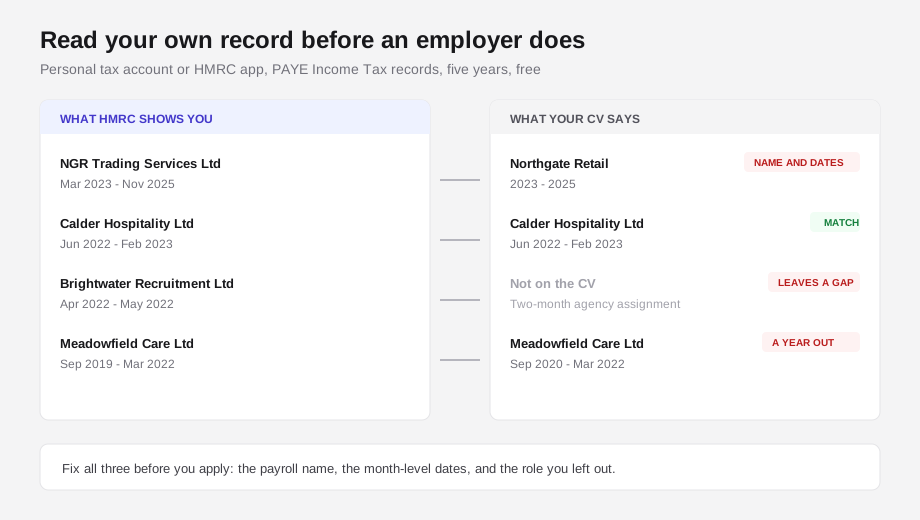
The payroll record a screening company requests is one you can read yourself, free, in your personal tax account. How to get your employment history from HMRC covers the five-year online view, the subject access request that reaches further back, and the paperwork that fills what PAYE misses. What matters here is what you do with it once you have it: put it beside your CV and read it the way a screener would, looking for three things.
- Dates that have drifted. Memory rounds to the nearest year and the payroll record does not. A start date you have carried for six years is worth checking against the month PAYE recorded.
- Employer names that do not match. This is the commonest discrepancy that is not a lie. The brand on the office door is often not the legal entity that runs payroll, so a CV saying "Northgate Retail" against a record saying "NGR Trading Services Ltd" reads as a mismatch until someone explains it. Use the payroll name, or give the trading name with the legal entity in brackets.
- Roles you had forgotten. Short stints, seasonal work and a job you left after a month all appear. If one falls inside a period your CV presents as continuous, fix the timeline before somebody else spots it.

What a reference can confirm, and what it cannot
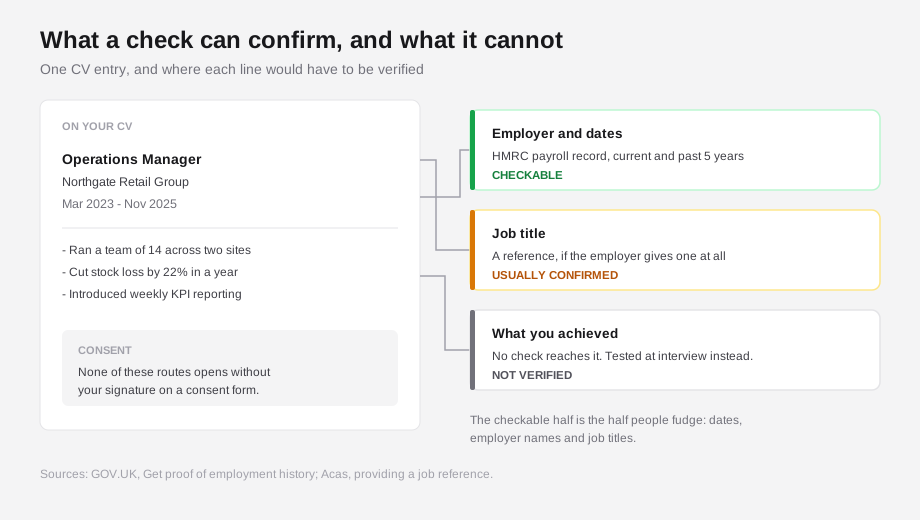
References are the route that reaches your job title, and they are narrower than most people expect.
Acas, the public body that advises on UK employment relations, is clear that an employer does not have to give a reference unless it has agreed in writing to do so, or the role is one where a reference is required, such as certain financial services jobs. Where a reference is given, it must be accurate and fair, must not be misleading, and must not include irrelevant personal information. Opinions need evidence behind them.
Because of that liability, many organisations issue a basic reference only. Acas describes it as a short summary of employment, for example the job title and the dates worked. It confirms the skeleton of your entry, and says nothing about how well you did the job.
Two things follow. Your job title is checkable, so it needs to be the one on your contract. And the parts of your CV that carry the most weight with a recruiter - your bullet points, your results, what you actually delivered - are verified by nobody. They are tested at interview instead, which is why rewriting a CV without inventing anything is a practical strategy rather than a moral one.
Qualifications, criminal records and the stricter sectors
Beyond employment history, three other checks reach your CV.
Degrees. HEDD, the Higher Education Degree Datacheck run by Prospects at Jisc, covers 471 recognised UK institutions and holds records on 243 bogus ones. With your consent an employer can confirm your institution, award, grade and dates of attendance from about £14. A degree claim is one of the cheapest things on your CV to verify.
Criminal records. DBS checks come at four levels, and the role decides which one applies: basic shows unspent convictions and conditional cautions, standard adds spent convictions and cautions, enhanced adds any information local police consider relevant, and enhanced with barred lists adds whether you are barred from the type of work. Which level applies is also what decides whether you have to declare anything at all, and none of it belongs on the CV itself.
Sector rules. Some employers have no discretion at all. The NHS Employment Check Standards require references validating three consecutive years of employment or training immediately before the application, with any unexplained gap or discrepancy explored at interview, and six years for board-level appointments under the Fit and Proper Person Test. Care providers in England must hold a full employment history with a written explanation of every gap. Security screening to BS 7858 covers at least five years. In those sectors a tidy CV is not enough on its own, and a dated line for every gap is what lets the reviewer complete the form.
What this means for how you write your CV
The checks are narrow, but the narrow parts are the parts people fudge.
- Use month and year on every role. Year-only dates read as vague to a recruiter and can disagree with a payroll record that knows the month.
- Never stretch an end date to close a gap. The gap is survivable, the amended date is not, and it is exactly what verification catches.
- Match the employer name to payroll, or give both, especially after an acquisition or a rebrand.
- Use the contractual job title. Inflating "Senior" onto it turns a reference that would have confirmed your entry into one that contradicts it.
- Keep the short job in. Leaving it out creates a gap in a timeline the record can reconstruct anyway.
FAQ
Can an employer check my employment history without my permission?
No. Every route needs your consent: a reference request, a document you supply, or a screening company acting for the employer, which requires a signed consent form before it can ask HMRC for anything. There is no register of employment an employer can search on their own.
How far back does a UK employment history check go?
Usually five years, because that is the span of the record HMRC makes available through PAYE Income Tax records. Employers can ask for specific earlier years in writing, and regulated sectors set their own floor: three years of verified references in the NHS, five years for BS 7858 security screening, a full history in CQC-registered care.
What happens if a check finds a discrepancy on my CV?
It depends what kind. A trading name against a legal entity name, or a start date a month out, is normally resolved with an explanation. An invented qualification, a role that did not exist, or dates stretched to conceal a gap are treated as a breach of trust, and a conditional offer is withdrawn.
Can I leave a job off my CV?
You can, and for a brief unrelated role inside a period your other entries already cover, it is unremarkable. What you cannot do is leave a hole. If the omission creates a gap, the gap invites a question the employment record can answer without you.
Dates and employer names are the checkable half of a CV, and they are also the half that quietly stops it being read at all when a parser cannot resolve them. Run your CV through Shadow CV's free scan to see the work history the software actually extracted, employer by employer and date by date. If the entries are landing wrong, the £5 rewrite rebuilds them so they parse cleanly and stand up to a check, once, with no subscription.