Key Takeaways
- A right to work check happens before employment starts, not at CV stage, so your CV does not have to prove anything.
- One short line is enough: whether you can work in the UK and whether you need sponsorship.
- Leave off nationality, visa numbers, passport numbers and share codes. Those come later, to the employer, on request.
A right to work check is not a CV screening step. The Home Office employer guidance is specific about the timing: the check must be completed before employment commences, which puts it after the offer rather than before the shortlist. That one fact settles most of what people are actually asking when they ask what to put about right to work on a CV. The CV is not the evidence. It is at most a line that saves the employer a guess.
Why employers ask about right to work at all
The penalty explains the behaviour. Under the Home Office code of practice on preventing illegal working, an employer who takes on someone without the right to work faces a civil penalty of up to £45,000 per worker for a first breach and £60,000 for a repeat breach within three years, for breaches on or after 13 February 2024. Carrying out the prescribed check correctly, before employment begins, gives the employer what the guidance calls a statutory excuse: protection against that penalty.
So the check is a compliance step bolted to the hiring decision, not a filter bolted to CV reading. What appears earlier, at application stage, is a different thing: a yes/no eligibility question on the application form. Those knockout questions are what produce a rejection within minutes of applying, and the post on how to tell whether your CV passed ATS screening covers how to recognise one. They are answered on the form, not inferred from your CV.
What to put about right to work on your CV
One line, if anything, and only where it removes a doubt the reader would otherwise have.
The useful version answers the only question a hiring manager has at this stage: do we need to sponsor this person, yes or no. Put it in the contact block at the top, in plain words:
Right to work in the UK. No sponsorship required.
Graduate visa, valid until September 2028. Eligible to work in the UK without sponsorship.
Skilled Worker sponsorship required.
Each is one line, factual, and complete for the purpose. The third is worth writing even though it filters you out of some processes, because the alternative is being filtered out at the offer stage instead, after four rounds. What does not belong anywhere on the CV:
- Your nationality. It is a protected characteristic, it does not answer the sponsorship question, and it is on the list of personal details to cut in what to remove from your CV.
- Your visa reference, certificate of sponsorship number, biometric residence permit number or passport number. These are identity documents, and a CV is a file you email to strangers and upload to job boards.
- Your date of birth, for the same reason it never belongs on a UK CV.
- A right to work share code. It is generated for a specific check and pairs with your date of birth. Hand it over when an employer asks for it, not before.
- A whole section. "Immigration status" as a heading gives the subject more space on the page than it earns.
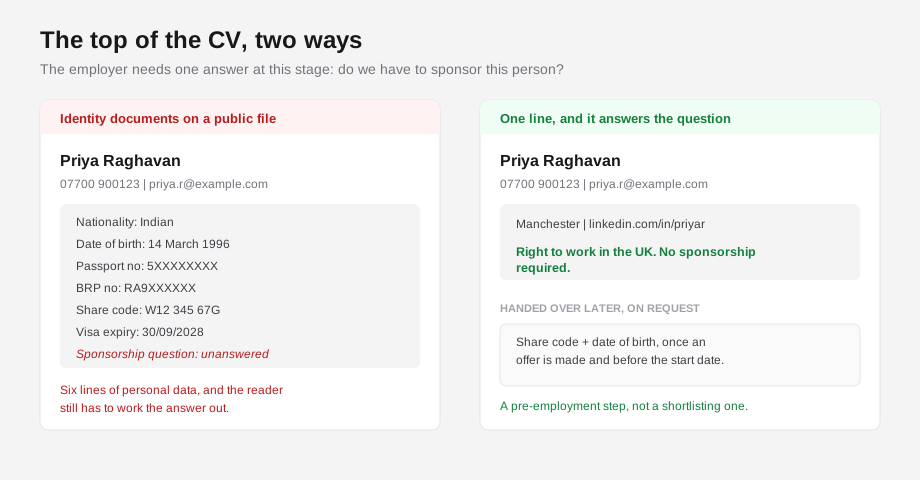
The share code is the actual document, and it comes later
For anyone who is not a British or Irish citizen, the check runs on a share code rather than a paper document. You generate it from your UKVI account; the employer enters it with your date of birth at the GOV.UK checking service and sees what work you are allowed to do and for how long. Two details are worth knowing before you need them:
- A share code is valid for 90 calendar days from the point it is issued, and can be used as many times as needed in that window. One code covers several employers if you are running several applications.
- British and Irish citizens cannot get a share code at all. They prove right to work with a passport, or through a certified identity service provider. If that is you, there is nothing to generate and usually nothing to write.
The order of operations is the part that gets missed. A share code is not a credential you attach to an application. It is what you produce once an employer has decided to hire you and needs to complete the check before your start date.
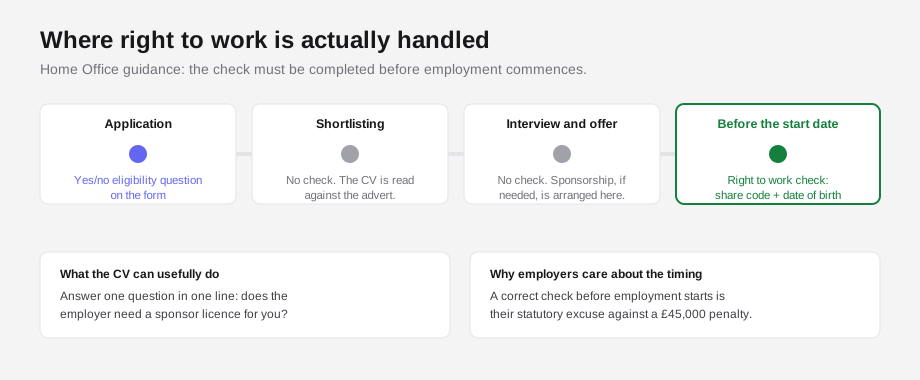
Sponsorship, not the CV, is what usually decides it
If you need a Skilled Worker visa, the thing that ends most applications is not how the CV is written. It is that the employer does not hold a sponsor licence and was never going to.
That is checkable before you apply, and almost nobody does it. The Home Office publishes the register of licensed sponsors as a free public CSV on GOV.UK, updated most working days. It carries over 123,000 entries under the Skilled Worker route, covering more than 122,000 separate organisations, nearly all of them A-rated. Search it for the employer's name and you know, before writing a word, whether sponsorship is possible there at all.
This matters more than it used to. Home Office immigration statistics for the year ending June 2026 record 234,841 work visas granted including dependants, 18% fewer than the previous year, with Skilled Worker grants down 26% to 61,120. Rules that took effect on 22 July 2025 raised the skill level for the route, and the same release notes that over 100 occupations are no longer eligible as a result. A role that could have been sponsored in 2024 may not be sponsorable now, whatever the employer intends.
Two practical consequences:
- Read the advert properly. Sponsorship statements are usually in the small print near the bottom, in the same region as the closing date and the DBS line. Treating the advert as a specification rather than a description is the habit set out in how to read a job description like a recruiter.
- Know when you do not need any of this. A Graduate visa needs no employer sponsorship and allows most work. It runs for two years for bachelor's and master's graduates applying on or before 31 December 2026, 18 months for applications from 1 January 2027, and three years for PhD graduates. If that is your position, the single most valuable line on your CV is the one that says the employer has nothing to do.
What an employer may and may not ask
The Home Office code of practice on avoiding unlawful discrimination, which applies to employment commencing on or after 6 April 2022, sets limits worth knowing because they change how much you need to volunteer.
- Checks are not applied selectively. If an employer is carrying out a right to work check on one applicant, the code says they should make sure they check all applicants being considered at that stage.
- Questions about status are narrowly bounded. Employers "should only ask questions about an applicant's or worker's immigration status where it is necessary to determine whether their status imposes limitations on the number of hours they may work each week", and should ensure nobody is asked because of their race, nationality or ethnic or national origins.
- Assumptions are ruled out. The code tells employers not to infer someone's right to work from their colour, nationality, ethnic or national origins, accent, surname, or how long they have lived in the UK.
A revised version, published in draft, applies to employment commencing on or after 1 October 2026 and updates the guidance for eVisas and digital checks.
Key point: A CV that says nothing about right to work has not failed to disclose anything. The disclosure point is the application form and the pre-employment check, both of which come with their own questions.
Where this leaves the rest of the CV
Nothing about your immigration status changes the ordinary work of a CV. It still has to parse cleanly, match the advert, and give a recruiter a reason to shortlist you. Two things on an international CV repay attention far more than the right to work line ever will: an overseas employer name that means nothing to a UK reader needs a short sector-and-size descriptor after it, and a qualification gained abroad reads better with its UK equivalent alongside.
FAQ
Do I have to put my right to work on my CV?
No. There is no requirement, and its absence is not a concealment: the check happens before employment starts, and the application form asks the eligibility question directly. Include a line only where it saves the reader a guess, most usefully when you do not need sponsorship and your name or history might suggest otherwise.
Should I put my visa type and expiry date on my CV?
The visa type is often useful, the expiry date only sometimes. What the employer needs to know is whether they must sponsor you and whether your permission is time-limited. "Graduate visa, valid until September 2028" does both in seven words. Never add the visa reference, certificate of sponsorship number or BRP number.
Can I put my right to work share code on my CV?
No. A share code is valid for 90 days and is checked together with your date of birth, so publishing it on a document you send to many employers and upload to job boards serves no purpose and exposes information you do not need to share. Generate one when an employer asks.
How do I find out whether an employer can sponsor me before I apply?
Search the GOV.UK register of licensed sponsors. It is free, public, updated most working days, and lists every organisation licensed for the Skilled Worker and other work routes along with its rating. If the employer is not on it, sponsorship is not available for that role no matter how well the CV is written.
Do British and Irish citizens need to write anything about right to work?
Usually not. A UK or Irish address and work history normally settles it, and the check is done from a passport after the offer. The one case where a line helps is a CV showing a long period of overseas work, where "British citizen, right to work in the UK" removes an assumption before it forms.
Right to work is one line on a CV. The other several hundred lines are what decides whether anyone reads it - which section the parser dropped, which keywords from the advert are missing, which dates came out wrong. Run your CV through Shadow CV's free scan to see the version the software builds from your file, and where the score is leaking. The £5 rewrite fixes what the scan finds, once, with no subscription.