Key Takeaways
- A self-employed CV entry has no former employer and no PAYE record behind it, so it has to carry its own evidence.
- Put a trading name or company in the employer position - a bare "Freelance" line can parse to an empty employer field.
- Line up your SA302, Companies House record and a client contact before a screening form asks.
There were 4.52 million self-employed people in the UK in the three months to May 2026, on ONS Labour Force Survey figures published on 18 August 2026. A good share of them will apply for a PAYE job sooner or later, and when they do, one block of the work history behaves differently from every other block on the page. A self-employed CV entry is the only one with nobody standing behind it.
Why a self-employed CV entry is the hardest one to write
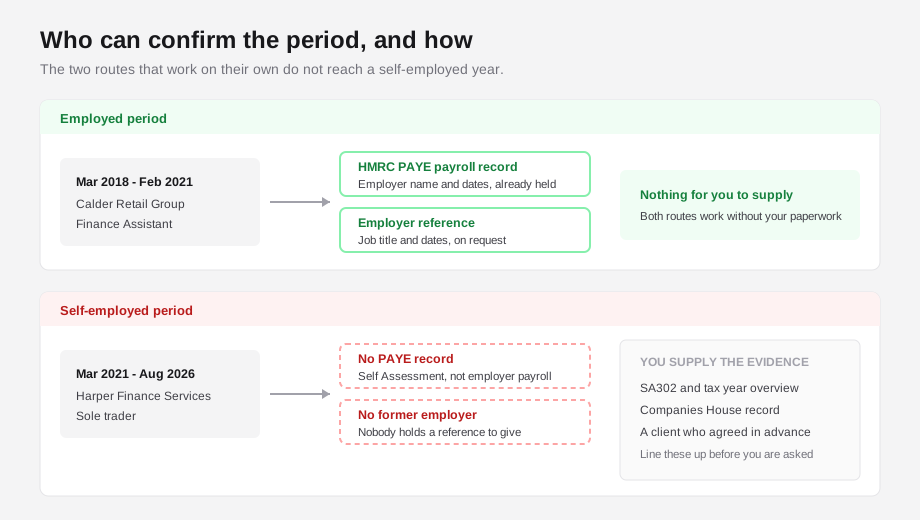
Take an ordinary employed role. Two independent things confirm it without you lifting a finger: a former employer who can give a reference, and an HMRC payroll record that already holds the employer name and the dates you were there. A recruiter or a screening firm can reach both, and what an employer can actually check about your work history sets out exactly how far each route goes.
Now take four years as a sole trader. There is no former employer, so there is no reference in the ordinary sense. There is no payroll record either: GOV.UK's guidance is that a sole trader earning more than £1,000 in a tax year registers for Self Assessment and keeps their own records, which is a different system from the PAYE payroll that employers report through. The work happened. The usual evidence of it was never created.
That is not something to hide or apologise for. It is a job the CV has to do itself.
Give the parser an employer, not a job description
Before any human forms a view, the entry has to survive parsing, and this is where self-employed CVs lose quietly.
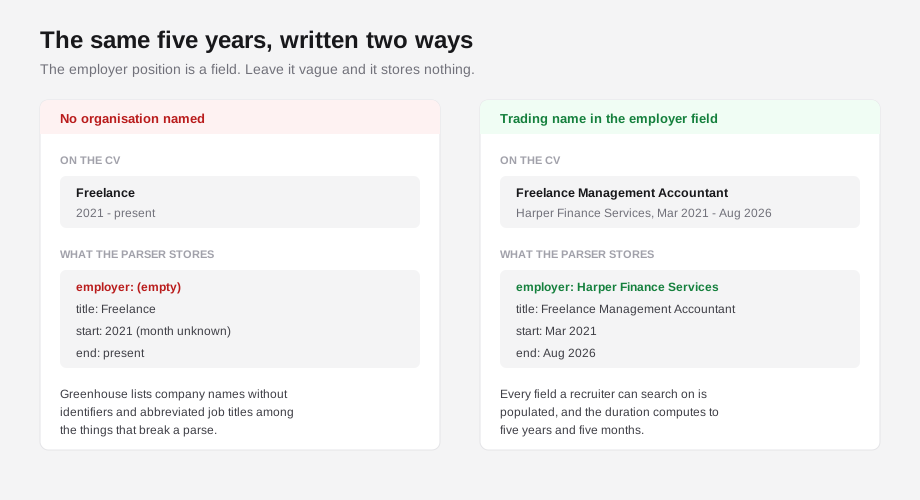
Screening software files each role into three fields: organisation, job title, dates. Greenhouse, an applicant tracking system used widely by UK employers, publishes its own list of what causes a CV to parse unsuccessfully, and two items on that list land directly on self-employed CVs: company names lacking identifiers, and abbreviated job titles. A line reading "Freelance, 2021 - present" gives the parser a vague title, no organisation at all, and a date range with no months in it. The employer field comes out empty, and an empty employer field is what a recruiter's database search fails to return.
So put something real in the organisation position. You have a trading name, a registered company, or at minimum your own name:
Freelance Management Accountant - Harper Finance Services (sole trader), Mar 2021 - Aug 2026
Director and Lead Developer - Northmoor Digital Ltd, Jan 2019 - present
Each of those hands over a genuine organisation string, a full job title in the words the sector actually uses, and month-and-year dates. The rules that govern the work experience section of any CV are not suspended because you happened to be the employer.
Key point: "Self-employed" is a tax status, not an employer. Used on its own in the employer position it tells the parser nothing and tells the recruiter less.

What actually proves a period of self-employment on your CV
Three routes exist, and they are worth lining up before you need them rather than during a conditional offer.
- Your Self Assessment record. HMRC lets you download evidence of your earnings, the SA302 tax calculation, together with a tax year overview. GOV.UK makes the last four years available.
- The public register, if you traded through a limited company. Companies House publishes the date of incorporation, the registered address, current and resigned officers and images of filed documents, free to anyone who searches.
- A client, standing in for an employer. The longest or most recent engagement, with someone who can confirm the dates and the work.
The third one needs arranging rather than assuming. An employer is under no general obligation to give a reference at all, and a former client is under even less. Ask before you list them, and ask for what a basic employer reference would contain: the engagement, the dates, the nature of the work.
How much of this you will actually be asked for depends on where you are applying. Most employers never go past a conversation about it. Regulated sectors are the exception, and they are strict about continuous history: care providers in England must hold a full employment history with a written explanation of every gap, and security screening to BS 7858 checks a continuous history for at least the five years before you start. A period of self-employment inside those windows becomes a form to complete, not a line to skim.
Write the work, not the business
The commonest failing in a self-employed entry is that it describes a company instead of a person. "Founded and ran a successful design consultancy" tells a hiring manager nothing about what you would do in their team on a Tuesday.
Recruiters are reading your self-employed years for the same thing they read every other role for: scope, delivery, and whether the work resembles theirs. Write bullets to the same standard as any employed role, as set out in how to write CV bullet points that pass ATS:
- Delivered month-end reporting and VAT returns for eleven SME clients, turnover £400k to £6m, across retail and professional services
- Rebuilt the management accounts pack for a 90-staff logistics firm, cutting close from twelve working days to five
- Held sole responsibility for client onboarding, engagement letters and AML checks
Two habits are worth breaking. Do not list clients you cannot name; a sector and a size does the same job without the awkwardness. And do not put the turnover of your own business where the achievement should be, unless growing it was genuinely the skill you are selling.
Dates and overlaps on a self-employed CV
Self-employment rarely starts and stops cleanly, which creates two specific problems.
The first is the overlap. Plenty of people freelance in the evenings while employed, or take a PAYE job while winding a company down. Overlapping date ranges look like an error to a parser and like an inflation to a reader. Date both entries honestly, put the primary role first, and add a clause to the secondary one: "Evenings and weekends alongside full-time employment" settles it in eight words.
The second is the dead patch. A quiet six months between engagements is a normal feature of self-employment, and the temptation is to stretch the end date over it. Do not. A stretched date is exactly what an employment history check is shaped to find, and how to explain employment gaps on your CV handles it better than a fiction does. If you were registered, trading and looking for work, the period is self-employment, not a gap, and one clause says so.
There is also the date the business started, which is not always the date you started trading. Use the trading date on the CV, because that is what the work history is describing, and keep the incorporation date for the form that asks for it.
FAQ
Should I write "self-employed" or my trading name on my CV?
Use the trading name or company, and mark the status in brackets after it: "Harper Finance Services (sole trader)". Screening software treats the employer position as an organisation field, and Greenhouse's own parse-failure documentation flags company names without identifiers. "Self-employed" alone leaves that field with nothing usable in it.
Does self-employment show up on a UK employment history check?
No. The HMRC record that employers and screening firms use is built from PAYE payroll submissions made by employers. Sole traders pay through Self Assessment instead, so a self-employed period appears in that record as a blank stretch. It is not evidence against you, but it does mean nobody can confirm the period for you without documents you supply.
Who can give a reference if I worked for myself?
A client, an accountant, or a long-standing subcontractor or supplier. Pick someone who can confirm the dates and describe the work, ask them first, and tell them what the employer is likely to want. Nobody is obliged to give a reference, so an unbriefed client contact is a risk rather than a safeguard.
Will recruiters assume self-employment means I could not find a job?
Some will wonder, and the CV decides what they conclude. An entry with a real organisation name, dated properly, carrying bullets about client delivery reads as work. A vague "Freelance, 2021 - 2026" with two lines under it reads as a holding pattern, because there is nothing else there to read.
Do I need to list every client on my CV?
No, and it usually hurts. Group the work under one entry for the business, then reference clients by sector and scale inside the bullets. Listing fifteen engagements as fifteen jobs turns a continuous five-year record into fifteen short ones, which is the opposite of what the timeline should say.
A self-employed entry fails in two places at once: the parser that cannot find an employer, and the reader who cannot tell what you did. Run your CV through Shadow CV's free scan to see which organisation, job title and dates the software actually pulled out of your self-employed years, and whether the entry survived at all. If it came back empty or thin, the £5 rewrite rebuilds it so the period reads as five years of work rather than a gap with a label on it - once, with no subscription.