Key Takeaways
- List languages on a CV as text: the language name plus a level, ideally a CEFR level such as B2 or C1.
- Avoid rating dots and bars, which an ATS cannot read.
- Expect any claim of fluency to be tested at interview.
- UK rules set real thresholds: B1 for public-sector customer-facing roles and B2 for Skilled Worker visas.
Putting languages on a CV looks like the easiest line on the page. You write "French - fluent" and move on. The trouble is that "fluent" has no fixed meaning. One recruiter reads it as "can run a client meeting in French", another as "got an A at A level", and the candidate who wrote it may have meant either. A language level that cannot be checked is one the reader quietly discounts.
It also matters to more people than the typical CV advice assumes. According to the ONS, 8.9% of usual residents in England and Wales, around 5.1 million people, had a main language other than English at the 2021 Census. Polish and Romanian were the most common. Add the people who learnt French, Spanish or German at school or university, and a large share of UK job seekers have a language they could put on a CV. Most of them describe it in a way a recruiter cannot use.
Where languages go on a UK CV
There are three sensible places, and the right one depends on how much the language matters to the job.
- In the skills section, for most people. If the language is a useful extra rather than a requirement, one line in your skills block is enough: "Languages: Polish (native), English (C1)". Our guide to what belongs in a CV skills section covers how to order the rest of it.
- In its own short section, if you have two or more. A "Languages" heading with one line per language is easier to scan than a long comma-separated list, and it gives a parser a clean, named section to read.
- In your profile and job entries, if the advert asks for it. When a role lists "fluent German" as essential, the language should not wait at the bottom of page two. Put it in the opening profile, and in the work history wherever you actually used it: "Handled German-speaking key accounts worth £400k a year" is evidence, where "German - fluent" is only a claim.
How to describe language levels on a CV
The clearest way to show a level is the Common European Framework of Reference for Languages (CEFR). It was built by the Council of Europe to standardise language levels across tests and qualifications, and it runs in six steps: A1 and A2 (basic user), B1 and B2 (independent user), C1 and C2 (proficient user).
UK government guidance uses the same scale. The Home Office's statutory Code of Practice on the English language requirement for public sector workers reproduces the CEFR level names and descriptors:
- B1, Threshold or intermediate. Can get across much of what they want to say, with very evident pauses for planning and repair.
- B2, Vantage or upper intermediate. Can follow changes of direction in conversation, with few noticeably long pauses.
- C1, Effective operational proficiency or advanced. Expresses themselves fluently and spontaneously, almost effortlessly.
- C2, Mastery or proficiency. Speaks at length so smoothly that the other person is hardly aware of any difficulty.
Plain-English labels still have a place, because not every reader knows CEFR. The best approach is to give both: "Spanish - B2 (professional working level)". The pairing below is our own rough guide, not an official mapping, but it keeps the words honest.
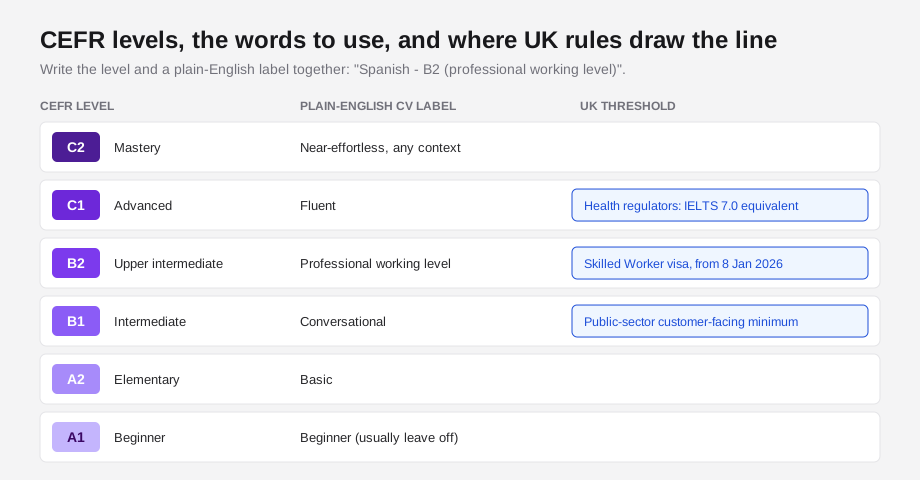
If you hold a formal certificate, name it, because the name is both proof and a search term. DELF and DALF (French), the Goethe-Zertifikat (German), DELE (Spanish) and IELTS (English) all report against CEFR. "French - DELF B2" tells the reader the level and how you know it. If you have a GCSE or A level in the language, that belongs in your education section, with your current level given separately on the languages line.
What if you have never taken a test?
Most people haven't. Self-assess against the descriptors honestly, write the level, and do not add "certified". A self-assessed B2 is a perfectly normal CV claim. The CEFR's own self-assessment grid, published through Europass, is the standard tool for it, and the Home Office code lists the Europass language passport alongside IELTS as an assessment tool.
Fluent, conversational, native: the words that cause trouble
Three words do most of the damage on language lines.
"Fluent" is the most common and the most often tested. The Home Office code of practice is explicit that public employers can check spoken fluency "as part of the interview process", and gives "competently answering interview questions in English or Welsh" as one way to demonstrate it. Private employers do the same informally: a hiring manager who speaks the language will often switch to it mid-interview. If "fluent" would not survive five unplanned minutes, write "B1" or "conversational" instead. A smaller true claim beats a bigger one that collapses in the room, and the line between the two is the same one covered in how to rewrite a CV without lying.
"Conversational" undersells more people than it oversells. It suggests chatting, not working. If you have handled customer calls, written emails or translated documents in the language, say so in your job entries, and give the level as B2 rather than "conversational".
"Native" is accurate for a language you grew up speaking, and it is fine to use. But it is not a CEFR level, and it is not a measure of written ability. The Council of Europe's 2020 update to the framework deliberately moved away from native-speaker benchmarks: its new pronunciation scale is built on intelligibility and accepts that many C2 speakers keep a noticeable accent. If you grew up speaking Urdu at home but have never written a formal letter in it, "Urdu (native speaker, spoken)" is more useful than "Urdu (native)".

English as your second language: the levels UK rules set
If English is not your first language, your English level is the one a UK employer cares about most, and two sets of rules put real numbers on it.
- Public-sector customer-facing roles: B1 minimum. Part 7 of the Immigration Act 2016, in force since 21 November 2016, puts a "fluency duty" on public authorities. Staff in customer-facing roles must speak fluent English (or Welsh, in Wales). The code of practice says any level an employer sets "must not be below the CEFR Level B1", and that employers should state the standard in adverts and job descriptions. A role counts as customer-facing when speaking to the public is a regular, planned and intrinsic part of the job. The duty does not apply to private or voluntary sector providers.
- Skilled Worker visas: B2 since 8 January 2026. GOV.UK states that new Skilled Worker applicants must prove they can "read, write, speak and understand English to at least level B2". People extending permission granted before that date stay at B1.
- Health professions: often C1. The same code notes that many health regulators use IELTS, with an overall score of 7.0 described as "the equivalent of C1".
The practical point for your CV: if an advert names a level and you meet it, write the level in the same terms. "English - C1 (IELTS 7.5, 2025)" answers the question before it is asked. Visa and sponsorship details are a separate matter, covered in our guide to right to work on a UK CV.
Key point: A CEFR level is the one language claim on a CV that means the same thing to every reader, every employer and every immigration rule. "Fluent" does not.
Languages on a CV and the ATS
Language lines fail ATS parsing in one specific way: the level is drawn rather than written. Many CV templates show languages as five dots, stars or a filled bar. These are graphics with no text layer, so the applicant tracking system extracts the language name, if it is lucky, and nothing about the level. Greenhouse lists graphics among the causes of failed CV parsing, which is why design-led CV templates cause so many problems.
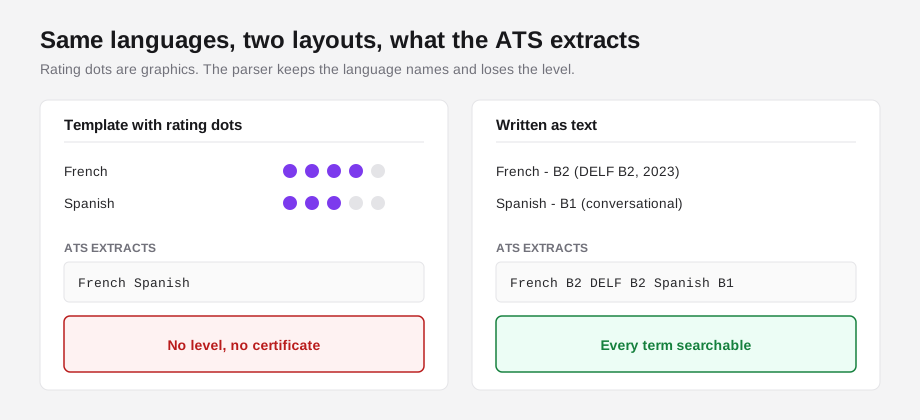
Three other habits help a recruiter's search find you:
- Name the language in full and consistently. "Mandarin Chinese" rather than "MC" or "Chinese (Mand.)". Recruiters search for the word in the advert, which is usually the language's plain name.
- Write the level next to the language, on the same line. A separate key or legend gets separated from the language when the layout is flattened.
- Use the advert's wording where it is true. If the advert says "business-level Italian" and you are C1, write "Italian - C1 (business level)" so both phrasings are present.
Worked examples: language lines that work
Each of these is a single CV line, written as text, with a level a recruiter can check:
- "Polish - native speaker. English - C1 (IELTS 7.5, 2025)."
- "French - DELF B2 (2023). Used daily with French-speaking suppliers."
- "Spanish - B1, self-assessed (conversational, can handle routine customer calls)."
- "Welsh - fluent, spoken and written (C1)."
- "German - A2 (basic, currently studying towards B1)."
The last one is worth noting. A low level is still worth listing when the role has any international contact, as long as you label it honestly. "Basic" and "studying" are both true and both useful.
FAQ
Should I put languages on my CV if the job does not ask for them?
Yes, briefly, as one line in your skills section. Many employers have customers, suppliers or colleagues who speak other languages, and a second language can tip a close decision. Keep it to the language and level unless the job uses it.
What does B2 mean on a CV?
B2 is the CEFR upper-intermediate or "vantage" level. It means you can hold a conversation without long pauses and follow changes of topic, and it is the level most UK employers would call professional working proficiency. It is also the English level required for new Skilled Worker visa applicants since 8 January 2026.
Is "fluent" the same as C1?
Roughly, but not officially. "Fluent" has no fixed definition, while C1 is a published CEFR level described as fluent and spontaneous, almost effortless expression. Writing "Fluent (C1)" gives the reader both the word they recognise and the level they can check.
Should I put English on my CV if I am a native speaker?
Not normally for UK roles, as it is assumed. List it only if the role is multilingual or you are applying abroad, where "English - native speaker" is useful information. If English is your second language, always list it with a level.
Can I use GCSE or A level grades to show my language level?
You can mention them, but they are school qualifications rather than a direct proficiency measure. Put the grade in your education section and give your current level separately in the languages line, since a GCSE taken years ago may not reflect what you can do now.
Most language lines fail quietly: a rating graphic the parser cannot read, or a "fluent" that tells the recruiter nothing. Run your CV through Shadow CV's free scan to see exactly what an ATS extracts from your languages and skills sections, and which of the advert's terms are missing. The £5 rewrite fixes what the scan finds, once, with no subscription.