Key Takeaways
- Put hobbies and interests on your CV only when they evidence a skill the job needs - a committee role, a captaincy, a relevant project.
- Official UK guidance treats the section as optional, and hiring managers rank it the least important part of a CV.
- Two to four specific lines at the bottom of the page is the format.
Whether you should put hobbies and interests on your CV is one of the few CV questions with a genuinely conditional answer. The section is optional in official UK guidance, ranked least important by the people who read it, and invisible to the software that scores it - and yet, used well, it is one of the cheapest ways to hand a recruiter evidence your work history cannot. The difference between the version that helps and the version that costs you half a page is entirely in what the lines contain.
What official UK guidance says about hobbies on a CV
The National Careers Service publishes the UK government's guidance on what a CV should contain. It recommends five sections: contact details, an introduction, education history, work history and references. Hobbies is not one of them.
It then adds a conditional: "You can also include your interests and hobbies that show some of the skills you have. For example, if you're a captain of a sports team, this demonstrates leadership and organisation skills."
That one sentence is the whole rule. The section is an optional extra, and the condition attached to it is doing all the work: interests that show some of the skills you have earn a place, and interests that show nothing are taking up lines a two-page CV has better uses for.
Notice what the guidance does not say: it never suggests the section proves you are "well-rounded" or gives the CV personality. The captain example is an evidence example. The team's fixtures got organised, and you were the one who organised them.
What UK hiring managers think of the interests section
There is recent survey data on this, and it cuts both ways.
A 2024 survey by CV Genius - 625 hiring managers and recruiters who had hired in the UK or Ireland in the previous year, polled that April - asked which CV sections matter most. Hobbies and interests came last of the five sections tested, behind work experience, key skills, the personal statement and education, with 39% of respondents calling it the least important part of a CV.
The same survey found two things pulling the other way. A minority of 15% rated hobbies and interests the most important section. And 61% of in-house hiring managers said they were more likely to interview a candidate with a unique, job-relevant hobbies and interests section - against 35% of recruiters who said the same.
That last split is worth acting on. An in-house manager is hiring one person for their own team and reads for fit; an agency recruiter is searching a database and shortlisting against criteria. If your application goes directly to the employer, a sharp interests section has a genuine audience. If it goes through an agency, the section is close to dead weight - the recruiter is reading for the client's essential criteria, and no interests line has ever been one.
What an ATS does with your hobbies and interests
Almost nothing - and that fact should shape how you use the section.
When an ATS parses your CV, it segments the text by section headings, and a plainly formatted interests section under a standard heading parses without trouble. But parsing is not scoring. Ranking and recruiter database searches run on the vocabulary of the role: qualifications, systems, job titles, named methods. Nobody building a shortlist has ever searched for "hill walking". The interests section makes almost no contribution to whether your CV surfaces, which means it cannot rescue a CV that is failing on keywords - the sections that carry search terms are your skills list and work history, and they have to do that job.
There is one honest exception: an interest that happens to contain role vocabulary. A developer whose interests include "building a personal finance tracker in Python" has put a searchable term on the page. That is the interest working as evidence and keyword at once - and it is the standard the whole section should be held to.
The practical conclusion: the interests section is written for the human pass, the minute or so a person spends deciding whether to shortlist you. It will not move your ranking. It can move a reader.
When hobbies and interests earn their place on your CV
Four situations reliably justify the section.
- You are a school leaver or graduate. With little work history, the captaincy, the society committee, the Duke of Edinburgh award and the part-time coaching are your evidence base, not decoration. An entry-level CV argues you can do a job you have not done, and interests are often where that argument lives. How to structure the rest of that argument is covered in our first CV guide for applicants with no work experience.
- You hold a named, verifiable role. Treasurer, captain, chair, coach, organiser. A title with responsibilities attached is a fact a reader can weigh and an interviewer can probe - the same verifiable-versus-asserted test your skills list has to pass.
- The interest is the job, at amateur scale. A candidate for a finance role who is treasurer of a sports club, a marketing applicant who grew a food blog to a real audience, a would-be developer with published side projects. These belong on the CV in any career stage.
- You are changing careers. When your work history is keyword-matched to the wrong field, a serious interest in the target field is bridging evidence that you are already doing the work nobody pays you for yet.
If none of the four applies - you are mid-career, applying inside your own field, and your interests are ordinary - the section is optional in the fullest sense. Cutting it is not a gap; it is a decision the official guidance explicitly permits.
What to leave off - including what the Equality Act should make you think about
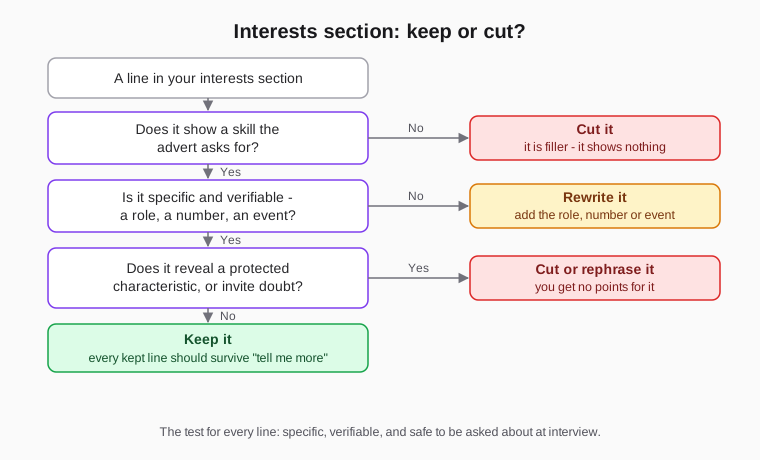
The obvious cut is filler. "Socialising with friends, reading, films, travel" describes most adults in the country and evidences nothing - it is the first thing to go when a CV needs space back. If a line could sit unchanged on a stranger's CV, it is not information.
The less obvious cut is the line that volunteers information the process is designed not to collect. UK application forms do not ask your age, religion or family situation, and the National Careers Service says plainly to leave your age, date of birth and marital status off a CV. The Equality Act 2010 makes nine characteristics protected - among them age, religion or belief, and sexual orientation - and an interests line can hand several of them straight back: a faith-group role, an era-marking hobby, "spending time with my grandchildren". The point is not that UK employers routinely discriminate on a hobbies line. It is that a reader cannot unread it, you get no points for it, and the rest of the process deliberately avoids collecting it. Volunteering it can only add risk.
The third category is the line you would rather not discuss. Anything polarising, and anything you have inflated, is an interview question waiting to happen. Every interests line should survive the follow-up "tell me more about that".
How to write the interests section if you keep it
The format takes five minutes once the selection is right.
- Use a plain heading - "Interests" or "Hobbies and interests" - so the parser classifies the section correctly and no reader has to guess.
- Put it last on the page. It is supporting evidence, and it should never displace work history or skills. If you are cutting to two pages, it is cut first.
- Write two to four lines, each one specific. The thing, plus the fact that makes it evidence: the role, the scale, the number, the event.
- Match each line to the advert where you can. Organisation, budget responsibility, coaching, building things - lead with whichever the job actually asks for.
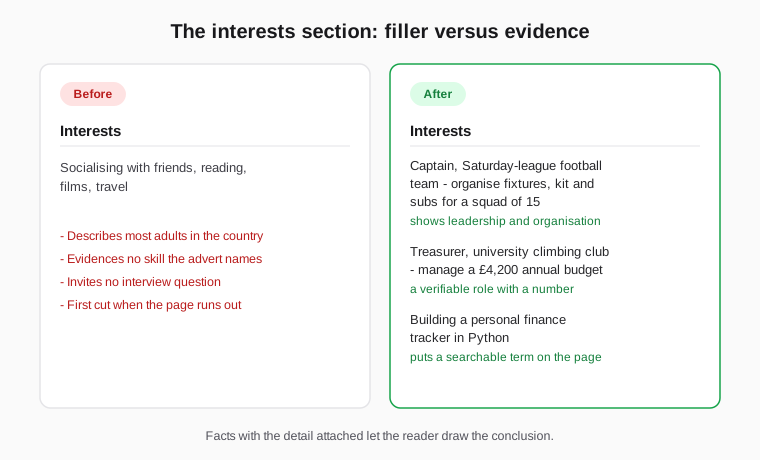
"Captain, Saturday-league football team - organise fixtures, kit and subs for a squad of 15" is one line, and it carries leadership, organisation and commitment without claiming any of them as adjectives. That is the entire trick of the section: facts that let the reader draw the conclusion.
FAQ
Do employers actually read the hobbies section on a CV?
Some do, and the ones who do are disproportionately the decision-makers. In CV Genius's 2024 survey of 625 UK and Ireland hiring managers and recruiters, 61% of in-house hiring managers said a unique, job-relevant interests section made them more likely to interview a candidate, against 35% of agency recruiters. Direct applications are where the section pays.
Should a school leaver or graduate put hobbies on a CV?
Yes - this is the strongest case for the section. With a short work history, committee roles, team captaincies, volunteering and personal projects are real evidence of skills the advert asks for. Write them as facts with detail attached, not as a list of pastimes.
Can hobbies on a CV cause rejection by an ATS?
No. An ATS does not score the interests section, and a plainly formatted one parses without problems. The risk sits at the human stage: filler wastes space, and an ill-chosen line can plant a doubt. The section only affects the machine stage if formatting breaks parsing - keep it single-column under a standard heading.
How many hobbies should you put on a CV?
Two to four lines. One line looks like an afterthought and six starts displacing material that ranks. Each line should be specific enough to be worth asking about at interview - if you cannot add a role, a number or a concrete detail, the line is probably filler.
Is it OK to put gaming on a CV?
Only in the evidence form. "Gaming" alone is filler, but "run a 30-player online gaming community - schedule events and moderate disputes" is organisation and moderation evidence, and for QA, development or community roles it is directly relevant. The test is the same as for any interest: specific, verifiable, and connected to something the job values.
The interests section is two lines of your CV. Whether the other fifty parse cleanly and contain the terms recruiters actually search for is what decides if anyone reads them. Scan your CV free - Shadow CV shows you what an ATS extracts from your CV, which keywords for your target role are missing, and what is costing you points. The £5 rewrite fixes what the scan finds - once, with no subscription.